Why is a place holy?

Mount Girnar in the mist
Image by Dhwani Bhatt © CC BY-SA 3.0
Jains often distinguish between two kinds of sacred places:
- where someone reached final liberation – siddha-kṣetra
- where any remarkable event took place – atiśaya-kṣetra.
The concept of siddha-kṣetra is crucial in Jain thought in defining a holy place. However, material items such as relics or remains of any kind are not important in thinking of a place as holy in Jain belief and practice. This attitude is in tune with the definition of liberated beings – siddhas – as pure souls.
A remarkable event – atiśaya-kṣetra – that causes Jains to hold a place sacred could be a miracle or the presence of any guardian deity or powerful image.
Holy places vary in size from small isolated spots to the large temple-cities built on mountains. Probably the best-known Jain temple-cities are those of Shatrunjaya and Girnar.
Sacred places are infused with multiple meanings and memories of mythical events. The sanctity is translated into various forms, including footprints, temples and images. But it also resides in elements of the landscape, with specific ponds, stones and trees often seen as holy. They are connected to certain episodes that are transmitted in oral and written form. In this way, some holy places such as Shatrunjaya are ascribed almost supernatural powers, including the power to cure illness. A pilgrimage is complete when it involves a tour of all the sacred spots found in a holy place.
The Jinas

Twenty Jinas
Image by British Library © CC0 1.0 (Creative Commons Public Domain)
Considering the central importance of the Jinas in Jainism – as the ultimate source of knowledge, teachings and behaviour – it is not surprising that most holy places are closely associated with them. Most are locations where events in the Jinas’ lives occurred. The traditional dates of these events given in scriptures form the basis of the religious calendar and festivals. Even today Jains are well aware of such links with the past.
Before reaching omniscience, the Jinas were part of the cycle of rebirths. All of their lives show a similar pattern. In the standard account of their lives, of which Hemacandra’s 12th-century work can be considered representative, there is a set of five events. These ‘auspicious events’ – pañca-kalyāṇakas – are at the centre of worship:
- conception – cyavana
- birth – janma
- initiation into monastic life – dīkṣā
- enlightenment – kevala-jñāna
- final liberation – nirvāṇa or mokṣa.
Any place connected with any of these events is potentially holy. The foremost sites, however, are those where the Jinas were born and those where they reached liberation. Sites where more than one such event took place are traditionally called kalyāṇa-kṣetras – ‘places of auspicious events’.
|
Holy place |
Jina |
Auspicious event |
|---|---|---|
|
Aṣṭāpada, legendary mountain |
Ṛṣabha |
liberation |
|
Ayodhyā |
Ajita and Ananta |
birth |
|
Banaras |
Supārśva and Pārśva |
birth |
|
Bhadrilapura |
Śītala |
birth |
|
Candrānana |
Candraprabha |
birth |
|
Campā = modern Bhagalpur, Bihar |
Vāsupūjya |
birth and liberation |
|
Girnār, Gujarat |
Nemi |
renunciation, omniscience and liberation |
|
Hastināpura or Hastinapur, Uttar Pradesh |
Śānti, Kunthu and Ara |
birth |
|
Kākandī |
Suvidhi |
birth |
|
Kāmpilya |
Vimala |
birth |
|
Kauśalya |
Sumati |
birth |
|
Kauśambī |
Padmaprabha |
birth |
|
Kuṇḍapura (see Brekke 2003) |
Mahāvīra |
birth |
|
Mithilā |
Malli and Nami |
birth |
|
Pāvāpurī, Bihar |
Mahāvīra |
liberation |
|
Rājagṛha = modern Rajgir, Bihar |
Munisuvrata |
birth |
|
Ratnapura |
Dharma |
birth |
|
Sammet Shikhar, Jharkhand |
20 Jinas |
liberation |
|
Siṃhapura |
Śreyāṃsa |
birth |
|
Soriyanagara |
Nemi |
birth |
|
Śrāvasti |
Sambhava |
birth |
|
Vinītā |
Abhinandana |
birth |
Several names in this list are also where one Jina or another received proper alms for the first time after a long fast – Ayodhyā, Śrāvastī, Hastināpura, Mithilā and Rājagṛha. More generally, they owe their sanctity to their association with several events, all recorded in specialised works.
Other mythical figures
Places where holy figures of the Jain tradition have attained final liberation are also potential sacred sites.
Mount Shatrunjaya in Gujarat is also called Puṇḍarīka Mountain because it is said that Puṇḍarīka, the first chief disciple of the first Jina Ṛṣabha, attained liberation there.
This is also where Rāma, Sītā, the Pāṇḍava brothers and their mother Kuntī were emancipated from the cycle of rebirth.
Religious teachers

Bhadrabāhu’s sacred footprints
Image by Ilya Mauter © CC BY-SA 2.5
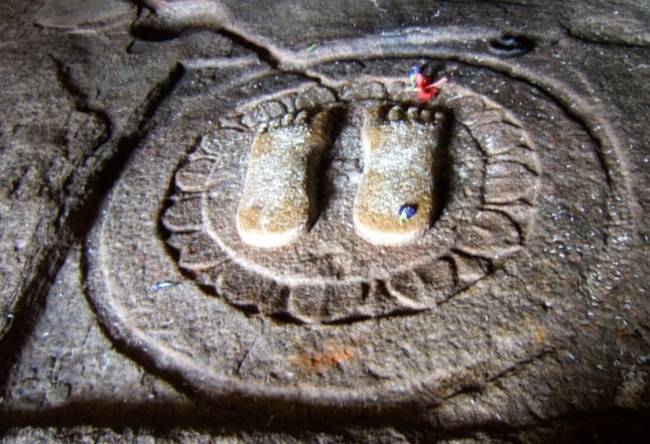
A place that is traditionally associated with the birth or liberation of a religious teacher is also considered holy and often develops into a pilgrimage site. There are examples of this phenomenon for both teachers in the distant past and more recent ones. Their presence takes material form in items such as footprints – pādukā – shrines or memorials of any kind.
Ponnur Hill, in Tamil Nadu, is the place where the early Digambara teacher and author Kundakunda is said to have reached liberation. Footprints have been carved in the rock and are worshipped.
Several Jain temples are found in Ladnun in Rajasthan. It has become a specially sacred place for Terāpanthin Jains in the 20th century because it is the birthplace of Ācārya Tulsī, eighth leader of the sect, who was chief monk for over 60 years.
About 20 kilometres from Delhi is the ‘Vallabh Smarak’ or Memorial to Ācārya Vijayavallabha-sūri. It has become a sacred place, and a temple enclosure has been built there.
Jina images
Several holy places are associated with the local image of a Jina. This link is often clear in their names, such as Sankheshwar-Parshvanath, Phalodi-Parshvanath and Jiravala-Parshvanath, which are all connected to the 23rd Jina, Pārśvanātha or Lord Pārśva.
Such images are considered holy because of their miraculous powers and the often extraordinary circumstances in which they were discovered or, rather, rediscovered. The stories of rediscovery underline that the statues had been there for a long time but were buried in the ground, at the foot of a tree and so on. The idol’s presence was revealed through the dream of a follower, the spontaneous lactation of a cow or other such phenomenon. When the image was found, it was ritually installed and became the focus of a holy place where the whole community came to worship. This type of account is found especially among the Śvetāmbara Mūrti-pūjak Jains. An example is Jinaprabha-sūri‘s collection, Vividhatīrtha-kalpa, which dates back to the 14th century. These tales may refer indirectly to historical events or, at least, the adventures of old Jina statues that survived the Muslim destruction of religious images during the medieval period.
Local gods

Nākoḍā Bhairava
Image by Knut Aukland © Knut Aukland
Some of the Jain holy places are considered sacred because of their association with figures that are neither Jinas nor religious teachers. Strictly speaking, Jains do not worship deities. Jinas are neither gods nor able to interfere in worldly affairs because they have attained liberation – believers honour their examples in worship. However, offerings are frequently made to the Jinas’ spiritual attendants, the yakṣa and yakṣī, who can play a part in human lives. Many Jains also make offerings to Hindu gods such as Gaṇeśa or Śrī. The increasingly popularity of Jain pilgrimages to places that are not associated with Jain religious tradition is awakening the interest of anthropologists as it shows original combinations of mainstream Jainism and other trends.
There are two good examples of this phenomenon. For centuries Nākoḍā in Rajasthan has been associated with a black idol of Pārśvanātha or Lord Pārśva, which was rediscovered and established in the temple in the 15th century. Over time the popularity of this site faded until it was revived through the efforts of a Jain nun at the beginning of the 20th century. It has now regained some of its former eminence thanks to its focus on the cult of the Nākoḍā Bhairava. This is a local image of Bhairava, who is a manifestation of Śiva. Recent ethnography shows that pilgrimage to Nākoḍā tends to be concentrated on this deity rather than on the Jina directly.
Similarly, Mahuḍī in Gujarat is a Jain tīrtha entirely dedicated to a god of a peculiar kind. Ghaṇṭākarṇ Mahāvīr is a ‘muscular, moustachioed male deity worshiped by Jains as a fellow Jain who can assist them within the worldly realm of wellbeing’ (Cort 2001: 165).
Visitors to such holy places form less homogeneous groups than pilgrims to traditional Jain tīrthas. The visitors may not be religious or even Jain at all. This is probably because these cults are essentially about worldly values. Jain pilgrimage sites of long standing usually focus on spiritual improvement.
Mythical sacred places

Mount Kailash
Image by reurinkjan © CC BY-NC-SA 2.0
Two places are considered holy by the Jains but are not part of ordinary geography.
- Aṣṭāpada
- Nandīśvara-dvīpa.
The former is the legendary mountain where the first Jina Ṛṣabhanātha or Lord Ṛṣabha reached liberation. It is often identified with Mount Kailāsa in the Himālayas.
The second cannot be located on maps of India either, since it belongs in the category of cosmography. According to traditional cosmological theories, it is a continent in the human world but inaccessible to humans. Considered a holy place because it is a centre of worship, Nandīśvara-dvīpa has 52 temples in which the gods worship the Jinas.
Since these two holy places are vital parts of Jain sacred geography, they are treated on a par with other sacred places in literary descriptions. From the 12th century onwards, they appear in the visual arts as three-dimensional models or sculpted on temple walls.
Holy places in writing and song

Temples at Mount Shatrunjaya
Image by JAINA © public domain
Like Jinas and religious teachers, a Jain sacred place draws homage, devotion and praise from believers. Writings about holy places are seldom neutral and purely descriptive, as guidebooks usually are. Even the numerous booklets about individual sacred places published today do not just describe the physical place. Descriptions usually narrate all the legendary events or signs that create the meaning and sanctity of a holy place.
Texts about holy places can be grouped in three main ways:
- lists in verses
- kalpas and māhātmyas
- hymns of praise to sacred places or to a particular Jina image associated with a holy place.
Lists of holy places in longer poems are known as tīrtha-mālās – ‘garland of sacred places’. They show the expansion of Jain sacred geography in the accumulation of names. Some refer to well-known places while others are no more than names, often difficult to identify and locate.
The second group of texts – kalpas and māhātmyas – may be in either prose or verse and is a skilful cross of descriptions and legends. The most famous kalpa is the Vividha-tīrtha-kalpa or Pieces on Various Sacred Places, written in the 14th century by Jinaprabha-sūri, a Śvetāmbara monk belonging to the Kharatara-gaccha. The holy places Jinaprabha treats are primarily in western and northern India, though there are also a few in south India. The text includes sometimes detailed topographical descriptions, legends of the origin of the holy places and lists of the mythical events that took place there. It also notes disturbances that affected sacred places and religious images in the author’s time. The ruler of India at the time of writing was the Muslim Sultan Muhammad bin Tughlaq, whose 26-year reign was tumultuous and unsettled.
Māhātmyas celebrate the greatness of a holy place through associated legends, its various names and so on. Many of the māhātmyas are dedicated to Shatrunjaya, assuredly the paramount holy place for Śvetāmbaras.
The devotional songs referring to holy places either extol a place itself or the particular Jina image associated with it. The hymns are chanted on pilgrimages to these places or when models and paintings of the places are seen on daily visits to the temple.
Sacred places in visual art

Worlds of gods and saviours
Image by San Diego Museum of Art © CC BY-NC-ND 2.0; Edwin Binney 3rd Collection
Holy places are thought of the proper destination of Jain pilgrimages. The most famous, especially those favoured by the Śvetāmbara sect, are a commonplace sight in many temples. They usually take the form of:
- bas-reliefs or sculptures on temple walls
- metal plaques or panels
- cloth-hangings on temple walls called paṭas
- mural paintings from all periods, including contemporary, in Śvetāmbara or Digambara temples.
Girnar, Shatrunjaya and Sammet Shikar are among those most frequently represented. But there are also paṭas featuring all sorts of holy places (Treasures of Jaina Bhaṇḍāras: 42).
The murals and cloth-hangings in particular are often detailed topographical maps showing all the sacred spots of a site, complete with captions. Still being created today by local artists, these pieces of art became more frequently made from the 17th century onwards.
One instance of relief carving is in a temple at Ranakpur, showing a combined representation of the temple-cities of Shatrunjaya and Girnar. It has stylised carvings of temples, standing Jinas, chariots and ponds. The peaceful atmosphere is symbolised by a snake and a peacock, which are normally natural enemies (Jain and Fischer 1978: plate XXXIb).
Depicting pilgrimage destinations is a way of guaranteeing the presence of these holy sites at all times and for all followers. On their regular visits to the local temple, worshippers perform a circumambulation. During this ritual walk around the sacred ground of the temple, they look at all the religious objects illustrated there. Mentally, they are transported to these sacred places by the sight of paintings or hangings of them (Jain and Fischer 1978: plate XXXIIa).
Importantly, the artworks are also surrogates for the physical journey of pilgrimage. All prescriptive texts consider this possibility for people who are ill, old or do not have the chance of taking a trip to distant places. In addition, pilgrimages are forbidden – or at least not encouraged – during the rainy season, for practical as well as religious reasons.
These paintings and hangings are also used during rituals or religious commemorations connected with these sacred places. Lay people sit in the temple hall and listen to the sermon of a mendicant, who shows the various holy spots linked to a given legend (Granoff, Victorious Ones: 276–281; Van Alphen: 128, figure 54 and pages 128 to 131; Hawon Ku 2007).
Geographical distribution of sacred places

Location of Mount Kailash
Image by University of Texas © CC-PD-Mark
There are Jain sacred places all over India and it is impossible to list all of them here. Several illustrated books published in India by various Jain organisations or managing trusts describe them by state. Titles such as Jain Sacred Places of India generally provide basic geographical and practical information, with a few photographs of the temples and their main images. A look at such publications shows how extensive the lists of holy places can be.
The distribution of religiously significant places on Indian territory is linked with historical factors and Jains’ periodic migrations or establishment of settlements.
The map of Jain sacred geography is continually changing, with hierarchies of temples and religious sites evolving over time. There are some places that boast local fame while others enjoy a supra-regional status and contribute to defining community identity.
Śvetāmbaras consider a group of five holy places – pañca tīrthas – to be the most prominent:
- Shatrunjaya
- Girnar
- Abu
- Sammeta Śikhara
- Aṣṭāpada.
In the medieval period, strategies developed to expand the circuit of pilgrimage sites and to promote new places, as older ones became inaccessible, or to call attention to fresh places and new celebrations.
Eastern India

Path to Jal mandir at Pāvāpurī
Image by Panchawatkar © CC BY-SA 3.0
The eastern part of India, especially that area corresponding to the modern states of Bihar and Jharkhand, was where Mahāvīra was born, lived and taught. Some important holy places are connected with events in his life and in the lives of other Jinas.
For example, Pāvāpurī is the small place where Mahāvīra died. Every year it becomes a vibrant pilgrimage site at the time of the Dīvālī festival, which commemorates Mahāvīra’s liberation. Sammet Shikhar – also known as Sammeta Śikhara – is the mountain where 20 out of the 24 Jinas attained nirvāṇa or mokṣa.
Western India

Temples on Mount Girnār
Image by peteranddorota © CC BY-NC-ND 2.0
Several places holy to the Jains, some of them globally famous, are found in western India, an area where Jainism has always flourished. The Śvetāmbaras are dominant here and many sites are associated with this sect.
The best known sacred places are:
- Mount Girnar
- Mount Shatrunjaya
- Mount Abu.
In eastern Gujarat, Mount Girnar is associated with Neminātha or Lord Nemi and is significant for both Śvetāmbara and Digambara sects.
Mount Shatrunjaya, near the village of Palitana in Gujarat, is considered the ‘king of sacred places’ – tīrthādhirāja – by the Śvetāmbaras. It is undoubtedly their most prestigious and famous tīrtha.
Found near the village of Delvara in southern Rajasthan, Mount Abu is famous for the marble temples erected there between the 11th and 13th centuries. This temple-city is an architectural jewel as much as a site of pilgrimage.
But there are many more holy sites in this part of India, such as Kumbharia, Taranga Hill, Sankheswhar, Kesariyaji, and Idar.
Delhi area
Hastinapur is a prehistoric site Jains consider holy because it is associated with events in the lives of four of the Jinas:
- Kunthunātha or Lord Kunthu
- Aranātha or Lord Ara
- Śāntinātha or Lord Śānti
- Ṛṣabhanātha or Lord Ṛṣabha.
Over the last 40 to 50 years Śvetāmbaras and Digambaras have developed it in different directions and now it occupies a prominent spot on the map of Jain religious geography. In recent decades it has become particularly well known as a Śvetāmbara destination for the Akṣaya-tṛtīyā celebration. Commemorating the fast-breaking of the first Jina Ṛṣabha, the festival draws thousands of pilgrims to witness the completing of the varṣītap fast.
Central India

Jinas at Gwalior
Image by Werner Van Der Cruyssen © CC BY-NC-ND 3.0
In Madhya Pradesh Digambara Jains are more prominent. They have left their imprint in several sacred sites of historical importance, as monuments and archaeological remains show.
Khajuraho and Deogarh have a special significance with regard to the history of art and architecture from the ninth century onwards.
Gwalior is known for its gigantic statues of Jinas carved in the stone of the fort. In particular, it demonstrates a glamorous Jain presence in the 15th century, thanks to the combined impact of Jain mendicant communities, literary figures such as Raïdhū and royal patronage.
Mahavirji, Sonagiri and Shivpuri are examples of three smaller sites that have gained wider exposure in recent times.
Maharashtra

Mukta-giri temple-city
Image by mAhEsH bAseDiA – Mahesh Basedia © CC BY-NC-SA 2.0
In this central Indian state the main Jain sacred places are chiefly Digambara. Among the many sites of religious importance in Maharashtra are Ellora, Karanja and Muktagiri.
The site of Ellora with its ancient Jain caves is an old site with important archaeological remains. The cave temples and their surrounds demonstrate rock-carvings and elaborate architecture.
In contrast, places such as Karanja and Muktagiri are living holy places with famous temples.
South India

Thousand Pillar Temple
Image by rjstyles – Riju K © CC BY 2.0
According to the Jain tradition, a 12-year-long famine led to the migration of part of the community to southern India in the third century BCE. It is said to have been led by Bhadrabāhu, the religious teacher, and the Maurya emperor, Candragupta. Reaching the area corresponding to modern Karnataka, they are believed to have ended their lives by performing the ritual of fasting unto death on the Candra-giri at Śravaṇa Beḷgoḷa.
In Karnataka, Tamil Nadu and, to a lesser extent, in Kerala, there are long-settled Digambara communities. The numerous holy places in these regions signal their presence as far back as the first centuries BCE.
The main holy sites that are still thriving and attracting pilgrims, in particular on the occasion of festivals, are:
- Shravana Belgola in Karnataka
- Mudabidri in Karnataka
- Humcha in Karnataka
- Gommatagiri in Karnataka
- Melsittamur in Tamil Nadu
- Ponnur in Tamil Nadu.
Numerous other sites that have now fallen out of use were prestigious at one time, as various remains show. Examples include Sirudkadumbur and Valathy in Tamil Nadu, which feature rock-beds with inscriptions where Jain ascetics ended their lives by fasting to death. The rocks are often engraved with inscriptions and Jina images. There is a plethora of caves where ascetics stayed in retreat, which are also sculpted with Jina images. Aihole and Badami in Karnataka are famous examples of such sites. Finally, there are abundant temples in south Indian style to be found in the area. Famous ones include the Karnataka sites of Pattadakal, Hampi, Humcha and Moodbidri while Melsittamur is the best known in Tamil Nadu.
Age and identification of holy places
Being rooted in the past is a determining factor in the definition of Jain sacred places. A recurring concern in Jain guidebooks, whether older or modern, is to establish the connection between the traditional name of a holy site and its actual location. This is not an easy task because names may have changed in the course of time.
From the late 19th century onwards the age of holy sites became an issue in India, parallel to progress in excavations and archaeology. For contemporary Jains it has become politically and culturally important to stress that their tradition is both old and distinct and that they form a separate community within Indian society. The dominance of various religious groups in India in different periods means that Jains have always had to struggle to be heard. Archaeological remains are proof of the antiquity of the distinct Jain identity.
Jains and Hindus

Peaks of Mount Girnār
Image by Le Batteur De Lune © CC BY-NC 2.0
It is interesting to note that several Jain holy places of antiquity are also names of well known early historical and religious centres, quite apart from their association with Jainism. Some of them, like Banaras and Ayodhyā, have been known as Hindu holy spots from the earliest times. It is likely that the Jains were keen on establishing a connection with them to claim their place as ‘an ancient component of the north Indian religious environment’ (Dundas 2002: 220).
Archaeological findings and historical sources show how several sites have not been associated with one religious community for eternity. They may have changed hands or were used simultaneously by different faiths.
One example is Mount Abu in southern Rajasthan, a Jain holy place from the 11th century onwards. These Jain associations were preceded by a Hindu presence. In fact Mount Abu was known as a place where a ceremony for the Hindu Rajput class was held. The story in the chronicles of the Kharatara-gaccha, a Śvetāmbara monastic order present in western India from the 12th century onwards, points to competition between religions. A Jain religious teacher found an image of the Jina Ṛṣabhanatha or Lord Ṛṣabha by the temple dedicated to the local Hindu goddess Arbudā. This was the justification for a Jain temple but the local Hindus allowed this only after the Jains paid them for land on which to build the temple (Dundas 2002: 221). Such stories show how both Hindus and Jains had claims to the place and how such potential conflicts could be resolved.
Jains and Muslims
Quwwat al-Islam mosque
Image by Nasser Rabbat © CC BY-NC-SA 2.0
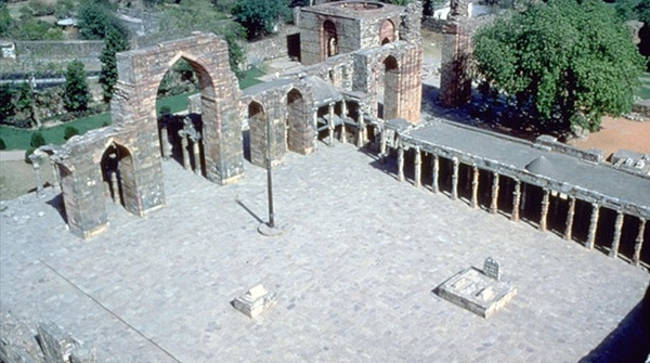
In the medieval period, there are numerous accounts of how Jain images, temples and thus sacred places were destroyed by Muslim persecutions. Many Jain images were buried or hidden in the underground chambers of temples to save them from the iconoclasts. The later rediscovery of such images offered chances to take back holy places into Jain control.
The 14th-century author Jinaprabha-sūri narrates how he played a role in returning an image of Mahāvīra to its original setting. Kept in the sultan’s treasury, the idol was moved to Kanyānayā, which then became a sacred place for the Jains once again.
When Jain temples were converted into Muslim buildings the corresponding tīrthas fell into disuse.
Ownership of holy places

Pilgrims at Mount Sammeta
Image by Deeeep – Deepak Mehta © CC BY-NC 2.0
Some holy places are more or less recognised as predominantly Śvetāmbara, such as Shatrunjaya, while others are accepted as Digambara, such as Shravana Belgola. Other sites are claimed by both sects, but the two groups focus on different parts of the place and on distinct religious manifestations in what can be regarded as productive competition. An example of this is Hastinapur, not far from Delhi. Here, Digambaras concentrate on events centring on the large model of Jambū-dvīpa while Śvetāmbaras focus on the celebration of Akṣya-tṛtīyā and other festivals in their own temples.
However, the ownership of holy places is often a burning issue, where Digambara and Śvetāmbara rivalries burst out. Sometimes this takes on a public dimension that spills over the boundaries of the whole Jain community, as each party calls politicians to its side. This is a source of embarrassment and a topic rather difficult to investigate, but it is echoed in the Jain newspapers.
Well over one hundred sectarian disputes regarding control of religious sites have become public to the wider Indian population. The best-known cases are:
- Bāhubali Hill, near Kolhapur in south Maharashtra in the 1980s (Carrithers 1988), which the Digambaras claimed
- the shrine at Śirpur in Maharashtra, in connection with the image known as Antarīkṣa Pārśvanātha – ‘Floating Pārśva’ – (Dundas 2002: 53–54), which the Śvetāmbaras claimed
- legal actions over Mount Sammeta.
Management of sacred places

Pilgrim prays at Mount Shatrunjaya
Image by Marina & Enrique © CC BY-NC-SA 2.0
In its smallest form a sacred place comprises a small shrine, a temple or any memorial. But in many cases, Jain holy places are vast complexes of several elements:
- clusters of temples
- rest-houses – dharma-śālas – for pilgrims
- eating hall for pilgrims – bhojana-śālās.
These buildings may be next to each other or may be completely separate. In Shatrunjaya or Shravana Belgola, for instance, the temple-city or the Bāhubali statue that are the main focus of pilgrimage are on top of hills where it is forbidden to stay overnight. The villages at the foot of the hill are therefore the places where pilgrims stay.
Prominent holy places such as these, or even more important ones, demand proper, permanent organisation to accommodate the crowds according to Jain principles and values. This presupposes proper, and sometimes rather strict, management, which is generally achieved by private trusts or foundations of varying sizes. One of the most powerful is the Ānandji Kalyānji nī peḍhī. Established around 1730, it controls several major Śvetāmbara holy places, including Shatrunjaya, Girnar and Hastinapur.
In small and secluded places pilgrims receive accommodation and food free of charge, as was the custom. It is understood that the pilgrims will make some donation in exchange. But the larger the place the more regulated arrangements are. These days regular payments for food and lodging are instituted more frequently. A sign of the development of holy places is the number and wide range of rest-houses available. The luxurious ones expected by many modern Jains used to urban comforts are often found side by side with very simple facilities.
New holy places

Jain Center of Greater Phoenix
Image by Vijay J Sheth © CC BY-SA 3.0
Jains consider the creation of new sacred places as a manifestation of their presence and dynamism in India. In areas where they are numerous, they invest a lot of money in the erection of new temples, which become the focus of new holy places. This may be observed not just in India but in places around the world where the Jain diaspora has settled in some numbers.
Where the site owes its sanctity to the birth or death of a religious teacher, the connection with the past that is so essential in making a place holy clearly exists. Examples are Ladnun in Rajasthan and the Vallabh Smarak near Delhi.
Even so, there are holy places that are totally new. Mostly, their construction is motivated by a Jain mendicant, who asks his followers to invest in it and thus marks his presence. A recent example is that of Ayodhyapuram in Vallabhipur, in Gujarat, on the road from Ahmedabad to Bhavanagar. The temple here has a distinctly new shape. The main novelty is a gigantic seated statue of Ṛṣabhanātha or Lord Ṛṣabha, measuring seven metres tall and weighing 350 tonnes. Even in this case, a link with the past is claimed – the idea is to present the first Jina with the physical measurements given in the scriptures.
This is just one instance of the unfolding map of Jain geography. Increasing numbers of holy places in the 20th and 21st centuries show the unlimited creativity of Jains in finding new means to assert their presence in the Indian environment and beyond. Jains living outside India must reconcile the old with the new. Creating brand-new religious spaces requires strategies that do not necessarily connect a tīrtha with a Jina‘s life, but find other ways of making a place holy.