Number and titles
According to the Jain tradition, the Aṅgas are 12 in number. The oldest sources refer to them as ‘the basket of the gaṇadharas which has 12 components’. This is also the case in Aṅga Number 4, which describes the contents of each of the texts. However, Number 12, the title of which is supposed to have been Dṛṣṭi-vāda, was lost rather early. Thus the Aṅgas have numbered 11 since before they were first written down in the fifth century. This is therefore the standard number referred to, for instance, when a canonical scripture says that a given character was a model Jain mendicant because he studied the 11 Aṅgas. This number also appears in Digambara sources. In fact, even though the Digambara sect recognises other writings as canonical, it does not totally reject the Aṅgas.
The titles of the Aṅgas can be understood in various ways. This table gives rough equivalents.
|
Number |
Prakrit title |
Sanskrit title |
Translated meanings |
|---|---|---|---|
|
1 |
Āyāraṃga |
Ācārāṅga |
‘On monastic conduct’ |
|
2 |
Sūyagaḍa |
Sūtrakṛtāṅga |
‘On heretical systems and views’ |
|
3 |
Ṭhāṇaṃga |
Sthānāṅga |
‘On different points [of the teaching]’ |
|
4 |
Samavāyaṃga |
Samavāyāṅga |
‘On “rising numerical groups”’ (Kapadia 1941: 126) |
|
5 |
Viyāha-pannatti or Bhagavaī |
Vyākhyā-prajñapti or Bhagavatī |
‘Exposition of explanations’ or ‘the holy one’ |
|
6 |
Nāyā-dhamma-kahāo |
Jñāta-dharmakathānga |
‘Parables and religious stories’ |
|
7 |
Uvāsaga-dasāo |
Upāsaka-daśāḥ |
‘Ten chapters on the Jain lay follower’ |
|
8 |
Antagaḍa-dasāo |
Antakṛd-daśāḥ |
‘Ten chapters on those who put an end to rebirth in this very life’ |
|
9 |
Aṇuttarovavāiya-dasāo |
Anuttaropapātika-daśāḥ |
‘Ten chapters on those who were reborn in the uppermost heavens’ |
|
10 |
Paṇha-vāgaraṇa |
Praśna-vyākaraṇa |
‘Questions and explanations’ |
|
11 |
Vivāga-suya |
Vipākaśruta |
‘Bad or good results of deeds performed’ |
The name of each work is generally followed by the generic Sanskrit term sūtra or Prakrit term sutta, thus it is the Āyāraṅga-sutta or Ācārānga-sūtra, for example. In this context, it lacks the technical meaning of sūtra and is an equivalent of the term ‘sacred scripture’, designating long texts. In the case of the holy text of the Tattvārtha-sūtra, however, the word has its usual technical meaning in Sanskrit literature, meaning it is written in concise aphorisms.
Language
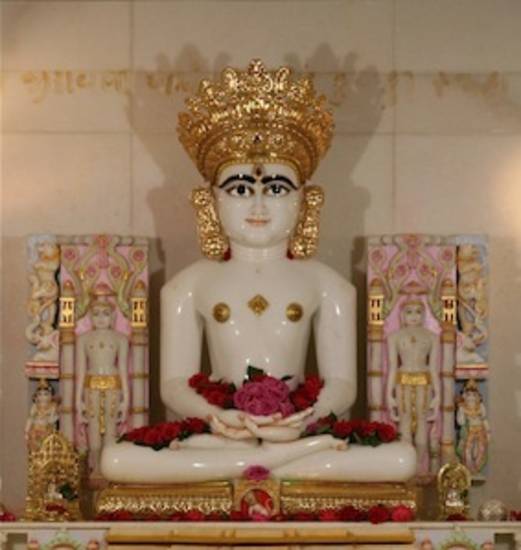
Māhavīra decorated
Image by Ravin Mehta © Ravin Mehta
The 11 Aṅgas are written in Prakrit. Although they form a set, they are not all written in the same dialect of Prakrit, nor in the same style. Scholars have recognised that some parts are older than others. Among the oldest parts are the first book of Aṅga Number 1 and some parts of Aṅga Number 2. In Aṅga Number 5 researchers have distinguished the nucleus from various additions.
The Prakrit dialect used in the oldest parts is Ardhamāgadhī, which is associated with the region of eastern India where Mahāvīra preached originally. In more recent parts, the language shows salient features of the Jaina Māhārāṣṭrī dialect. This is associated with western India, where followers of the Jinas migrated and the Śvetāmbara Jain canon was finally put into writing in the fifth century CE.
Literary styles

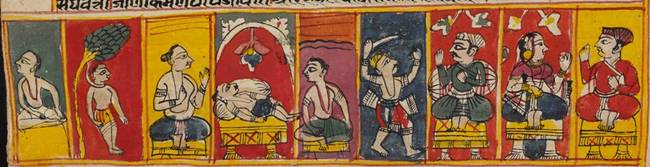
Senior monk teaching
Image by Victoria and Albert Museum © V&A Images/Victoria and Albert Museum, London
The 11 texts that make up the class of scriptures known as the Aṅgas displays a variety of literary forms and styles.
Aṅgas Numbers 3 to 11 are written in prose. The style of prose used in the Aṅgas has several characteristics. Often referred to as ‘canonical prose’, the style relies heavily on repetition and stock descriptions. These allow full descriptions of situations and characters to be referred to directly in the texts of other writings in the Śvetāmbara canon. These other writings are mainly the Aṅgas but also their complementary works, the Upāṅgas. The two sets of teachings thus form a larger group of texts that draws on a close knowledge of all the works to make sense of each one. They must be thought of as closely connected texts that cannot be considered separate items.
Poetry is also found in the Aṅgas. Verse is used in the final section of Aṅga Number 4 and also in several parts of Aṅgas Number 1 and 2. The contrast between archaic metrical forms and other metres has helped scholars distinguish between very old and newer passages or sections of these works.
The Aṅgas use a variety of formats to transmit the teachings. The traditional dialogue and question-and-answer formats are the dominant ones. The texts most commonly follow Indian literary traditions that feature a teacher and pupil talking about a philosophical topic. These techniques expose various sides of the subject and allow for argument and counter-argument. They also foreground the oral aspect of the teachings.
Other favourite methods of passing on key points in Jain belief are the parable and story. Particularly useful to illustrate a concept and its workings, these techniques are effective at all levels of understanding.
Canonical prose

An omniscient Jina preaches
Image by British Library © CC0 1.0 (Creative Commons Public Domain)
The prose of the Aṅgas is sometimes called canonical prose, and uses a specific style and phraseology. Repetition and stereotypical descriptions are features of this style.
There are many sentences that use patterns such as ‘he approached X, after having approached X he said, after having said, he…’. Another feature is the use of series of quasi-synonyms instead of a single word as a way to emphasise something.
This canonical prose has numerous set descriptions, called varṇakas, which describe a city, a beautiful lady, a park, an ascetic, a universal gathering and so on. A specific stylistic form associated with these descriptions is the veḍha. These are long descriptive compounds arranged to form metrical units.
Such descriptions are stereotyped and can be used in different texts. This explains why there is a lot of cross-referencing between the different Aṅgas, as well as between the Aṅgas and the complementary texts called the Upāṅgas – the ‘auxiliary limbs’ of the Śvetāmbara canon. Each of these works should not be viewed as a closed and independent unit. All the Aṅgas and Upāṅgas form an intertextual network.
For instance, the first chapter of Aṅga Number 6 devotes a lot of space to the episode where Prince Megha asks permission to renounce worldly life and become a monk. He and his parents have a lengthy dialogue on the subject. In other similar situations the text will say ‘like Megha’ and the reader will know where the detailed passage is found. There are many techniques for shortening descriptions of stock situations or individuals in this way. Another case is that of Skandhaka, whose story is told in Aṅga Number 5. His life as a ‘perfect ascetic’ serves as a reference for depicting the behaviour of any exemplary ascetic.
Ascetic poetry
Though the majority of the Aṅgas is prose, verse is also used. It is often known as ‘ascetic poetry’ mainly because it is on matters to do with mendicants.
Verses can be found in the last section of the fourth Aṅga and in several parts of the first two works.
Aṅga Numbers 1 and 2 in particular are specimens of ascetic poetry. Among the most famous passages are:
- the description of Mahāvīra’s wandering as an ascetic among hostile populations, in Ācārānga I. 9
- the first hymn of praise to Mahāvīra, found in Sūtrakṛtānga I. 6.
Dialogues and question-and-answer formats

Indrabhūti Gautama
Image by British Library © CC0 1.0 (Creative Commons Public Domain)
Traditional Indian formats for philosophical works are dominant in the Aṅgas. Philosophical texts in Indian culture historically use two main methods to present information. Firstly, a master and his follower have a dialogue discussing the subject thoroughly. Secondly, the guru and his pupil follow a question-and-answer format. The pupil may effectively be a surrogate for the reader or audience of the text.
The Aṅgas primarily follow the traditional dialogue and question-and-answer formats. Though the dialogues may be formalised, the consistent use of these modes of presentation plunges the reader directly into intellectual debates. It also underlines the importance of orality in passing on Jain beliefs.
Mahāvīra is the chief teacher in the Aṅgas. His major direct interlocutor is Indrabhūti Gautama, his chief disciple. Gautama features in several works and is prominent, for instance, in Aṅga Number 5.
The setting frame of many of the Aṅgas begins with the elders Jambū and Sudharman in conversation. Usually, Jambū asks Sudharman what Mahāvīra teaches in the given work. After Indrabhūti’s omniscience, Sudharman was the sole leader of the monastic community Mahāvīra founded. He taught his disciple Jambū what he had learnt from Mahāvīra himself. According to tradition Sudharman taught for 12 years after Mahāvīra’s death and in the 13th year reached omniscience.
Jambū’s questioning takes the following standard forms:
- what is the name of this Aṅga?
- how many chapters does it have?
- what are the names of these chapters?
Then Sudharman answers. What he then tells his disciple forms the text itself. Examples of this framing device can be found in Aṅgas Numbers 2, 8, 9, 11.
In the narrative Aṅgas, which are made up of Numbers 6, 7, 8, 9 and 11, the characters are in permanent dialogue with monastic teachers. Hearing mendicants’ teachings is the reason they wish to become monks themselves. When they want to undertake special penances, they request permission from mendicants as well.
Parables and stories
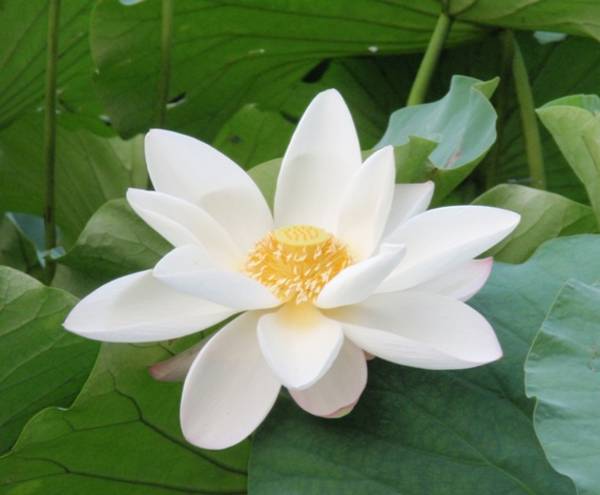
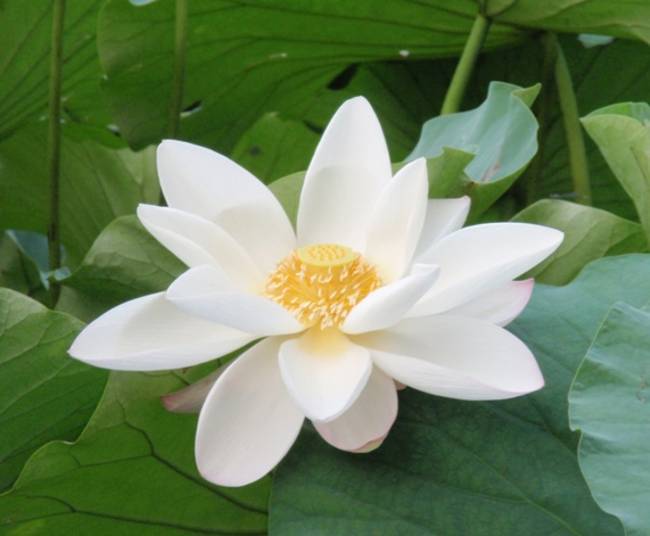
White lotus
Image by Haha169 © public domain
Parables and stories are also favourite means of passing on the teachings. They contain familiar examples or exciting narratives to make or explain a possibly complex point or sophisticated concept. Stories form the bulk of Aṅgas Numbers 6, 7, 8, 9 and 11, which are discussed in more depth in the article dedicated to story Aṅgas.
In the Ācārānga and Sūtrakṛtānga, the methods of Mahāvīra’s teachings are emphasised. They include the use of parables, comparisons and examples of all kinds.
A well-known example of one of Mahāvīra’s parables is that of the lotus, found in Sūtrakṛtānga II. 1. Four men come from the cardinal directions and try in turn to enter the pool to fetch the beautiful flower, but all get stuck in the mud. A monk comes along. Realising that the men’s method is not the right one, he stays on the shore and shouts: ‘O white lotus, fly up!’ The flower flies up so he can grasp it. This parable is then explained systematically. The four men represent heretics of various creeds.
The 11 Aṅgas
With numerous common elements, such as language and purpose, the 11 Aṅgas form an interwoven set of holy writings. To best understand each text, familiarity with the others is necessary and thus the Aṅgas should ideally be considered as a whole. Even so, these scriptures can be divided into two categories.
The first category can be thought of as the ‘story Aṅgas’, because the literary forms of narratives and parables are characteristic of these works. The second category is looser, linked less by form and style than by intention and scope. These texts can be labelled the ‘reference Aṅgas’.
Story Aṅgas
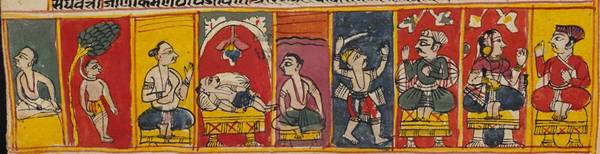
Kinds of human lives
Image by British Library © CC0 1.0 (Creative Commons Public Domain)
Aṅgas number 6, 7, 8, 9 and 11 are the story Aṅgas. These five scriptures underline the importance of narratives as a crucial medium to teach the doctrine in practice. They chiefly comprise life sketches featuring men and women from various backgrounds, though short parables are also a favourite form.
The purpose is to show how an individual’s behaviour determines future births, which are also the result of past lives. Apart from exceptional cases, when someone can remember his or her previous lives, the mediator who knows both about past and future is a Jina, especially Mahāvīra. These five scriptures are examined in detail in a dedicated article called Story Aṅgas.
Other Aṅgas

Scenes of forgiveness
Image by Wellcome Trust Library © Wellcome Library, London
The remaining Aṅgas – numbered 1, 2, 3, 4, 5 and 10 – can be considered together. They also feature narrative techniques but can be thought of as primarily reference sources. They contain detailed discussion of the rules by which mendicants are expected to live and exhaustive listings of Jain doctrine, thought and practice. This is also the only place to find certain information about the 24th Jina, Mahāvīra. The ‘reference Aṅgas’ are explored in depth in the article of the same name.
Commentaries
Like several other Jain scriptures, the Aṅgas have been the starting point of a long and continuous process of explanation and critical interpretation. This takes the form of commentaries written in different forms and various languages.
The commentaries developed in four phases.
|
Commentary name |
Form and language |
Period |
Information |
|---|---|---|---|
|
first centuries of the Common Era |
methodological character listing synonyms of the main terms, analyses of terms according to fixed parameters and so on. |
||
|
prose in Jaina Māhārāṣṭrī Prakrit |
6th century |
These are not available for all Aṅgas |
|
|
prose in Sanskrit |
8th to 9th century onwards |
Each Aṅga has at least one, with some Aṅgas having more. There are some authors who have specialised in such commentaries. The most famous is Abhayadeva-sūri, in the 11th century, who wrote commentaries on nine Aṅgas. |
|
vernacular languages, in particular Old Gujarati |
15th century onwards |
Among the specialist commentary authors is the 16th-century monastic teacher Pārśvacandra-sūri |
The commentaries of the first two phases are mostly scholarly texts. Those of the latter phases focus more on the literal understanding of the texts. The commentaries are instrumental in the handing down of the Aṅgas through the centuries.
|
Aṅga number |
Prakrit title |
Sanskrit title |
Niryukti |
Cūrṇi |
Sanskrit commentary |
|---|---|---|---|---|---|
|
1 |
Āyāraṃga |
Ācārāṅga |
Yes |
Gandhahastin |
Śīlānka, 9th century |
|
2 |
Sūyagaḍa |
Sūtrakṛtāṅga |
Yes |
Yes |
Śīlānka, 9th century |
|
3 |
Ṭhāṇaṃga |
Sthānāṅga |
No |
No |
Abhayadeva |
|
4 |
Samavāyaṃga |
Samavāyāṅga |
No |
No |
Abhayadeva |
|
5 |
Viyāha-pannatti or Bhagavaī |
Vyākhyā-prajñapti or Bhagavatī |
No |
Yes |
Abhayadeva |
|
6 |
Nāyā-dhamma-kahāo |
Jñāta-dharmakathānga |
No |
No |
Abhayadeva |
|
7 |
Uvāsaga-dasāo |
Upāsaka-daśāḥ |
No |
No |
Abhayadeva |
|
8 |
Antagaḍa-dasāo |
Antakṛd-daśāḥ |
No |
No |
Abhayadeva |
|
9 |
Aṇuttarovavāiya-dasāo |
Anuttaropapātika-daśāḥ |
No |
No |
Abhayadeva |
|
10 |
Paṇha-vāgaraṇa |
Praśna-vyākaraṇa |
No |
No |
Abhayadeva |
|
11 |
Vivāga-suya |
Vipākaśruta |
No |
No |
Abhayadeva |