Number and titles

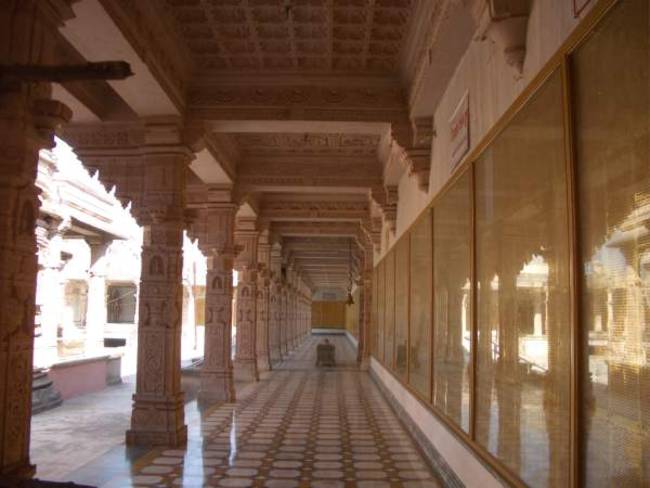
Gallery of an Agam Mandir
Image by Nalini Balbir © Nalini Balbir
Śvetāmbara Jains believe the Aṅgas are the teachings of the 24th Jina. In the Jain tradition there were originally 12 Aṅgas, but one book has always been considered lost very soon after the time of Mahāvīra. This text, the Dṛṣṭi-vāda, was therefore never written down along with the other Aṅgas by the Jains who became the Śvetāmbara sect. The other main Jain sect, the Digambaras, does not hold these 11 Aṅgas to be canonical.
The titles of the Aṅgas can be understood in various ways. This table gives rough equivalents.
|
Number |
Prakrit title |
Sanskrit title |
Translated meanings |
|---|---|---|---|
|
1 |
Āyāraṃga |
Ācārāṅga |
‘On monastic conduct’ |
|
2 |
Sūyagaḍa |
Sūtrakṛtāṅga |
‘On heretical systems and views’ |
|
3 |
Ṭhāṇaṃga |
Sthānāṅga |
‘On different points [of the teaching]’ |
|
4 |
Samavāyaṃga |
Samavāyāṅga |
‘On “rising numerical groups”’ (Kapadia 1941: 126) |
|
5 |
Viyāha-pannatti or Bhagavaī |
Vyākhyā-prajñapti or Bhagavatī |
‘Exposition of explanations’ or ‘the holy one’ |
|
6 |
Nāyā-dhamma-kahāo |
Jñāta-dharmakathānga |
‘Parables and religious stories’ |
|
7 |
Uvāsaga-dasāo |
Upāsaka-daśāḥ |
‘Ten chapters on the Jain lay follower’ |
|
8 |
Antagaḍa-dasāo |
Antakṛd-daśāḥ |
‘Ten chapters on those who put an end to rebirth in this very life’ |
|
9 |
Aṇuttarovavāiya-dasāo |
Anuttaropapātika-daśāḥ |
‘Ten chapters on those who were reborn in the uppermost heavens’ |
|
10 |
Paṇha-vāgaraṇa |
Praśna-vyākaraṇa |
‘Questions and explanations’ |
|
11 |
Vivāga-suya |
Vipākaśruta |
‘Bad or good results of deeds performed’ |
Aṅga 1 – non-violence, monastic conduct and Mahāvīra’s career
The first Aṅga is called the Ācārānga-sūtra. It deals with many aspects of monastic conduct and emphasises non-violence as the ultimate ideal and asceticism as the highest value. It presents the Jain mendicant as a sage living in seclusion and absolute self-control rather than as a member of an organised community.
Aṅga Number 1 contains two sections. The first is probably one of the oldest parts of the Jain holy writings. The second section is very likely to be younger and may have been added later. Each of the section is divided into several parts.
First section of the Ācārānga-sūtra
The first section of the Ācārānga-sūtra has the title of Bambhacerāiṃ – Pure Life. Because of its antiquity, the German scholar Walther Schubring dubbed it the ‘senior’ work. The seventh of its nine chapters was lost centuries ago.
The text mixes poetry and prose, with the final chapter describing Mahāvīra’s wandering as an ascetic a particularly well-known example of ascetic poetry.
|
Chapter number |
Title |
Details |
|---|---|---|
|
1 |
Knowledge of the Weapon |
This is a plea in favour of non-violence. Separate parts deal with the different types of bodies in Jain cosmology. This chapter is often regarded as the oldest of all, on the basis of its archaic language and phrasing. |
|
2 |
Spiritual Conquest |
Spiritual conquest of the world implies knowledge of the world, rejection of pleasures and control of behaviour. |
|
3 |
Hot and Cold |
These qualities are used as symbols of extremes. Faced with these, the wise ascetic should not depart from equanimity. Similarly, he should not be affected by passions. |
|
4 |
Righteousness |
Correct understanding of the world and faith in correct principles is a prerequisite for correct behaviour. These are the ‘three gems’. |
|
5 |
Essence of the World |
Desire and its cause should be uprooted. Watchfulness is the condition for true freedom. Detachment and solitude are the main values, and ‘the greatest temptation in this world are women’ (Jacobi’s translation p. 48). Contemplation of the Self and the inner purity of the soul are discussed. |
|
6 |
Process of Cleaning |
Knowing which are the causes of rebirth, one should try to cast them off to become totally free and purified. |
|
7 |
Lost long ago |
|
|
8 |
Discusses the concept of liberation |
|
|
9 |
The ascetic Mahāvīra |
Righteousness as practised by Mahāvīra during his wandering ascetic life. The exemplary life of the 24th Jina can be seen as an illustration of all the preceding chapters. This is a well-known example of ascetic poetry. |
Second section of the Ācārānga-sūtra
The second section of the Ācārānga-sūtra has linguistic and content features pointing to a later date than the first. There are also hints that it was originally a supplementary work. It is divided into sixteen chapters.
|
Chapter number |
Title |
Details |
|---|---|---|
|
1 |
Search for Alms |
Rules and precautions regarding alms |
|
2 |
Search for Lodging |
Rules and precautions regarding conditions for proper monastic lodging or stays |
|
3 |
Walking |
Precautions in walking and other movements |
|
4 |
Modes of Speech |
Precautions in the use of language and speech |
|
5 |
Search for Monastic Clothes |
Rules and precautions regarding clothes |
|
6 |
Search for Monastic Bowl |
Rules and precautions regarding alms-bowls |
|
7 |
Regulation of Possessions |
Rules regarding permission, especially for accepting a place of stay, and the notion of proper limits |
|
8 to 14 |
These sections are considered as forming a set of seven lectures, covering the topics of:
|
|
|
15 |
The Reinforcing Practices |
A large part of this section on Mahāvīra’s life is close or identical to the corresponding section of the Kalpa-sūtra. It serves as an introduction to the innovation of Mahāvīra’s teaching, namely the five great vows – mahā-vratas. These are then detailed along with the practices meant to reinforce them – the bhāvanās. |
|
16 |
Pursuit of liberation explained through similes. |
Aṅga 2 – right and wrong paths

Monastic teacher and pupils
Image by Victoria and Albert Museum © V&A Images/Victoria and Albert Museum, London
One of the main characteristics of Aṅga Number 2 is the emphasis on the principles of Jain doctrine – the true doctrine. It contrasts them with the beliefs of other schools, whose followers are ‘fools’. Thus the Sūtrakṛtānga gives insights into the sects and schools that were rivals to the Jains. A number of comparisons and examples are used to impart the teaching.
There are 23 chapters in the Sūtrakṛtānga. The first section is made up of a mix of prose and verse chapters. The sixth chapter is a famous passage of poetry on mendicants and their lives. All in prose, the second section boasts a very well-known parable.
First section of the Sūtrakṛtānga
The first section of the second Aṅga has 16 chapters, in a mixture of prose and verse. One of the most famous examples of ascetic poetry is the sixth chapter, which pays homage to the 24th Jina, Mahāvīra.
Contents of the Sthānānga and the Samavāyānga

14 magical jewels
Image by British Library © CC0 1.0 (Creative Commons Public Domain)
The two scriptures can be viewed as reference books of Jain terms and concepts in the form of headings and enumerations. They are not encyclopaedias since they do not expand upon the meaning of each term. The Sthānānga and the Samavāyānga merely list concepts that are organised into categories based on numbers. Taken at face value, some statements are therefore quite challenging.
The terms and concepts of the works cover all possible areas of Jainism:
- metaphysics
- epistemology
- cosmology
- ethics
- mythology – namely data relating to the categories of Jain Universal History, Jinas, Cakravartins, Baladevas, Vāsudevas and Prativāsudevas.
- aspects of language theory are also treated, not just those related to the Jain faith.
The same concept is often dealt with more than once. This is because, depending on the angle of analysis, it can be considered differently with different kinds of subdivisions. For instance, the total number of the colours of the soul – leśyā – is six. But they are not found at the same time in the same living being. Thus it also occurs in the section discussing concepts grouped in threes, in connection with the number of colours applicable to various types of living beings.
In some ways, therefore, the Sthānānga and the Samavāyānga cover all areas of knowledge.
These two Aṅgas are thus highly technical. They address readers who are familiar with the doctrine because they suppose a lot of background knowledge. For the specialists, they function as highly developed mnemonic tools. Even so, the way the concepts are ordered within each numerical section is not crystal clear.
They are mostly written in prose, but verses are occasionally used in some topics. These could be quotations from external sources.
|
Section |
Subject |
Examples |
|---|---|---|
|
1 to 10 |
concepts with numbers of subdivisions according to section number |
Some of the lists are identical with the corresponding sections in the Sthānānga |
|
11… |
concepts with 11, 12, 13 subdivisions and so on |
|
|
…22 |
concepts with 22 subdivisions |
This is followed by a list of troubles mendicants must overcome |
|
…24 |
concepts with 24 subdivisions |
This is followed by a list of the 24 Jinas |
|
…10 to the power of 14 – sāgarovama-koḍākoḍī |
concepts with numbers of subdivisions according to section number |
|
|
Appendices |
Various |
Aṅga 5 – ‘the Venerable One’
The fifth Aṅga is often referred to by the laudatory epithet Bhagavaī – ‘Venerable’. This name is probably more widely known than its formal title of Viyāhapannatti or Vyākhyāprajñapti.
Structure of the Bhagavaī Aṅga
This bulky book is divided into 41 sections known as śatakas. These are themselves subdivided into subsections called uddeśas, except for section 15, which has no subdivision. In many cases these subdivisions have further divisions. Since the beginning of Jain studies, the structure of this work has been discussed. With variations, it is now more or less agreed that there is a nucleus. This corresponds to sections 1 to 20, except for section 15. Later stages of accretions have been identified (Weber, Deleu, Ohira, Dixit), mainly on the basis of formal criteria.