Origins
 Ācārya Bhikṣu
Image by Pramodjain3 © PD
The Terāpantha was founded by Muni Bhikhan (1726–1803), who was later known as Ācārya Bhikṣu. He was born in the village of Kantaliya near Jodhpur in Rajasthan. His parents belonged to the Osvāl caste, which has always supplied a large number of recruits to the Terāpantha. Many Osvāls follow the tradition of worshipping idols while many others follow the Sthānaka-vāsins as well.
After his wife’s death, Bhikhan entered the monastic order of the Sthānaka-vāsin, who are against worshipping images. But Bhikhan left and formed a new group with 12 other men. Ācārya Bhikṣu’s opponents scorned it as the ‘path of the 13 – terah-panth – but he understood it as meaning ‘your group’ – terā panth. He also interpreted the number 13 as referring to the following principal points of Jain doctrine:
- the ‘five major vows’ – mahā-vratas
- the ‘three restraints’ – gupti
- the ‘five precautions’ – samiti.
Monastic organisation
 Ācārya Mahāprajña with Ācārya Bhikṣu
Image by Terapanth © PD
The Terāpantha monastic order has an important feature which distinguishes it from other Jain monastic orders. Ācārya Bhikṣu set out the maryādā, a code of practice for ascetics, in which there is a single ācārya, who is a teacher-cum-group leader. He holds all the power in the sect and is chosen by his predecessor. Ācārya Bhikṣu established this rule to prevent schisms and the development of loose discipline.
The ācārya is a central autocratic leader who:
There is also a chief nun – sādhvī-pramukhā – who is the head of the female ascetics but she is subordinate to the ācārya.
Since it was founded, the Terāpantha monastic order has grown more or less regularly, peaking during the 20th century.
- initiates all monks and nuns
- chooses his successor, who is given the title of Yuvācārya
- decides the number and size of the different groups of mendicants by selecting their members during the annual plenary assembly called Maryādā Mahotsava.
| Name | Dates | |
|---|---|---|
| Birth | Ācāryaship | |
| Ācārya Bhikṣu | 1726 | 1760–1803 |
| Ācārya Bharimal | 1747 | 1803–1821 |
| Ācārya Jītmal | 1803 | 1821–1881 |
| Ācārya Maghrāj | 1810 | 1881–1892 |
| Ācārya Manaklāl | 1855 | 1892–1897 |
| Ācārya Dalchand | 1852 | 1897–1909 |
| Ācārya Kālugaṇi | 1877 | 1909–1936 |
| Ācārya Tulsi | 1914 | 1936–1997 |
| Ācārya Mahāprajña | 1921 | 1997–2010 |
| Ācārya Mahāśramaṇa | 1962 | 2010 to present |
| Date | Monks | Nuns | Total ascetics |
|---|---|---|---|
| 18th century – Ācārya Bhikṣu | 21 | 27 | 48 |
| 1955 | 180 | 480 | 660 |
| 1975 | 151 | 506 | 657 |
| 1981 | 164 | 531 | 695 |
| 1999 | 145 | 543 | 688 |
Samaṇas and samaṇis
Until 1980 mendicants in the Terāpantha order were either monks – sādhus – or nuns – sādhvīs – as in the other Jain monastic orders. In the modernisation process characteristic of his reign, Ācārya Tulsi created a new intermediate category. The males in this new ascetic class are called samaṇas and the females samaṇis. There are many more samaṇis than samaṇas. Whereas traditional Jain mendicants are only allowed to go on foot, samaṇas and samaṇis may use transport. This is a very important innovation because it allows them to travel abroad on missionary tours. For many Jains living outside India samaṇas and samaṇis are the only Jain mendicants with whom they can have direct contact.| Year | Samaṇas | Samaṇis |
|---|---|---|
| 1992 | 4 | 51 |
| 1996 | 4 | 81 |
| 1999 | 4 | 80 |
Scriptures and philosophy
 Discussing the scriptures
Image by Amitjain80 © CC BY-SA 3.0
The Terāpanthins recognise the authority of 32 of the Śvetāmbara canonical scriptures. Influenced by the most recent ācāryas, Tulsi and Mahāprajña, Terāpanthin mendicants have published numerous critical editions, indexes, dictionaries and analyses of these scriptures to a high standard. They have also provided Hindi translations of several texts.
On the other hand, the Terāpanthins are also indebted to early Digambara thinkers such as Kundakunda. Their work promotes absolute renunciation and exposes the difference between the conventional point of view and the religious or absolute point of view. The conventional viewpoint – vyavahāra-naya – sees things from the angle of everyday life while the religious viewpoint – niścaya-naya – focuses on the religious perspective.
Beside that, the Terāpanthin teachers also have to their credit a good number of creative writings where they set out their viewpoints on certain crucial topics. Most of these writings are in Rajasthani and Hindi, their native languages.
For example, Ācārya Bhikṣu’s 1787 Poem on Compassion – Anukampā rī caupaī – gives the Terāpantha’s specific position on this topic. In his view, because good acts create karma, they also obstruct the liberation of the soul, just as bad acts do. Therefore all acts should be avoided, even acts of compassion. Activities are positive from the social point of view of everyday life, but they create disadvantages from the religious or absolute point of view. For him, pure renunciation of all activity is the highest aim.
Finally, under the influence of Ācārya Tulsī and Ācārya Mahāprajña, increasing numbers of books and pamphlets promoting Terāpanthin ideas in English are being published. This supports the work of the Terāpanthin samaṇas and samaṇis, who undertake missionary tours outside India among the Jain diaspora.
Significant beliefs and practices
The Terāpanthin do not worship images. Formed after a schism within the Sthānaka-vāsin Jains, who are against idol worship, the Terāpanthin sect has rejected image worship from its beginnings. However, the Terāpanthins worship their living teachers as examples of religious conduct to follow. Key characteristics of the sect‘s practices include:- ‘insight meditation‘ – prekṣā dhyāna
- Festival of Restraint – Maryādā Mahotsava
- modernising outlook, demonstrated in the Aṇuvrat movement, creation of a new mendicant category, stress on female education and the nayā moḍ – ‘new turn’.
Insight meditation
 Ācārya Mahāprajña meditating
Image by Amitjain80 © CC BY-SA 3.0
Terāpanthins stress fasting, ascetic practices and meditation.
Since 1975, they have placed most emphasis on what they call prekṣā dhyāna – ‘insight meditation’. This was introduced by Ācārya Mahāprajña in 1975, after twenty years of experimentation, following the success of the Buddhist meditation known as vipassanā. Insight meditation has become the hallmark of the Terāpanthins. Whether in India or abroad, they conduct classes and produce books to encourage more people to practise it.
Insight meditation aims to purify the practitioner’s mental state, which, according to Mahaprajna 2003:
- involves ‘careful concentration on subtle consciousness by mental insight’, starting with perception of the body
- produces ‘spiritual vigilance, or awakening of the consciousness and constant alertness’
- results in ‘total relaxation of the body with self-awareness’, which, together with awareness of one’s breathing, enables the meditator to channel and concentrate mental functioning
- produces perception of body, psychic centres and psychic colours, of the present moment and of thoughts, which leads to self-discipline, which brings willpower.
Maryādā Mahotsava
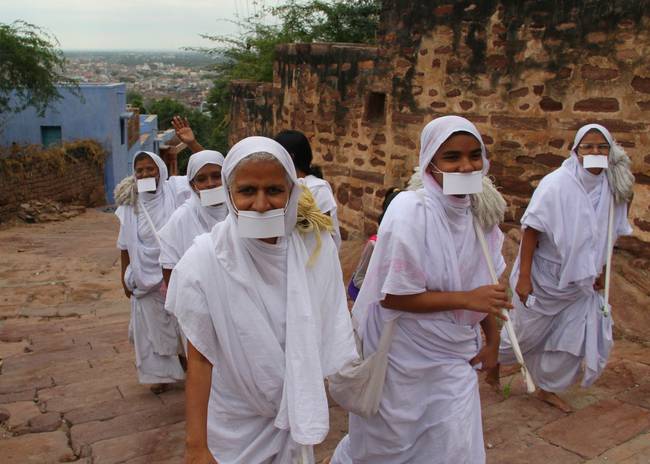
 Śvetāmbara Sthānaka-vāsin or Terā-panthin nuns
Image by arjunstc – Arjun © CC BY-NC-ND 3.0
All monks and nuns in the Terāpanthin order attend the annual Festival of Restraint. Lay Terāpanthin communities send representatives to the festival, which lasts three or four days in January or February. Recently, it has become a large occasion, with some 50,000 pilgrims attending.
Instituted by Ācārya Jītmal – Jayācārya – in 1864 to mark Ācārya Bhikṣu’s completion of the rules governing monastic behaviour, the festival is when Terāpanthin mendicants recite an oath of loyalty to the ācārya. He chooses the members of groups of ascetics for the following year and decides where they will travel and spend the rainy season.
Modernising Jainism
 Ācārya Tulsi
Image by Pramodjain3 © CC BY-SA 3.0
In post-Independence India, Ācārya Tulsi insisted not only on the religious values of detachment and asceticism, but also that social values such as education and morality should be encouraged among the Jain laity.
In 1949 Ācārya Tulsi created the Aṇuvrat movement to develop non-violence and morality among lay followers. The movement is based on the aṇuvrat, meaning ‘minor vows’. The term ‘minor vows’ describes the vows of lay Jains while Jain ascetics take the mahā-vrata or ‘great vows’. Membership of the Aṇuvrat movement is open to all people, including non-Jains, and provides rules of ethics that guide everyday life. The rules emphasise self-restraint, tolerance, peace, friendship and unity. This shows Ācārya Tulsi’s drive to create a new Jain way of life and to extend traditional Jain values into wider society.
Female education is another area where Ācārya Tulsi’s contribution has been highly significant. The nuns, especially the samaṇis, are encouraged to study the scriptures and follow university courses. Several have gained PhDs in India and have written scholarly books.
In 1960 an initiative called nayā moḍ – ‘new turn’ – sought to stamp out ‘outdated’ social customs among the Terāpanth laity, such as dowries, ritual wailing and female purdah. Nowadays female education is encouraged and marriage across caste barriers permitted while dowries have been abolished.