Basic information
Each Jina has standard biographical information found in various sources. Among the earliest Śvetāmbara canonical sources that provide biodata of all the 24 Jinas is the final section of the fourth Aṅga, the Samavāyānga-sūtra and the Āvaśyaka-niryukti. Among the earliest Digambara sources is a cosmological work, the Tiloya-paṇṇatti. Further, Mallinātha’s story is narrated at length in sources from both sects.
The main variation in sectarian accounts is the colour of Mallinātha’s body. According to the Śvetāmbaras it is dark blue, but it is golden for the Digambaras.
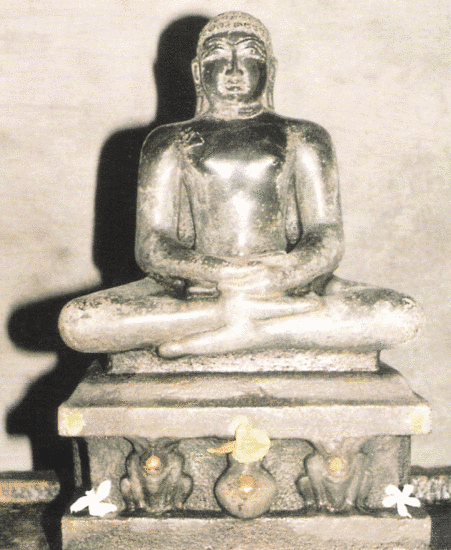
The biographical data can be categorised in a standard manner, and includes numbers, which are significant in wider Indian culture. These standard details can also be used to identify individual Jinas in art, since they are usually depicted as stereotyped figures. Pictures or statues of Jinaspresent them in either the lotus position or the kāyotsarga pose. Both of these imply deep meditation.
Parents
The important feature of a Jina’s father is that he is a king, from the kṣatriyacaste.
A Jina’s mother has an important role because she gives birth to a future Jina, and in practice a Jina is often called ‘the son of X’. Another reason for her importance is that the names given to the various Jinas are said to originate either in pregnancy-whims or in a dream their mothers had. This dream is specific, and adds to the traditional auspicious dreams that foretell the birth of a child who will become a Jina.
In the case of ‘Malli’ – ‘Jasmine’ – Śvetāmbara sources report that the mother wanted a bed covered with excellent and sweet-smelling jasmine flowers during her pregnancy.
|
Mother |
Father |
|---|---|
|
Prabhāvatī |
Kumbha |
Places

Peaks of Mount Sammeta
Image by CaptVijay © public domain
Of the five auspicious events that mark a Jina’s life – kalyāṇakas – four take place on earth and are associated with a specific village or town in the sources. Archaeological evidence often helps to identify the old names with modern places. Even when it is lacking, there is a tendency to carry out this identification process. Associating auspicious events with certain locations makes these places sacred to Jains, so that they are potential or actual pilgrimage places and temple sites.
|
Last incarnation and birth place |
Initiation and omniscience |
Emancipation |
|---|---|---|
|
Mithilā |
Sahasrāmravana, outside Mithilā |
Mount Sammeta |
The 14th-century Śvetāmbara monk Jinaprabha-sūri devotes one section of his work on Jain sacred places – the Vividha-tīrtha-kalpa – to Mithilā. The fact that four of the auspicious events in Mallinātha’s life took place there is among the elements that make it sacred. This location is identified with modern Janakpur, in today’s Nepal.
Dates and numbers
The five auspicious events that mark a Jina’s life – kalyāṇakas – are traditionally associated with a specific date. This is given according to the system of the Indian calendar:
- month
- fortnight
- day in the fortnight.
Astrological considerations also play a role here and the texts normally mention the constellations when an auspicious event takes place.
|
Last incarnation |
Birth |
|||
|---|---|---|---|---|
|
4th day of the bright half of Phālguna |
11th day of the bright half of Mārgaśīrṣa |
|
|
The dates associated with these events are potential or actual dates of commemoration. These may be marked in festivals, which determine the Jain religious calendar.
There may be variations in the dates in different sources, Śvetāmbara on one side, Digambara on the other. But there are also cases of differences within the same sectarian tradition.
Mallinātha’s birth, initiation and omniscience all fall on an 11th day and are among the events commemorated in the festival known as Maunaikādaśī.
There are also other numbers connected with the life of this Jina.
|
Height |
Total lifespan |
|---|---|
|
25 bows |
55,000 years |
Monastic and lay communities
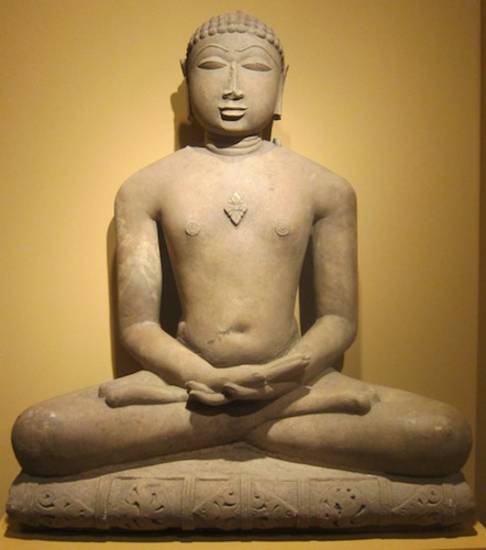
Statue of Malli
Image by Hiart; Honolulu Academy of Arts © public domain
A Jina is not an enlightened being who exists alone after reaching omniscience. After perfect knowledge comes general preaching – samavasaraṇa. This sermon, which is attended by all, is reported in the scriptures as resulting in large numbers of listeners being inspired. Many turn to religious life, becoming monks or nuns, while many others make the vows that lay people – śrāvaka and śrāvikā – can follow in their everyday lives. Further, the Jina’s teachings are preserved and passed on by his chief disciples – the gaṇadharas. This is why a Jina is also called a Tīrthaṃkara, meaning ‘ford-maker’ or ‘founder of a community’.
Each Jina establishes a ‘fourfold community‘, led by the chief disciples. Made up of monks, nuns, lay men and lay women, the fourfold community follows the principles the Jina has set out in his preaching. How members follow the religious teachings vary according to whether they remain householders or take initiation into mendicancy. Individual figures relating to each Jina are thus important.
|
Chief disciples |
Monks |
Nuns |
Lay men |
Lay women |
|---|---|---|---|---|
|
28, led by Bhiṣaj |
40,000 |
50,000 |
183,000 |
370,000 |
Identification
All Jinas have individual emblems – lāñchanas – and colours that help to identify them in artwork. They also have attendant deities known as yakṣa and yakṣī, who often appear flanking them in art.
|
Colour |
Emblem |
Yakṣa |
Yakṣī |
|---|---|---|---|
|
golden – Digambara |
water pot |
Kubera |
Vairoṭyā |
More details
Besides the basic information, the sources provide more details on various topics. These are almost infinite and vary depending on the sources. Such information differs between Śvetāmbaras and Digambaras. Here are only a few instances of extra detail.
All of the princes who become Jinas are carried on a palanquin to the park where they perform the ritual gesture of initiation into monastic life – dīkṣā. Mallinātha’s palanquin is named Jayantī. On this occasion, he is accompanied by one thousand kings.
Mallinātha performs a two-day fast. The next day he breaks his fast at the house of King Viśvasena.
Mallinātha reaches omniscience under a tree of the aśoka variety.
Śvetāmbara life of Malli
The earliest Śvetāmbara biography of Mallinātha or Lord Malli is narrated in their canonical scriptures. It forms the eighth chapter of the sixth Aṅga, called Nāyā-dhamma-kahāo in Prakrit or Jñāta-dharma-kathānga in Sanskrit. The inclusion of Malli’s story in a canonical scripture is probably a way to stress its importance and authoritativeness. Even so, this biography is not found in a work which focuses on the Jinas’ lives, such as the Kalpa-sūtra.
The account in the Jñāta-dharma-kathānga has become the standard Śvetāmbara biography. It is retold by later authors, whether in comprehensive biographies of all the Jinas or in individual works focusing on this particular Jina. Hemacandra’s 12th-century Tri-ṣaṣṭi-śalākā-puruṣa-caritra is an example of the first kind. Mallinatha’s biography is found on pages 52 to 71 in volume IV of Johnson’s translation of Hemacandra’s work. Vinayacandra’s verse work Mallinātha-caritra is a representative of the second one.
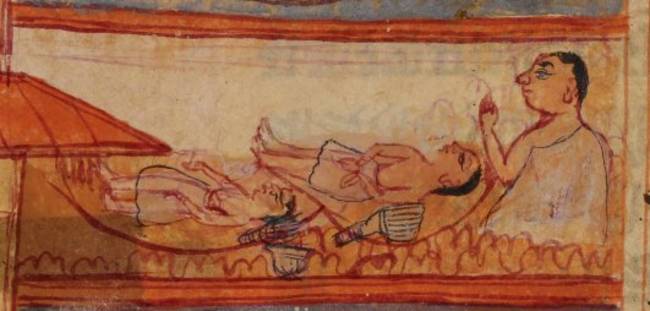
Previous birth – ascetic but deceitful
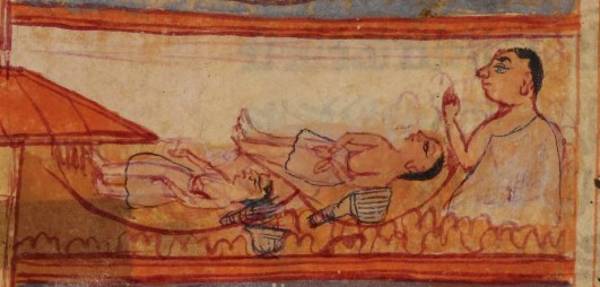
Fasting unto death
Image by British Library © CC0 1.0 (Creative Commons Public Domain)
After listening to a Jain ascetic called Dharmaghoṣa, King Bala of Vītaśoka in Mahā-videha renounces worldly life, becomes a monk and reaches emancipation. His son, Mahā-bala, succeeds him on the throne.
Mahā-bala has six childhood friends:
- Acala
- Dharaṇa
- Pūraṇa
- Vasu
- Vaiśravaṇa
- Abhicandra.
All seven men were born on the same day and have grown up together. They are so close that they have decided that they will do everything with mutual consent.
After hearing an ascetic who had come to preach, Mahā-bala resolves to become a Jain monk. When he tells his friends they all decide to do the same.
The men are exemplary ascetics. Once they agree that whatever fast one practises, whether short or long, the others will do the same.
The monk Mahā-bala acquires a karma that determines his future birth as a woman – itthi-ṇāma-goyaṃ kammaṃ. This is the result of his behaviour, because he wants to outdo his friends secretly. If his six friends observe a one-day fast, he fasts for two days. If they keep a two-day fast, he fasts for three days and so on.
With the permission of their religious teacher, the seven monks perform various types of increasingly difficult fasts. When their bodies have become emaciated, they ask his permission to fast unto death. After this they are reborn as gods in the ‘Unsurpassable’ heaven – Anuttara – called Jayanta.
Later on, the six friends are born as princes and become kings, each ruling a region of India.
|
Name |
Name as king |
Kingdom |
|---|---|---|
|
Acala |
Pratibuddhi |
Ikṣvāku |
|
Dharaṇa |
Candracchāya |
Anga |
|
Vasu |
Śankha |
Kāśi, modern-day Varanasi |
|
Pūraṇa |
Rukmin |
Kuṇāla |
|
Vaiśravaṇa |
Adīnaśatru |
Kuru |
|
Abhicandra |
Jitaśatru |
Pañcāla |
Mahā-bala, however, is reborn as a girl.
The account of the sixth Aṅga does not comment or analyse this any further. But in later sources, the mistake of Mahā-bala is named as deceit or treachery – māyā – which is one of the four main ‘passions’ – kaṣāya – in the Jain system. This is considered characteristic of women in general.
In Hemacandra’s work Mahā-bala’s ambiguous destiny is twice described as having been caused by his deceit. Hemacandra writes:
Because of penance mixed with deceit, he acquired woman-inclination-karma strī-veda and also the body-making-karma of a Tīrthakṛt because of the [guru-]sthānas, devotion to the Arhats, et cetera
Triṣaṣṭiśalākāpuruṣacaritra volume IV, page 53
He then describes it thus:
[Her mother] bore a daughter because of the female-birth karma produced by deceit in a former birth
page 54
Birth as a Jina
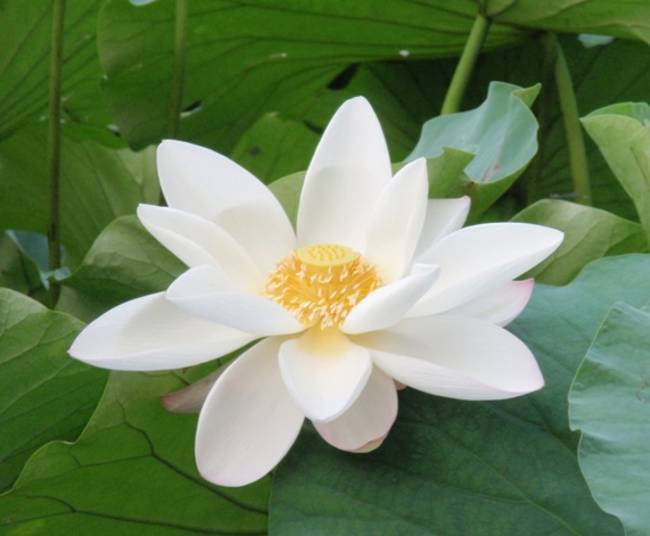
White lotus
Image by Haha169 © public domain
The future destiny of Mahā-bala’s soul as a Jina is announced to the mother when she experiences the 14 auspicious dreams. These are dreamed by all women who bear the Jinas.
During her pregnancy, the mother develops a fancy for flowers of all sorts. She gets her wish and in due course gives birth to the ‘19th Tīrthaṃkara’. The baby is named Mallī – ‘Jasmine’ – in reference to the pregnancy whim.
Mallī turns into an extremely beautiful young lady. Through her clairvoyance – avadhi-jñāna – she recognises that her six friends who shared their previous lives as devout monks are in love with her. She uses a device to teach them right behaviour.
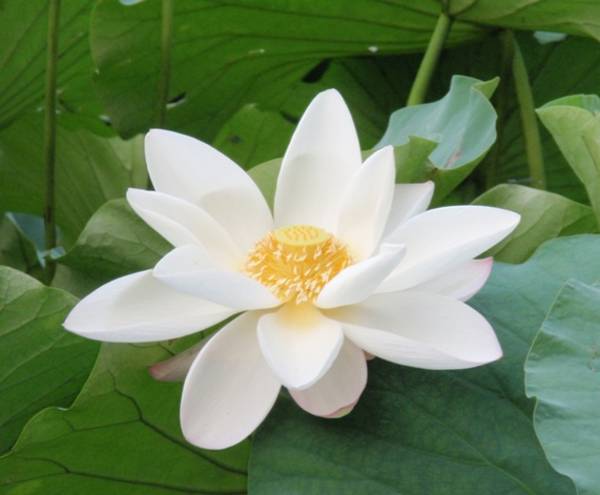
Princess Mallī orders a pavilion to be made, constructed with a central room surrounded by six connected rooms. She commissions a life-size statue of herself to be installed on a pedestal in the central room. The statue is hollow, with a hole at the top. The hole is covered with a lotus. Through this hole, Mallī drops food every day, then covers the hole with the lotus again. After a few days, the rotting food starts to stink.
The six kings come to Mallī’s father asking to marry her. This part of the story has distinct incidents for each of the kings, with new characters coming into the tale.
Rebuffed by Mallī’s father and feeling humiliated, they all decide to attack and besiege Mithilā, his capital city.
Mallī advises her father to tell each of the kings that she will marry him, and that he should come at night to the pavilion. Messages are sent separately to each of them. Each of the kings arrives and is directed to a different room in the pavilion. When the king arrives he is overwhelmed by the beauty of Mallī but he sees the statue instead of the living woman. When Mallī herself enters, she removes the lotus cover. The princes are disgusted by the stench that billows from the lovely statue. Mallī explains that in the same way the body is bound to deteriorate and therefore one should not feel love or attachment to it. She recalls facts of their common previous births, which they remember fully when she talks of it.
Mallī decides to renounce worldly life. Designated so far in the story as ‘Princess Mallī’ or ‘this Mallī’ with feminine gender, she is now called:
- ‘Mallī the Arhat’
- ‘Mallī the Jina’
- Mallinātha or Lord Malli.
The six kings put their sons in charge of their kingdoms and follow the same path.
The further stages of Mallī’s career are the usual ones for a Jina’s life.
Two unusual details are noteworthy, however. These relate to the periods of time that a Jina usually spends in certain activities. The Jina Malli:
- spends only a very small part of her life as a princess, namely 100 years out of a total of 55,000
- takes initiation and reaches omniscience on the same day so there is no period as a wandering mendicant between the two events, and also no period of testing, which involves possible challenges to asceticism.
Digambara life of Malli
The earliest and standard Digambara biography of the 19th Jina is found on pages 305 to 312 of the 1968 edition of Guṇabhadra’s comprehensive 9th-century work Uttarapurāṇa. Another very similar version is that of Puṣpadanta’s Mahā-purāṇa, written in the 10th century in Apabhraṃśa Prakrit (Roth 1983: 51–57).
As an individual biography, Sakalakīrti’s Mallinātha-purāṇa can be mentioned. Written in Sanskrit in the 15th century, it is basically the same, but has an interesting passage. This describes how deluding karmas – mohanīya-karmas – can be beaten by worshipping the ‘three jewels’ with the help of a diagram – yantra.
In all the Digambara biographies, the masculine gender is always used for the name Malli and the epithets that go with it.
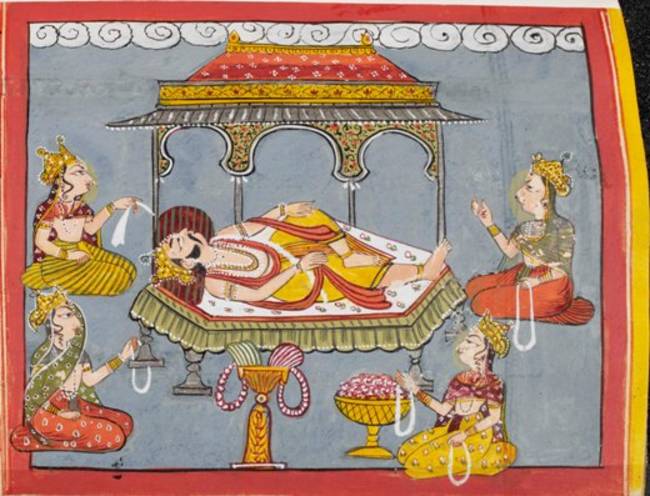
Previous birth – an exemplary ascetic
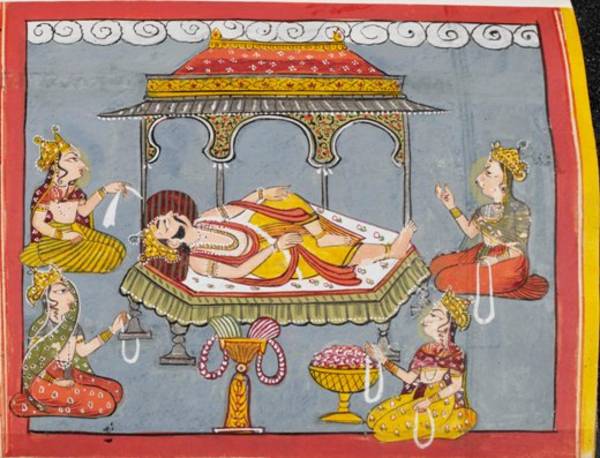
Heavenly pleasures
Image by British Library © CC0 1.0 (Creative Commons Public Domain)
King Vaiśravaṇa of Vītaśoka goes to a forest, where he sees a magnificent tree and thinks it is a good comparison for him. When he comes back later, the tree has been struck by lightning and is now totally destroyed.
He realises that change and impermanence characterise all things and make them lose their power and beauty. The king puts his son on the throne, goes to a monk and takes initiation.
The former king is a perfect ascetic and forms for himself the karma that leads to future rebirth as a Jina. However, before this he is reborn among ‘Unsurpassable gods’ – Pañca Anuttara – in the heaven called Aparājita.