Basic information
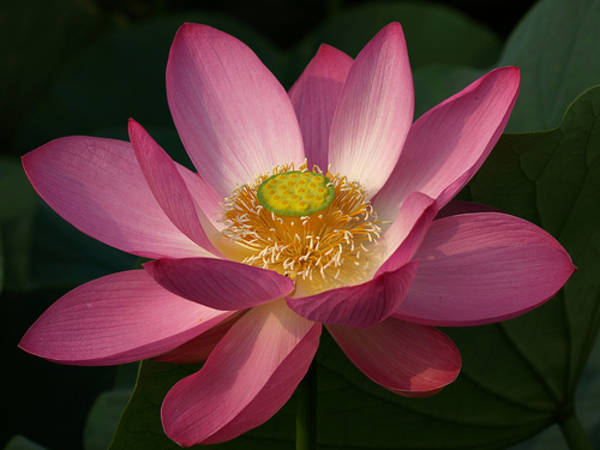
Red lotus
Image by inoc © CC BY 2.0
Each Jina has standard biographical information found in various sources. Among the earliest Śvetāmbara canonical sources that provide biodata of all the 24 Jinas is the final section of the fourth Aṅga, the Samavāyānga-sūtra and the Āvaśyaka-niryukti. Among the earliest Digambara sources is a cosmological work, the Tiloya-paṇṇatti.
The standard Digambara biography of Padmaprabha-svāmin or Lord Padmaprabha is found on pages 33 to 38 of the 1968 edition of Guṇabhadra’s Uttarapurāṇa in Sanskrit and Hindi. The standard Śvetāmbara biography is on pages 1288 to 303 in volume II of Johnson’s English translation of Hemacandra’s work, Tri-ṣaṣṭi-śalākāpuruṣa-caritra.
The biographical data can be categorised in a standard manner, and includes numbers, which are significant in wider Indian culture. These standard details can also be used to identify individual Jinas in art, since they are usually depicted as stereotyped figures. Pictures or statues of Jinas present them in either the lotus position or the kāyotsarga pose. Both of these imply deep meditation.
Parents
The important feature of a Jina’s father is that he is a king, from the kṣatriyacaste.
A Jina’s mother has an important role because she gives birth to a future Jina, and in practice a Jina is often called ‘the son of X’. Another reason for her importance is that the names given to the various Jinas are said to originate either in pregnancy-whims or in a dream their mothers had, at least in Śvetāmbara sources. This dream is specific, and adds to the traditional auspicious dreams that foretell the birth of a child who will become a Jina.
In the case of ‘Padmaprabha’, it is said in Śvetāmbara sources that his mother had a fancy for a couch of red lotuses – padma – while he was in her womb.
|
Mother |
Father |
|---|---|
|
Susīmā |
Dhara – Śvetāmbara |
Places
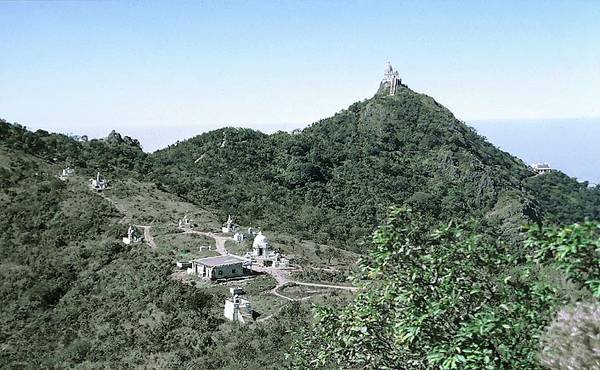
Mount Sammeta
Image by Takeo Kamiya © Takeo Kamiya
Of the five auspicious events that mark a Jina’s life – kalyāṇakas – four take place on earth and are associated with a specific village or town in the sources. Archaeological evidence often helps to identify the old names with modern places. Even when it is lacking, there is a tendency to carry out this identification process. Associating auspicious events with certain locations makes these places sacred to Jains, so that they are potential or actual pilgrimage places and temple sites.
|
Last incarnation and birth place |
Initiation and omniscience |
Emancipation |
|---|---|---|
|
Kauśāmbī |
Sahasrāmravana |
Mount Sammeta |
Now a village, Kauśāmbī used to be an important capital in ancient India. It is located on the northern bank of the river Yamuna, about 60 kms from Allahabad in Uttar Pradesh. Its existence and connection with this Jina are recorded and praised in the Vividha-tīrtha-kalpa, a 14th-century work on sacred places by the Śvetāmbara monk Jinaprabha-sūri. He devotes section 12 of his collection to it. According to him, a temple dedicated to this Jina contained an image of Candanabālā, who gave proper food to the 24th Jina Mahāvīra so that he could break his long fast.
Dates and numbers
The five auspicious events that mark a Jina’s life – kalyāṇakas – are traditionally associated with a specific date. This is given according to the system of the Indian calendar:
- month
- fortnight
- day in the fortnight.
Astrological considerations also play a role here and the texts normally mention the constellations when an auspicious event takes place.
|
Last incarnation |
Birth |
|||
|---|---|---|---|---|
|
6th day of the dark half of Māgha |
|
13th day of the dark half of Kārttika |
full moon of Caitra |
|
The dates associated with these events are potential or actual dates of commemoration. These may be marked in festivals, which determine the Jain religious calendar.
There may be variations in the dates in different sources, Śvetāmbara on one side, Digambara on the other. But there are also cases of differences within the same sectarian tradition.
There are also other numbers connected with the life of this Jina.
|
Height |
Total lifespan |
|---|---|
|
250 bows |
30,00,000 pūrvas |
Monastic and lay communities
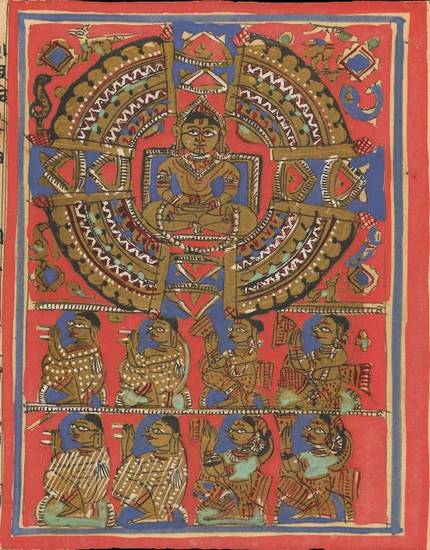
Universal gathering and fourfold community
Image by British Library © CC0 1.0 (Creative Commons Public Domain)
A Jina is not an enlightened being who exists alone after reaching omniscience. After perfect knowledge comes general preaching – samavasaraṇa. This sermon, which is attended by all, is reported in the scriptures as resulting in large numbers of listeners being inspired. Many turn to religious life, becoming monks or nuns, while many others make the vows that lay people – śrāvaka and śrāvikā – can follow in their everyday lives. Further, the Jina’s teachings are preserved and passed on by his chief disciples – the gaṇadharas. This is why a Jina is also called a Tīrthaṃkara, meaning ‘ford-maker’ or ‘founder of a community’.
Each Jina establishes a ‘fourfold community‘, led by the chief disciples. Made up of monks, nuns, lay men and lay women, the fourfold community follows the principles the Jina has set out in his preaching. How members follow the religious teachings vary according to whether they remain householders or take initiation into mendicancy. Individual figures relating to each Jina are thus important.
|
Chief disciples |
Monks |
Nuns |
Lay men |
Lay women |
|---|---|---|---|---|
|
107 led by Suvrata – Śvetāmbara |
336,000 – Śvetāmbara |
420,000 – Śvetāmbara |
276,000 – Śvetāmbara |
500,005 – Śvetāmbara |
Identification
All Jinas have individual emblems – lāñchanas – and colours that help to identify them in artwork. They also have attendant deities known as yakṣa and yakṣī, who often appear flanking them in art.
|
Colour |
Emblem |
Yakṣa |
Yakṣī |
|---|---|---|---|
|
red |
red lotus |
Kusuma – Śvetāmbara and Digambara |
Acyutā – Śvetāmbara |
More details
Besides the basic information, the sources provide more details on various topics. These are almost infinite and vary depending on the sources. Such information differs between Śvetāmbaras and Digambaras. Here are only a few instances of extra detail.
All of the princes who become Jinas are carried on a palanquin to the park where they perform the ritual gesture of initiation into monastic life – dīkṣā. The palanquin of Padmaprabha-svāmin or Lord Padmaprabha is named Nirvṛttikarā. On this occasion, he is accompanied by numerous kings.
He performs a two-day fast. The next day he breaks his fast at the house of King Somadeva in the town of Brahmasthal.
Padmaprabha wanders for six months as an ordinary ascetic and reaches omniscience under a banyan tree.
Events, stories and hymns

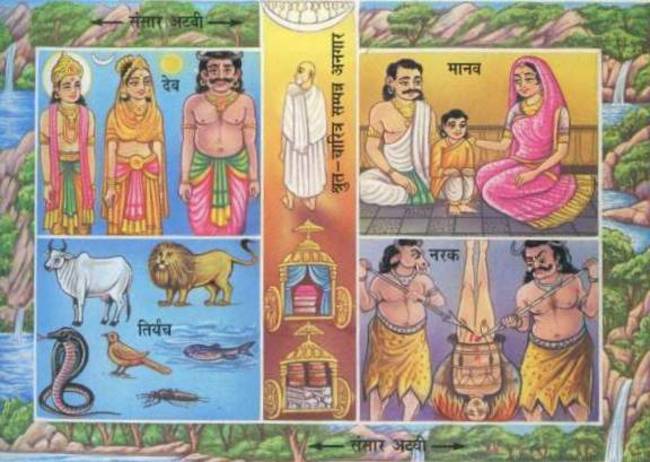
Four types of existence
Image by Diwakar Prakashan / Padma Prakashan © Diwakar Prakashan / Padma Prakashan
The life of Padmaprabha-svāmin or Lord Padmaprabha is almost eventless. In the 9th-century Lives of the 54 JainGreat Men – Cauppaṇṇa-mahāpurisa-cariya – written in Prakrit by the Śvetāmbara monk Śīlānka, the chapter about the sixth Jinais amplified by a long description. The Jina’s general assembly – samavasaraṇa – after he has reached omniscience is described in great detail.
In the 12th-century Sanskrit text Tri-ṣaṣṭi-śalākā-puruṣa-caritra, written by Hemacandra, has become the standard Śvetāmbara version of the Jinas’ lives. Here Padmaprabha’s life story is enlarged through a long sermon he delivers after reaching omniscience, which deals with the four modes of existence – gati:
- hell-being
- animal
- human being
- god.
Among individual story works dealing with the sixth Jina, the most important is the Pauma-ppaha-sāmi-cariya – Life of Lord Padmaprabha – written in Prakrit in 1197 CE (1254 of the Vikrama era) by the Śvetāmbara monk Deva-sūri (Pagaria 1995). He belonged to a relatively minor monastic order, the Jālihara-gaccha. The life stages of the Jina are the same as in other Śvetāmbara works, but the narrative is inflated with embedded stories that feature independent characters showing the doctrine in practice or illustrating the Jina’s teachings.
Padmaprabha is mainly praised alongside other Jinas in hymns dedicated to the 24 Jinas. One instance is the devotional song dedicated to this Jina in the Gujarati set of hymns composed by Yaśo-vijaya in the 17th century. This example can be found among the manuscripts digitised on JAINpedia.
Temples and images
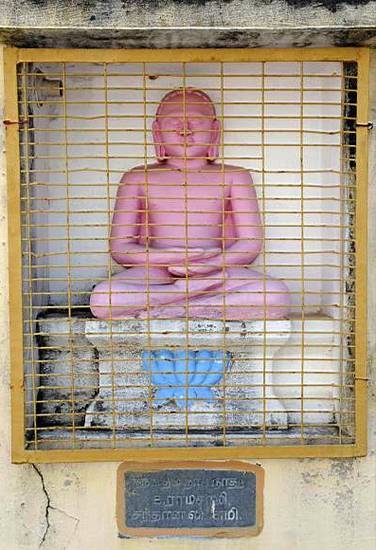
Padmaprabha image
Image by Ramesh Kumar © Jain Sites in Tamilnadu
Padmaprabha-svāmin or Lord Padmaprabha is not one of the most popular Jinas. Yet he is known through a number of stone sculptures (Shah 1987: 138), such as:
- 11th-to 12th-century images in temples in north India
- a standing image from Narwar in the Shivpuri Museum, Madhya Pradesh
- rock-cut images in caves 8 and 9 of Khandagiri, Orissa
- a wall sculpture in a rock-cut cave at Kuppalanatham in Madurai district, Tamil Nadu
- a figure flanked by yakṣa and yakṣī in the Bhaṇḍāra Basti at Shravana Belagola
- sculptures in the western Indian temples of Vimala Vasahi at Mount Abu and at Kumbharia in Gujarat.
Metal images showing Padmaprabha alone or with other Jinas are also available in temples and museums.
In these examples the Jina is identified either through an inscription or his emblem, or both.