Definition
A temple-city is a term for a large number of temples built very closely together. Jain temple compounds tend to contain a multitude of major temple buildings and minor shrine structures. Dense accumulations of such compounds are then referred to as temple-cities. Usually found in sites of religious importance, these are not conventional cities, because human beings do not live in them. Instead, Jains make pilgrimages to these temple-cities, which are devoted to spiritual matters.
Jain temple complexes are frequently altered and enlarged and there is no rule or convention as to when a large number of temple compounds can be described as a temple-city.
Architecture
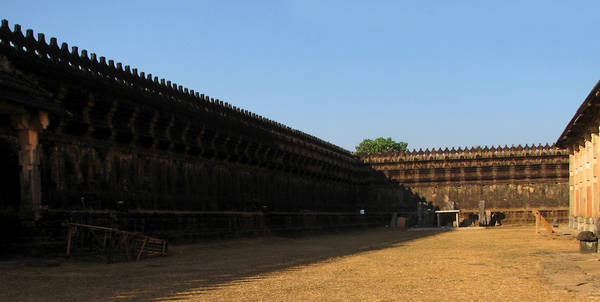
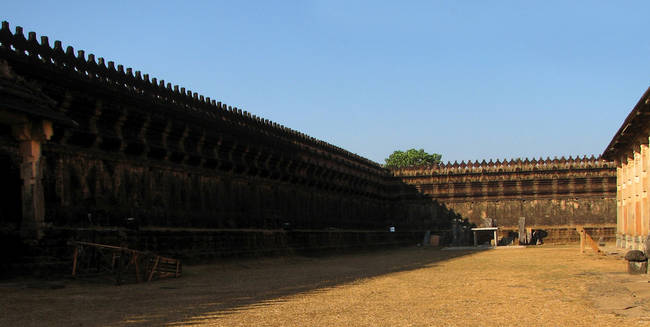
Walls of a temple compound
Image by Eric.Parker © CC BY-NC 2.0
There is a clear tendency in Jain temple architecture towards creating numerous shrines. This leads to the construction of temple buildings with many shrines and storeys, which are often surrounded by further free-standing and interconnected shrines. These collections of religious buildings frequently combine temples of different forms.
The religious buildings are regularly grouped into compounds and surrounded by high protective walls – prākāras. The enclosing walls can consist of uninterrupted lines of small shrines – deva-kulikās – which form a solid wall on the outside. The walled complexes – tunks – are strongly fortified. They have massive gateway structures and can be securely locked.
Location
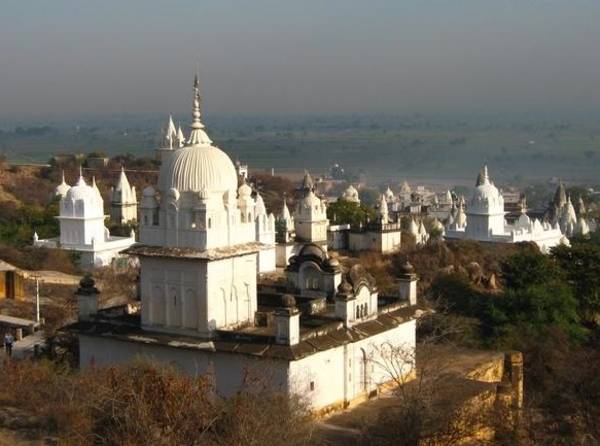
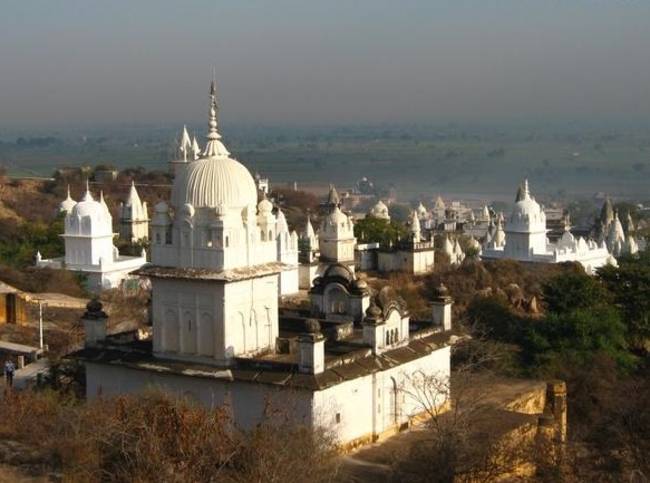
Temples at Sona-giri
Image by nkjain © CC BY-SA 2.0
By building several such walled compounds in one place, the Jains create so-called temple-cities at particularly important sites of pilgrimage. These sacred cities can contain several hundred temples and smaller shrines.
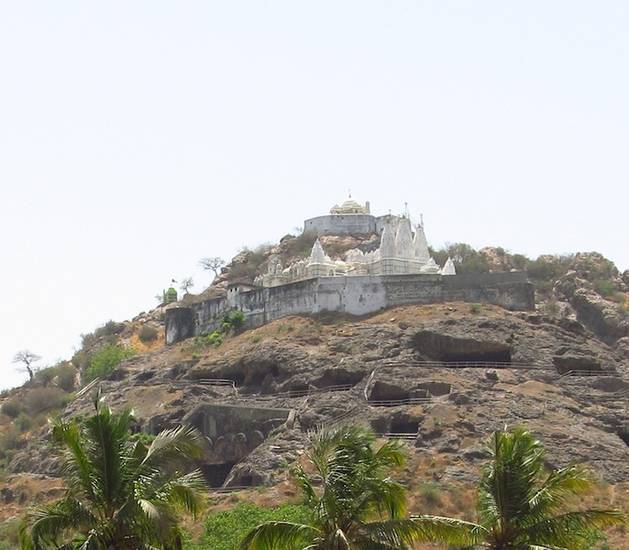
Many temple-cities are on raised ground or high mountain peaks. This is frequently indicated in their names, which bear the suffix ‘-giri’ – hill. Examples include Drona-giri and Naina-giri in Central India.
Visiting temple-cities
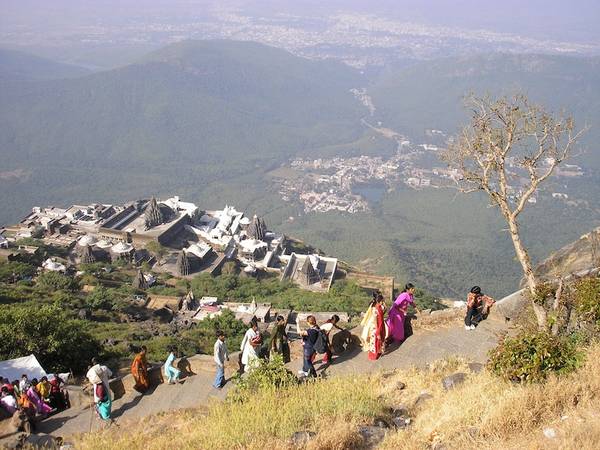
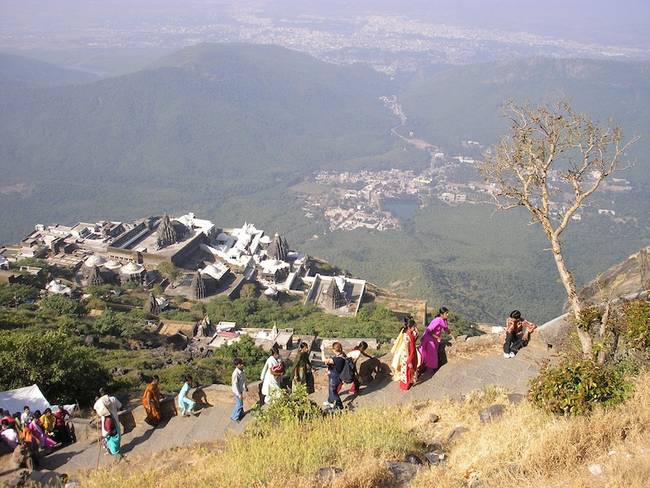
Pilgrimage at Girnar
Image by gatomato © CC BY-NC-SA 2.0
No human beings live in the temple-cities. There are no shops and houses, and no streets inside the cities. Therefore the temple-cities are not cities in a domestic or commercial sense.
Pilgrims and priests climb the hills in the morning, venerate the statues, clean the compounds and descend to their accommodation at night. People visiting the city walk barefoot on small, usually paved, paths, so that they can follow the concept of ahiṃsā – non-violence – and avoid stepping on minute creatures.
Many temple-cities contain large sub-complexes and group their temples into smaller sets. This helps pilgrims to find their way, since they usually visit the individual temples of a sacred site in an organised and ritually prescribed sequence. These temple clusters are regarded as pure spheres, which aid meditation and the development of a detached attitude towards the physical world. Focusing on spiritual progression instead of material concerns is what Jains should aim to do.
Development
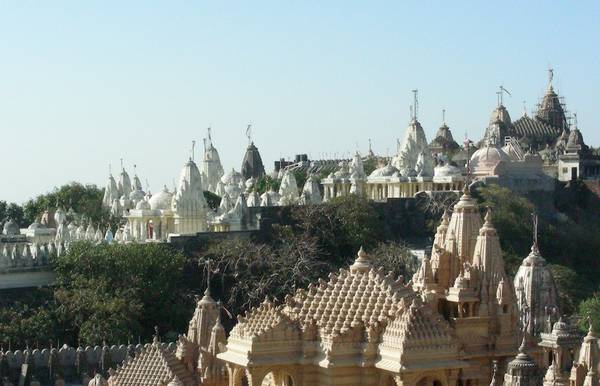
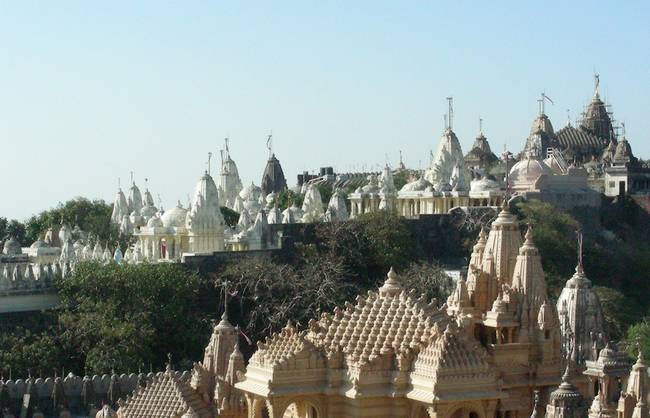
Temple-city of Mount Shatrunjaya
Image by liketearsintherain – tommy © CC BY-SA 2.0
Temple-cities have developed from the Jain custom of constructing many shrines close together. Temples and shrines are built with donations from lay Jains, who gain spiritual merit from this act. Holy sites that have special religious significance attract many donations over the centuries, meaning that popular pilgrimage centres are frequently very large and may well be described as temple-cities. A temple-city may develop from just two original temple compounds next to each other.
The various temples and shrines that comprise a temple-city are probably built over some time, rather than all at once. The buildings may therefore display a variety of architectural styles. Donors express their devotion by giving money towards the construction of impressive temples and entire temple-cities. Such donations also glorify the Jain religion and the 24 enlightened saintly teachers, the Jinas or Tīrthaṅkaras.
There is a smooth transition from a number of tightly grouped temple compounds to the creation of substantial, fully-fledged temple-cities. The more statues and donations a sacred site receives, the more it expands and comes closer to the ideal of the temple-city.
In many instances, this process starts with just two neighbouring temple complexes. In such cases, one is often administered by the Śvetāmbara sect and the other by the Digambara community. This is the case at Taranga and Idar, both located in Gujarat. However, double complexes do not only exist at jointly managed Jain sites. There are examples where two Śvetāmbara complexes are next to each other, as may be seen at Bikaner in Rajasthan.
Temple-cities across India
The development from temple compounds towards the creation of complete temple-cities can be found in all regions of India. The most famous temple-cities are the principal pilgrimage sites in the Jain faith.
North-western India

Temple complex at Talaja
Image by Mv.shah © CC BY-SA 3.0
In the north-west of the subcontinent there are adjacent Jain compounds in several places. In Rajasthan neighbouring temples number:
- three at Rānakpur
- four at Mirpur
- five at Kumbharia
- six on Mount Ābū.
The latter case also illustrates the location of such clusters of large temple complexes on the summit of a hill. A further good example is the hill at Talaja in Gujarat, which consists of a great number of tightly grouped temple compounds.
The largest concentrations of temple compounds can be found on the sacred mountains of Girnār and Śatruñjaya, both in Gujarat. On Mount Girnār, near Junagadh, there are about six substantial walled complexes and many more stand-alone temples. On Mount Śatruñjaya, near the town of Palitana, between 800 to 900 temples are grouped in about ten substantial walled compounds, covering the two peaks and the valley between. Each of these Jain temple compounds contains a multitude of major temple buildings and minor shrine structures.
North and east India

Peaks of Mount Sammeta
Image by CaptVijay © public domain
The phenomenon of temple-cities can also be studied in the north and east of India. For instance, adjoining large temple compounds are comprised of:
- three at Sauripur in Uttar Pradesh
- four at Manicktolla in the north of Kolkata in West Bengal
- several at Hastinapur in Haryana
- five at Pavapuri in Bihar.
Also in Bihar, the town of Arrah alone accommodates forty Digambara Jain temples in the city centre.
Like other parts of the subcontinent, such accumulations of Jain temples are regularly located on hill tops. At Rajgir in Bihar, caves and temples of different construction styles are found on five sacred hills surrounding this ancient pilgrimage centre. The largest Jain temple-city in the east is the venerated hill site of Mount Paraśnātha. Also known as Mount Sameṭa Śikhara, it has developed near the village of Madhuban in Bihar.
Other examples include the temples and cave temples on:
- Mandar Hill in Bihar
- Pabhosa Hill in Uttar Pradesh
- the twin peaks of Udaya-giri and Khada-giri in Orissa.
Central India
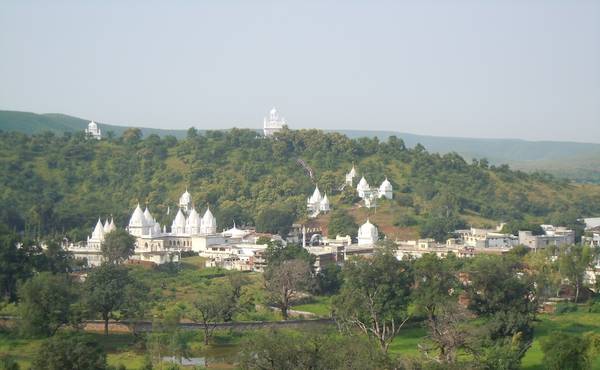
Temple-city of Kundalpur
Image by Adarshj4 © CC BY-SA 3.0
Accumulations of temples are equally popular and widespread in the central region of India.
In Madhya Pradesh, large numbers of temple complexes are found at:
- Mount Cūla-giri
- Deogarh
- Khajuraho
- Mandu
- the hill at Pisanhariki Mariya.
In Maharashtra the same phenomenon can be seen at Anjaneri and Ramtek, and on the sacred hills at:
- Gajpantha
- Kumbhoj, also known as Bāhubali Hill
- Maṅgī Tuṅgī.
There is no clear dividing line from where a large number of Jain temple compounds starts to be defined as a temple-city, and temple complexes are regularly enlarged and added to. Sites in the region that can be referred to as fully developed temple-cities are the mountains Droṇa-giri and Nainā-giri, with roughly forty temples each, and Papora and Mount Muktā-giri in Maharashtra with more than fifty shrines each.
At Kundalpur in Madhya Pradesh, the number of temples at one site is even larger, reaching up to sixty. The temples have been arranged around a central lake and on a crescent-shaped ridge enclosing half the lake.
The largest temple-city in the central region of India, however, is Mount Sonā-giri. This site boasts 108 individually numbered temples, spread over hilly terrain near Datia in Madhya Pradesh.
South India
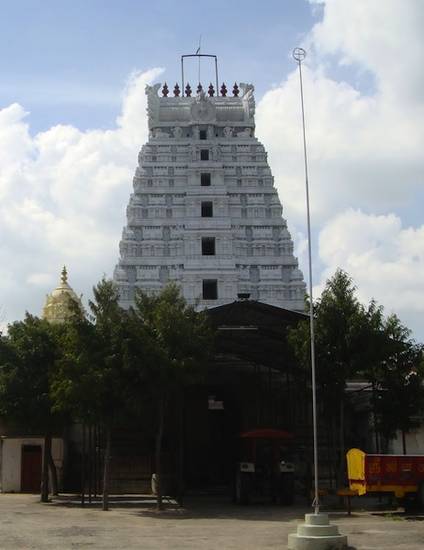
Maṭha in Melsittamur
Image by Vijayan Teacher © CC BY-SA 3.0
It is common practice in the southern Indian states to have many temple compounds at pilgrimage sites.
In the small town of Shravana Belgola in Karnataka, for instance, the Arkaṇṇa Temple group consists of two walled compounds. At Varanga, in the same state, three religious complexes lie side by side, and at the site of Gommateshvara, near Mysore, five fenced sacred areas are grouped on and around the monumental central rock formation.
This tendency to build temple compounds next to each other has also led to the creation of so-called Jain temple-cities in the south. Those on Vindhya-giri and Candra-giri at Shravana Belgola, as well as the temple-city on Tirumalai in Tamil Nadu are dispersed over hill sites, with a concentration of temples towards the peak. The paths leading up the steep hills are lined by religious statues, small shrines and water structures.
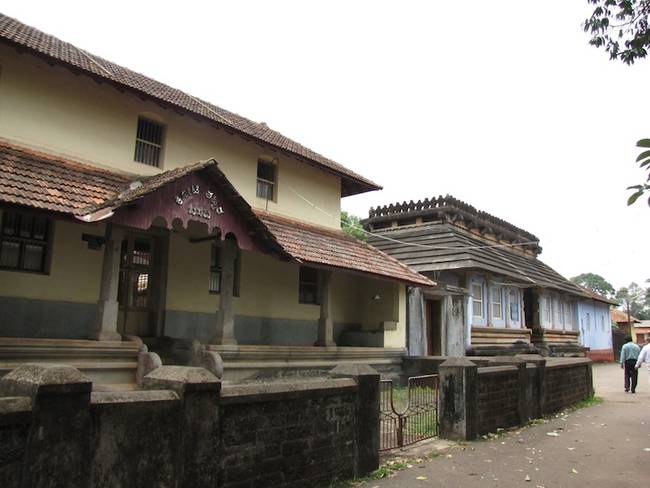
As in other regions, not all Jain temple-cities in the south have been constructed on high peaks. The one at Melsittamur in Tamil Nadu, as well as the substantial Hiriangadi Temple complex at Karkala in Karnataka, have been created on level ground.
Urban temple-cities
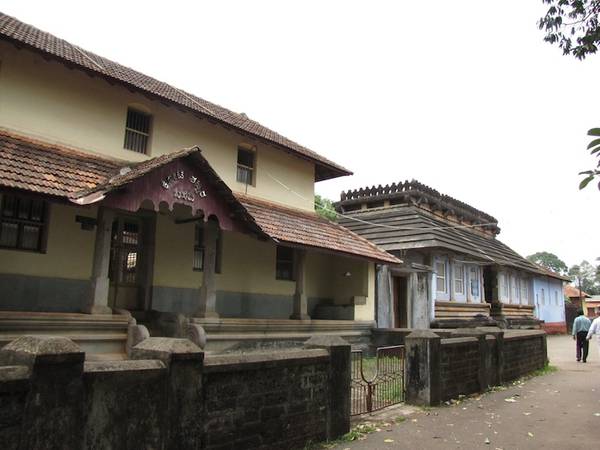
Entrances to Koti Basadi and Guru Basadi
Image by Vaikoovery – Vaishak Kallore © CC BY 3.0
Most Jain temple-cities are relatively isolated. They can be reached from towns or monastic settlements but are usually quite remote sites. An alternative form of the Jain temple-city is a dense complex of walled temple compounds in the centre of a city or in the main Jain quarters of a town.
This kind of urban temple-city can be found in Jaisalmer in Rajasthan, where a large number of Jain temples are very closely grouped inside the old fort. Further examples, also from Rajasthan, are the high concentration of Jain temples in Nadol and Udaipur, where most of the temples are located along just one road.
The compact cluster of Jain temple complexes inside north-western Indian towns, however, can best be studied in Jamnagar and Sirohi, both in Rajasthan. In these towns, large areas have been densely packed with Jain temples, thus creating temple-cities within towns.
This phenomenon can also be observed outside the region of north-western India. For instance, there is a sizeable collection of Jain temples in the centre of Seoni in Madhya Pradesh.
An example of a Jain temple-city that forms the physical centre of an actual inhabited village in the south is Mudabidri in Karnataka. In Mudabidri the so-called Jain temple street runs through the centre of the village and is lined by walled temple complexes on both sides. In addition to the nine major temple compounds along this road, at least another seven large temple complexes are scattered throughout this large traditional south Indian village.
Temple-cities in art

Worlds of gods and saviours
Image by San Diego Museum of Art © CC BY-NC-ND 2.0; Edwin Binney 3rd Collection
Because of the wide popularity and strong sacred associations of temple-cities, they have frequently been represented in Jain art. Artistic representations of temple-cities mainly consist of:
- pilgrimage banners – tīrtha-paṭas
- carved panels in marble
- miniature models.
These sacred objects are displayed and venerated in Jain temples throughout the subcontinent and in temples among the diaspora. Jains study and meditate on these depictions of temple-cities for two main reasons. Firstly, it allows devotees who are unable to make the journey to these often distant pilgrimage centres to gain merit. Secondly, they can mentally visit a sacred site.
Replicas of temple-cities
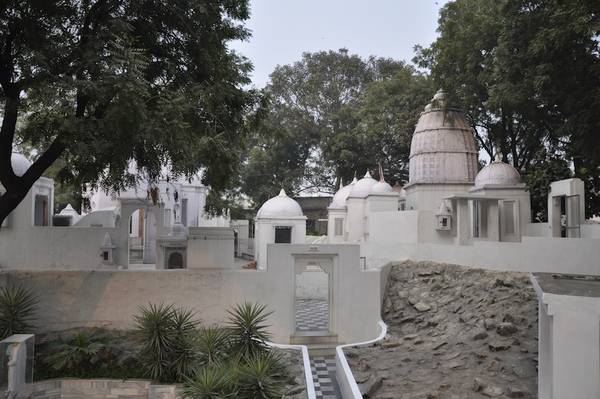
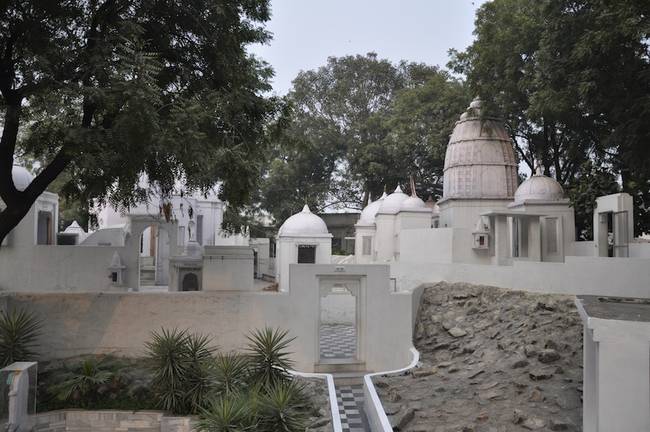
Shrines in the Dādā Baṛā temple compound
Image by rajkumar1220 © CC BY 2.0
It is fascinating that, due to the particular importance and sacredness of certain temple-cities and venerated hills, there are Jain sites throughout India that imitate their layout and shape.
The sacred hill of Mount Bāmaṇavāḍjī in Rajasthan, for instance, which itself has nine large temples and thirty small pavilions – chatrīs – is perceived to be a replica of the sacred Sameṭa Śikhara in Bihar.
Another striking example is the collection of small shrines on raised ground inside the Śvetāmbara Dādā Baṛā Jain temple complex in Delhi. This is said to recreate in miniature form the layout of the famous Mount Śatruñjaya in Gujarat.