Temple attacks and reuse
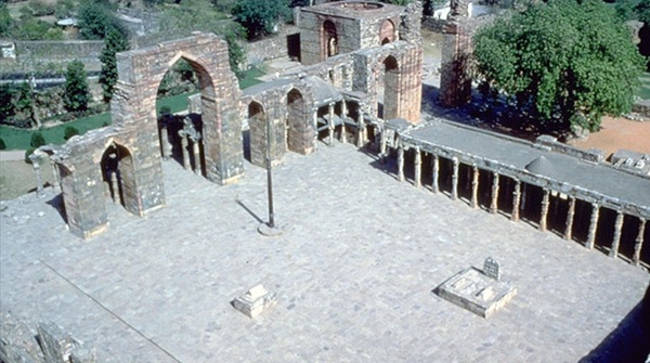
Quwwat al-Islam mosque
Image by Nasser Rabbat © CC BY-NC-SA 2.0
The early Delhi Sultanate rulers occasionally engaged in temple destruction, which had been a political strategy of both Islamic and Hindu kings in India for centuries. Śvetāmbara and Digambara communities alike experienced raids. For example, the key Gujarati pilgrimage site of Shatrunjaya suffered desecration in 1313. In the 15th century, a bhaṭṭāraka in Rajasthan distributed a thousand images across the subcontinent to replace those harmed by Islamic attacks. Jains often viewed these incidents as part of the degradation of the age rather than as religious conflicts.
The sultanates also used parts of ruined Jain temples in their own building projects, such as the Quwwat al-Islam mosque near the Qutb Minar. However, the extent and meaning of such reuse remains heavily debated today.
Trade and politics

Mount Shatrunjaya temples
Image by Amre Ghiba © CC BY-NC 2.0
Despite occasional temple damage, Jains and Muslims generally associated on friendly terms during Delhi Sultanate rule. Strong trading relationships developed between members of the two communities, particularly in Gujarat. These business connections also extended to cultural and political favours.
In the 13th century, Jain merchants already enjoyed good relations with Muslims. For instance, Jagaḍū was a 13th-century merchant from Kachchh, Gujarat, who frequently did business with Muslims. Many details of his life are recorded in the 14th-century Sanskrit biography by Sarvānanda, entitled Jagaḍū-carita – Acts of Jagaḍū. Jagaḍū’s work occasionally raised ethical issues, such as when he profited from animal products that involved violence against living beings. One of the key Jain values is non-violence. Nonetheless Jagaḍū and other Jain merchants forged successful commercial connections with Muslims. They even subsidised the building of mosques in Gujarat for their trading partners.
The Islamic presence increased in western India after Alauddin Khalji’s generals raided Somanatha in Gujarat in 1299. The next few decades witnessed the spread of Sultanate rule in Gujarat, which prompted Jains and Muslims to interact more frequently and amicably. In one instance, Khalji soldiers aroused local resentment by damaging some Jain temples at the pilgrimage site of Shatrunjaya in 1313. Good relations were restored when a Patan merchant and the local Khalji governor jointly financed the temples’ repairs.
Jain traders flourished during Khalji rule both in Gujarat and Delhi. Thakkar Pheru may have been the first Jain to gain a prestigious position at the royal court in Delhi, where he was charged with caring for precious stones and minting coins in the Khalji treasury. Thakkar Pheru also served in this position under Ghiyasuddin Tughlaq.
Monks at the Tuqhlaq court
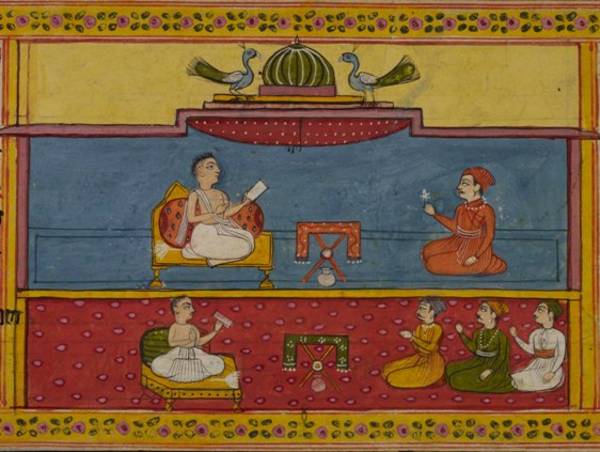
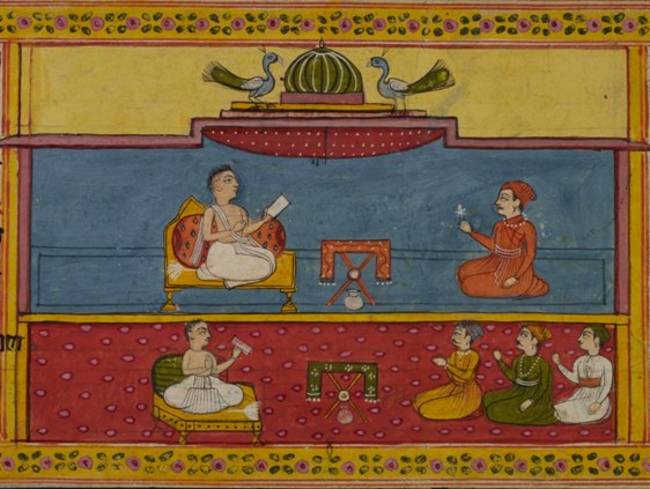
Lay men listen to monks
Image by British Library © CC0 1.0 (Creative Commons Public Domain)
During the 14th century, a monk from the Kharatara-gaccha sect named Jinaprabha-sūri visited the Islamicate court in Delhi. There he met the sultan, Muhammad bin Tughlaq, several times. Jinaprabha personally described these encounters in his Vividha-tīrtha-kalpa – Guidebook to Various Pilgrimage Places. Jinaprabha converted his imperial influence into royal favours for the Jain community, beginning a pattern continued by Jain monks who gained political support from Mughal rulers.
In their first meeting, Jinaprabha impressed Muhammad bin Tughlaq with his eloquent poetry and sharp debating skills. The Tughlaq ruler rewarded Jinaprabha and his companion, Jinadeva, with many gifts, a lavish ceremony and a formal order granting protection to all Śvetāmbara Jains.
In later meetings, Jinaprabha secured:
- assurances of safety for pilgrimage sites
- the discharge of prisoners
- the return of an image of Mahāvīra held in the sultan’s treasury.
Jinaprabha eventually left the court and headed south. He may have subsequently come across Muhammad bin Tughlaq on the road and accompanied the sultan on a military campaign. A contemporary of Jinaprabha narrates these later events.
Many Jain authors retold Jinaprabha’s experiences at the Tughlaq court, often with creative embellishments. For example, a Prakrit collection of stories called Vṛddhācārya-prabandhāvalī – Accounts of the Eminent Teachers – narrates that Jinaprabha exorcised a demon from Muhammad bin Tughlaq’s wife. An undated prabandha work changes the sultan to Firuz Shah, Muhammad bin Tughlaq’s successor, and claims that Jinaprabha nearly converted the Muslim ruler to the Jain faith.
This same text also questions the appropriateness of ascetics visiting a royal court. Mendicants renounced earthly concerns upon their initiation, and kingly courts were hubs of worldly affairs. This tension was a common issue for Jain monks who had relations with rulers of all religious faiths.
Cultural impacts on Jains
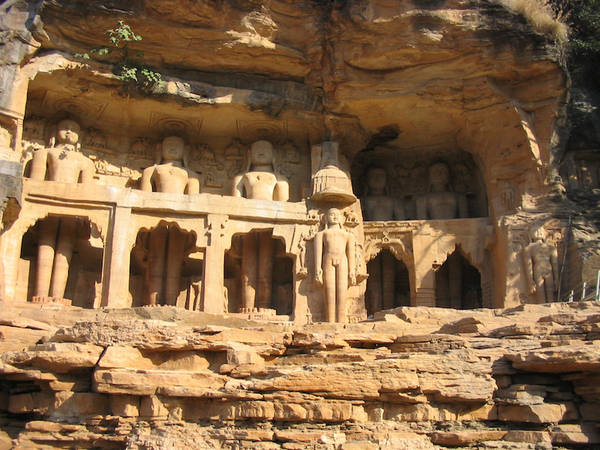
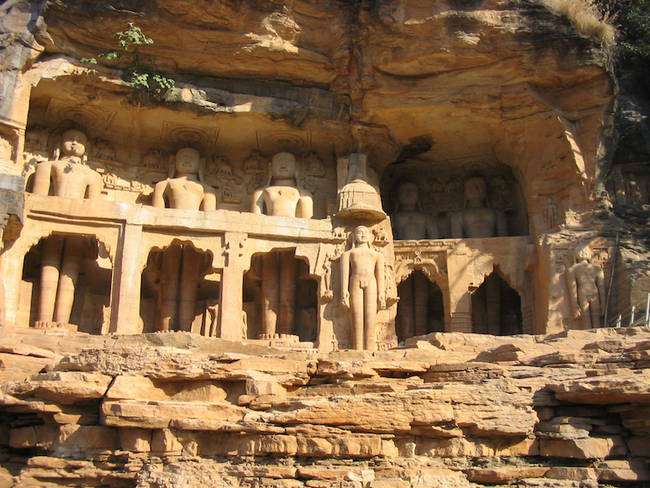
Figures of Jinas
Image by YashiWong © CC BY-SA 3.0
During the Sultanate period, relations with Muslims had notable effects on the Jain cultural sphere. Jains wrote about various features of the Islamicate world and began incorporating aspects of Persianate culture into Sanskrit texts. In addition, Jains responded in material forms to the Islamic practices they encountered.
Jains authored numerous texts that emerged from their exposure to Islamicate traditions. For example, the monk Jinaprabha has been attributed with as many as three works that use Persian extensively. The Śāntināthāṣṭaka remains enigmatic but is described as a ‘Persian-language citrakāvya‘. The other two texts are:
- a one-stanza Persian praise to a Jina accompanied by a commentary
- an 11-verse hymn to Ṛṣabhanātha or Lord Ṛṣabha, the first Jina.
Scholars have fruitfully analysed these works to show that, though written grammatically in Persian, they also conform to Sanskrit metrics. Therefore these two works have a peculiar position as truly cross-cultural projects.
Jains also produced various technical treatises that reflect their ties with Islamic culture. In 1365, Salakṣa crafted the first bilingual Sanskrit–Persian dictionary. Entitled Śabda-vilāsa – Play of Persian – it was sponsored by a regional Rathod ruler in Gujarat. The Jain monk Mahendra-sūri spent time at the court of Firuz Shah Tughlaq and authored the first Sanskrit treatise on astrolabes, called Yantra-rāja – King of Instruments – in 1370. His pupil, Malayendu-sūri, added a commentary to the work in 1382.
Jains were also responsible for some of the earliest historical kāvyas that feature Muslims as major actors. For example, Nayacandra’s Hammīra-mahākāvya – Great Poem on Hammira – written around 1420, describes Alauddin Khalji’s military exploits in Rajasthan. Like many of his contemporaries, Nayacandra presents Islamic military victories as part of the inevitable depravity in the Jain conception of cyclical time.
Beyond texts, scholars have suggested that certain Jain building projects were also responses to Islamic authority. For instance, Digambara Jains carved a series of colossal statues of the Jinas at Gwalior, Madhya Pradesh, in the 15th century. These monumental images may have been designed to survive the end of the world, which was being ushered in by Islamic rule.