
Festival of Āyambil Oḷī
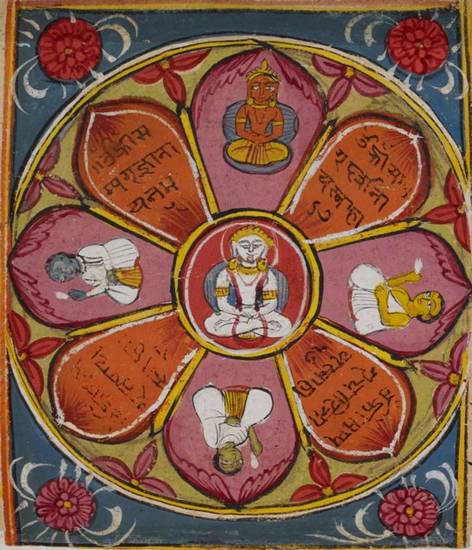
Siddhacakra
Image by British Library © CC0 1.0 (Creative Commons Public Domain)
Each year the Āyambil Oḷī festival falls in the spring during Caitra bright 7 to 15 and in the autumn during Aso bright 7 to 15. The autumn festival is celebrated by more people, in part because at that time of year Jain mendicants frequently stay near local communities during the rainy season retreat.
Principal themes of the Āyambil Oḷī festival are marital happiness and the good health of all the family. It focuses on religious practices and goals associated primarily with married women, such as the practice of fasting. Therefore it is almost exclusively married women who take part in and concern themselves with this festival.
The Āyambil Oḷī festival is strongly linked to the narrative of Śrīpāḷ and Mayṇāsundarī, the worship of the siddhacakra yantra and the recitation of the Navkar-mantra. Sermons on each of these elements are characteristic of the festival, particularly in the autumn.
Sermons on the siddhacakra
The siddhacakra yantra is a symbolic representation of the nine things worthy of worship in the Jain tradition. Each of the nine days of the festival is strongly related to one of the nine points on the siddhacakra. Mendicants often structure their sermons to reflect on the particular part of the siddhacakra being venerated on that day. For example, the first position is Arhat – the enlightened ones – and the sermon on that day might focus on the nature of the arhats.
Sermons on the Navkar-mantra
The siddhacakra is the visual form of the Navkar-mantra. Most Jains recite this mantra daily and it is considered a key Jain religious practice. If there is a mendicant in residence, he will give a daily sermon about the power of the Navkar-mantra and retell the Śrīpāḷ and Mayṇāsundarī story.
Tale of Śrīpāḷ and Mayṇāsundarī
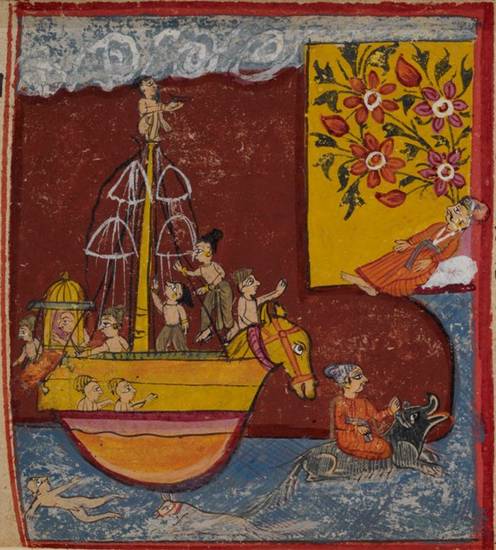
Śrīpāla’s adventures
Image by British Library © CC0 1.0 (Creative Commons Public Domain)
Jain ascetics often give the example of Śrīpāḷ and Mayṇāsundarī when they deliver a sermon on the siddhacakra. They concentrate on Mayṇāsundarī’s performance of the Navpad Oḷī Fast, which leads to the miraculous healing of Śrīpāḷ’s leprosy.
This narration echoes the preoccupation of the festival, which is marital happiness. It does not reproduce the structure of the epic – Śrīpāḷ Rājāno Rās – from which it is drawn, which includes many episodes tracing Śrīpāḷ’s adventures after he is healed.
Fasting

Woman praying
Image by Chandu Shah © Chandu Shah
A major element of the twice-yearly Āyambil Oḷī festival is the fast, of which there are three types. Fasting is accompanied by a structured series of additional devotional and ascetic practices, including twice-daily confession, extensive temple worship focused on the siddhacakra yantra, recitation of the Navkar-mantra and study of the Śrīpāḷ and Mayṇāsundarī narrative.
Each day the participants gather for the better part of the afternoon to eat their single meal together, to study the story of Śrīpāḷ and Mayṇāsundarī and to perform the evening confession as a group. This sociability contrasts with the ascetic nature of these practices and, in this case, the tasteless food.
Generally, this fast is seen as a married women’s fast. While there are men who perform occasional, single-day āyambil fasts they virtually always do so at the behest of their wives. This almost imitates Śrīpāḷ’s performance of siddhacakra worship after his wife Mayṇāsundarī convinces him.
Types of fast
Within the Āyambil Oḷī fast complex, there are three related fasts. Each suggests varying degrees of commitment, but all are understood to aim at the shared goal of well-being of the family. The fasts differ primarily in terms of their length:
- a single āyambil fast
- the nine-day Āyambil Oḷī
- the Navpad Oḷī, which is a series of nine āyambil olīs.
An āyambil fast is a one-sitting fast involving the eating of only tasteless foods. It is therefore more of a restriction on diet than a fast as it is generally understood. The fact of the lack of taste, of course, makes the austerity of an āyambil fast substantially greater than a one-sitting fast of regular food.
Āyambil fasts are predominantly performed during the biannual nine-day Oḷī festival, but are also performed on those days where fasting is a requirement for Jains. Many mendicants take nearly constant āyambil vows. Lay Jains will sometimes take an āyambil vow so that mendicants can receive alms at their house.
Oḷī means ‘a line’ and the Āyambil Oḷī fast is a line of nine days of āyambil fasts performed back to back during the Āyambil Oḷī festival.
The Navpad Oḷī is a series of nine consecutive nine-day Āyambil Oḷīs performed during the spring and autumn Āyambil Olī festivals. This results in 81 days of āyambil fasting over four and a half years.
Religious importance of the fast
Jains believe that the vows of fasting, together with the twice-daily confessions and the worship of the yantra, reduce the flow of karma into the performer’s soul and destroy her existing karma. They are also powerful forces that help protect the health of the performer’s family, especially her husband, through a transfer of merit or through magical agency.
Effects of Āyambil Oḷī

Equipment for religious rituals
Image by Ravin Mehta © Ravin Mehta
Traditionally, Jains believe that the āyambil fast and the worship of the siddhacakra, especially during the Āyambil Oḷī festival, promote marital happiness and the healing of skin diseases. The protection of general good health for all the family is another traditional benefit. These claims are drawn directly from the Śrīpāḷ and Mayṇāsundarī story.
Jains’ confidence in the effectiveness of the various āyambil fasts in worldly matters may arise from the siddhacakra worship as presented in the tale of Śrīpāḷ and Mayṇāsundarī and the other rituals associated with the fasts. It is vital to recall that the siddhacakra serves as both a powerful mantra and a yantra. In addition, Jains believe that both the siddhacakra and the Navkar-mantra it illustrates have magical powers. A Jain can harness these powers by reciting the mantra and worshipping the siddhacakra. The mantra is said to have the following powers:
- to protect the chanter from harm
- to counteract the negative effects of making contact with inauspiciousness
- to stand in for all other ritual utterances.
Jains often bless themselves with the water used to bathe religious icons or symbols used in daily or special worship, which they believe can prevent and cure skin diseases. However, Jains do not think that the water has gained its sacred powers from the Jinas because honouring them in rites of worship does not include expecting favours to be granted. Instead, Jains consider that this water has got its powers from flowing over the magical siddhacakra.
Thus there are connections between the tantric powers of mantra and yantra, as expressed in a Jain context through the siddhacakra, and the worldly effectiveness of a fast. The magical power of the yantra allows the fast to work on a worldly level while the fast also works on the level of karma reduction at the same time.