Scriptures
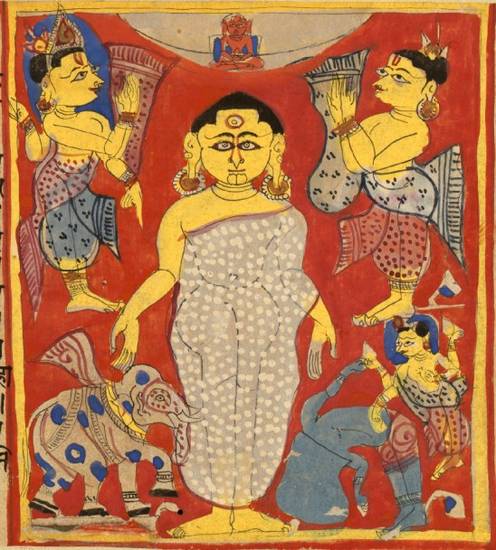
Right monastic behaviour
Image by Victoria and Albert Museum © V&A Images/Victoria and Albert Museum, London
Several key holy texts are highlights of the manuscripts on JAINpedia.
The Kalpa-sūtra is the best-known book of the Śvetāmbara sect. Written in Ardhamāgadhī Prakrit, the Kalpa-sūtra features:
- biographies of the Jinas
- lineages of early Jain teachers
- monastic rules for the rainy season.
It is surely the Jain work that has produced the largest amount of illustrated manuscripts. There are several examples on JAINpedia showing a variety of pictorial styles.
The British Library I.O. San. 3177 and the manuscript Gamma 453 in the Wellcome Library are remarkable specimens from the 15th century that use calligraphy, golden or silver ink, and coloured papers. In contrast, the manuscript Or. 13701 is an example of informal style with Mughal costumes and cursive script. All the other Kalpa-sūtras deserve interest in their own right as they are finely executed artefacts.
The Uttarādhyayana-sūtra is one of the most famous and fundamental books of the Śvetāmbara canon. In Ardhamāgadhī Prakrit, it contains both didactic and narrative material. It is one of the works that have developed an elaborate pictorial tradition. The two complete manuscripts of the Uttarādhyayana-sūtra digitised on JAINpedia offer remarkable paintings. Held by the British Library, the manuscript Or. 13362 and its counterpart in the Victoria and Albert Museum (V&A), with the shelfmark IS 2-1972, are powerful examples of Jain art.
The Āvaśyaka-sūtra, along with its commentary the Āvaśyaka-niryukti, holds central importance in the practice of Śvetāmbara Jains. It includes the:
- homage to the five entities – panca-namaskāra-mantra
- first hymn to the 24 Jinas
- core formulas recited during the repentance ritual – pratikramaṇa.
One of the JAINpedia manuscripts is from the 15th century, which is noteworthy as it is comparatively early. Found in the British Library, the Āvaśyaka-niryukti manuscript with the shelfmark Or. 13550 dates back to 1466.
Considered with its commentaries, the Jītakalpa-sūtra deals with monastic rules and atonements for transgressions. Such works are not commonly found in manuscripts kept outside India. Therefore the two British Library manuscripts on JAINpedia, under the shelfmarks of Or. 1385 and Or. 1386, are notable. Another reason that makes them remarkable is that they are written on palm leaf, a material rarely found in libraries outside India for manuscripts from Western India.
Cosmology
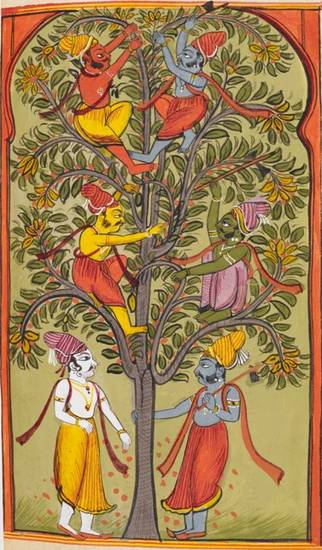
Parable of the tree
Image by British Library © CC0 1.0 (Creative Commons Public Domain)
Writings on the Jain universe form one of the main branches of Jain scriptures. These manuscripts are often illustrated with charts, diagrams and paintings, because visualisation is part of the teaching.
Works of the kṣetra-samāsa variety focus on Jain geography, describing components such as continents, oceans and lands. A good example on JAINpedia is held in the British Library under the shelfmark Add. 26374. The saṃgrahaṇī texts are more concerned with karma and destiny. They deal with the spaces of the Jain universe as places where a soul is reborn, depending on its behaviour. Notable examples presented on JAINpedia are:
- the Victoria and Albert Museum’s IS 2-1984
- the British Library’s Or. 13454
- Or. 13456 in the British Library
- Or. 2116 ms. C, also held in the British Library.
To this genre belong the large cloth paintings called aḍhāī-dvīpas – Two and a Half Continents. These have been executed from the 15th century onwards in Gujarat and Rajasthan. Remarkable aḍhāī-dvīpas on JAINpedia include the IS 6565 held at the Victoria and Albert Museum and several examples in the British Library, with the shelfmarks:
Teaching the niceties of karma is one of the most important topics of the Jain faith. Among the manuscripts digitised on JAINpedia are two remarkable items that deal with karma. They are a:
- full set of a cosmological work, the classic Karma-granthas, and verse commentaries
- fundamental Digambara text, the Karma-kāṇḍa, accompanied by a Persian commentary, held at the Bodleian Libraries, University of Oxford.
Stories
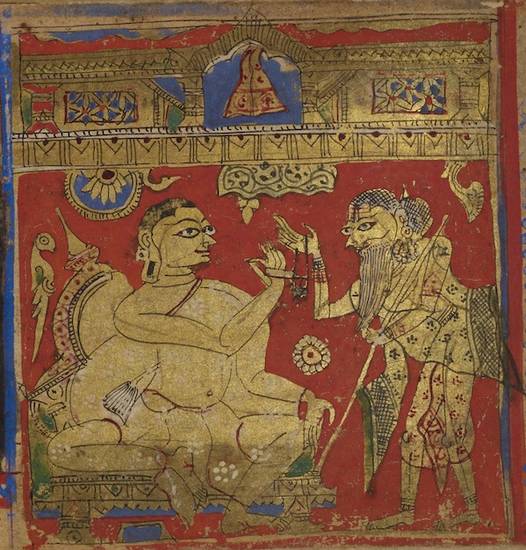
Kālaka with Śakra in disguise
Image by British Library © CC0 1.0 (Creative Commons Public Domain)
From the earliest times tales have been regarded as an essential part of teaching, for all types of audiences. The Jinas themselves recounted stories in their preaching. In the course of centuries, some simple anecdotes have developed into full-fledged works of fiction. Some characters who were just names meant to illustrate a notion have turned into heroes at the centre of novel-like works, undergoing ups and downs, losses and gains. In short, they have become figures that fully illustrate the concepts of karma and rebirth, and also inspiring heroes that hold the reader’s attention.
The most popular Jain heroes and heroines have been the starting point of numerous retellings. They also feature prominently in paintings in the manuscripts, which could be shown and used in festivals or temple-halls.
There are several good examples in manuscripts digitised on JAINpedia, especially the:
- Story of the Teacher Kālaka, often appended to the Kalpa-sūtra, which is connected with the Śvetāmbara festival of Paryuṣaṇ
- Story of Yaśodhara, held in the Wellcome Trust, which illustrates ahiṃsā
- Story of Śālibhadra, found in the British Library, shows the power of giving alms to Jain monks
- Story of Śrīpāla, closely associated with the worship of the siddhacakra
- Āditya-vāra-vrata-kathā in the British Library, a popular story among Digambaras, which relates to the results of observing or not observing the so-called Sunday’s vow.
Jain authors are also famous for their rewritings of non-Jain stories, which are part of the common Indian heritage. Good examples of such illustrated manuscripts digitised on JAINpedia are the :
- Story of Ḍholā and Marū, a folk legend popular in Rajasthan
- Story of Mādhavānala.
Hymns
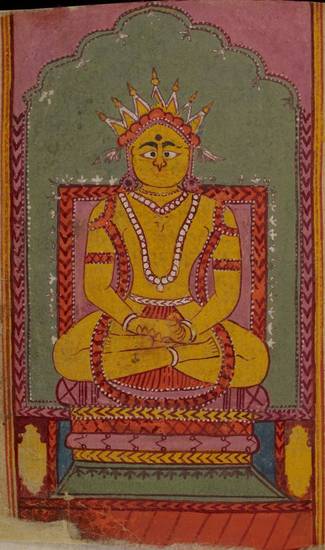
A Jina meditating, probably Supārśva
Image by British Library © CC0 1.0 (Creative Commons Public Domain)
Devotional songs are part of Jain daily religious practice. They have been composed in all the ancient and modern languages of India, including Prakrit, Sanskrit, Gujarati, Hindi and Tamil. Hymns combine text, rhythm and chanting, but also have a visual dimension in many instances.
This is often the case with the Bhaktāmara-stotra, one of the most famous Jain hymns. One JAINpedia manuscript has vignettes and graphical characteristics that make it unusual. Another one has different diagrams for each of the 48 stanzas of the text and indications about performance.
In addition, JAINpedia presents another well-known set of devotional songs with a strong visual element. A collection of hymns to each of the 24 Jinas, composed by the 17th-century writer and philosopher Yaśovijaya, has an image of every Jina.
Objects
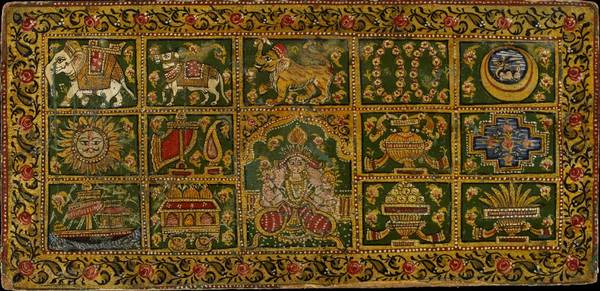
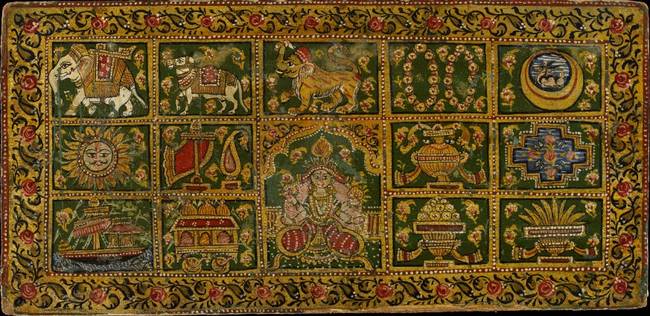
Fourteen auspicious dreams
Image by Victoria and Albert Museum © V&A Images/Victoria and Albert Museum, London
Manuscripts proper are not the only medium of teaching. Material culture in the form of various artefacts is also part of the Jain heritage. Some of these artefacts may be inscribed with text.
Remarkable items on JAINpedia are:
- two manuscript covers depicting the auspicious dreams, both held in the Victoria and Albert collections, under shelfmarks IS 20-1978 and IS 50-1983
- a V&A cloth painting showing the game of snakes and ladders, with elaborate captions, which illustrates the process of karma and rebirth
- a letter of invitation – vijñapti-patra – with paintings and a detailed text, which is a highlight of the British Library collections
- a victory banner featuring a variety of gods and goddesses, a striking piece in the V&A collections
- a maṇḍala with images of the 24 Jinas, which is an appropriate object for worship or remembrance
- a rare sūri-mantra-paṭa – special yantra used only by high-ranking Śvetāmbara monks – held in the collections of the Royal Asiatic Society.