Title and features
 Jain emblem
Image by Mpanchratan © CC BY-SA 3.0
The full title of the Jain scripture known as the Tattvārtha-sūtra is Tattvārthādhigama-sūtra. It can be translated into English as Aphorisms on the Sense of Principles Aphorisms on the Understanding of Principles. Its title indicates the nature of the text and why it is widely considered to be the essence of the principal Jain beliefs.
The Tattvārtha-sūtra has three features that make it unique among Jain religious texts.
Firstly, it is the earliest religious scripture recognised as authoritative by both the Śvetāmbara and the Digambara sects. The Digambaras do not consider the Śvetāmbara canonical scriptures to be authentic and vice versa.
This is the reason the Tattvārtha-sūtra was selected to represent Jainism in the Sacred Literature Series. It is one of the books published by the International Sacred Literature Trust, which organises the publication of key texts in different faiths. It was translated into English under the title That Which Is. However, this does not mean that Śvetāmbaras and Digambaras agree on everything relating to this text.
Secondly, it is written in Sanskrit. The different scriptures which are thought of as canonical by the Śvetāmbaras and the Digambaras are in Prakrit.
Thirdly, its literary form is remarkable. Whereas the canonical scriptures are mostly lengthy texts, the Tattvārtha uses the sūtra style. This means extremely concise aphorisms or a general truth made up of only a few words. Some aphorisms have only one word.
An example of a Tattvārtha aphorism is parasparopagraho jīvānām (5.21) or ‘souls render service to one another’. This proclamation of the interdependence of beings has become a slogan of Jainism for many contemporary Jains. Literally, it means: ‘[there is] reciprocal dependence of living beings’.
The latter two features are noteworthy because they show that it was written to provide a vigorous summary of Jain principles for audiences who were familiar with both Sanskrit and the sūtra style. These audiences were probably specialists in various Indian philosophical doctrines, of yoga and so on. All Indian philosophical schools have their own text in Sanskrit and use the same sūtra style.
Author and date
Among the Śvetāmbaras the author is known as Umāsvātī while the Digambaras call him Umāsvāmī. These two forms refer to the same person, but hardly anything personal is known about him. He is believed to have come from a brahmin family and later become a Jain monk. The Tattvārtha-sūtra is regarded as his greatest work, but the Śvetāmbaras believe that he also wrote another text, the Praśamaratiprakaraṇa or Treatise on the Love for Tranquillity. The question of the dates of the author’s activities and the composition of the Tattvārtha-sūtra has given birth to fervent discussions. It was probably written some time between the 2nd and 5th centuries CE. Comparing the Tattvārtha-sūtra with Śvetāmbara scriptures shows many correspondences. Not all consider this to be true, but it can be seen that the Tattvārtha-sūtra is indebted to Śvetāmbara canonical doctrine and philosophy, which it presents in a systematic way in Sanskrit.Contents of the text
The Tattvārtha-sūtra is made up of hundreds of sūtras or aphorisms. Organised into ten chapters, these sūtras explore the seven tattvas or ‘realities’. Accepting the truth of these is the first step along the path of spiritual development that will lead, after a great deal of hard work and time, to final liberation. Even though it is the only holy text accepted by the two main Jain sects of Digambaras and Śvetāmbaras, they have slightly different versions. These differences range from variations in some sūtras to disagreements over the interpretation and classification of some concepts in the text.Chapters
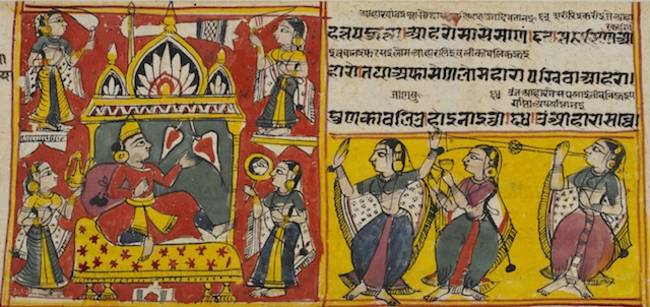
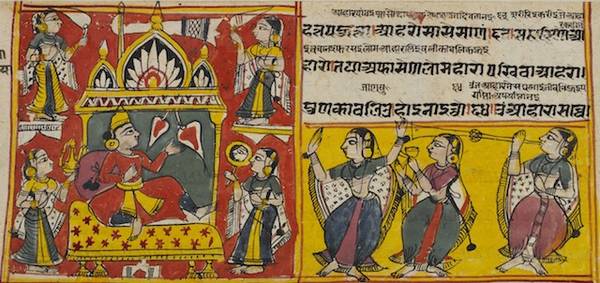 Gods enjoy life in the heavens
Image by British Library © CC0 1.0 (Creative Commons Public Domain)
The Tattvārtha-sūtra is divided into ten chapters or adhyāyaya without titles.
To translate the distribution of Tattvārtha-sūtra material into modern terms, it is convenient to follow K. K. Dixit’s analysis (Ref. 3: 1974: 1):
it takes up in its first chapter problems pertaining to epistemology,
in the second those pertaining to an empirical study of the animate world,
in the third and fourth those pertaining to mythological cosmography,
In the latest English translation of the work, called That Which Is and published in 1994, the ten chapters have been given the following titles:
Sūtras
The total number of aphorisms or sūtras ranges from 344 to 357. The variation is explained by differences among Śvetāmbaras and Digambaras. Some sūtras may not be included by one sect while others may be divided into two or even combined into one. In the text itself, the architecture of the whole work is built on the terms found in the initial sūtra. Many Jains consider it to be typical of the Tattvārtha-sūtra.| Transliteration | samyag–darśana–jñāna–cāritrāṇi mokṣamārgaḥ |
|---|---|
| Literal translation | right faith–cognition–conduct is the way to salvation |
| That Which Is translation (1, p. 5) | The enlightened world-view, enlightened knowledge and enlightened conduct are the path to liberation. |
Fundamentals of Jain belief
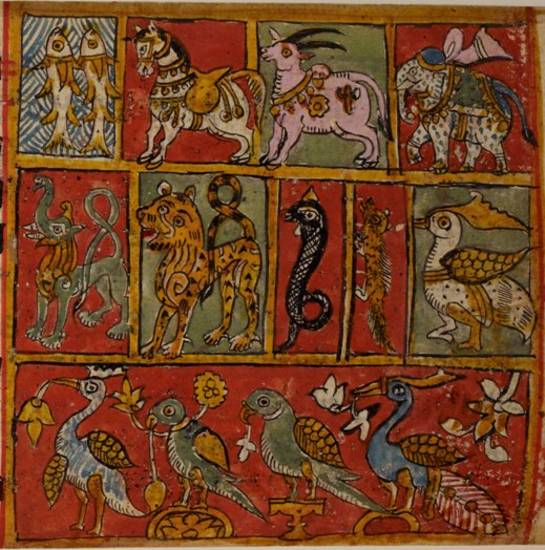 Five-sensed animals
Image by British Library © CC0 1.0 (Creative Commons Public Domain)
The basics of the Jain system are specifically mentioned here.
The aim is to be liberated or to reach salvation. This means to become free from the cycle of rebirth and leave for ever the world of transmigration. Hence the Tattvārtha-sūtra is also known by the name Mokṣa-sūtra or Aphorisms for Salvation.
A believer can reach salvation by following the principles of correct faith, correct understanding and correct conduct. The way these terms are arranged in the original text emphasises that all three together are necessary. They form the triplet commonly known as the ‘three gems’ or ‘three jewels’ – ratna-traya.
These terms are far from being obvious, and have been the starting point of considerable discussion, especially darśana – ‘faith, vision, intuition’. It comes first because it means that, before anything else, the individual must at least have a positive approach to the doctrine he is going to learn about and begin acting out. If he refuses certain basic principles at the start, there is no need for him to continue. Thus it is a crucial first step.
In practice, it means belief in tattvas. This means recognising the existence and truth of certain ‘realities’, ‘principles’ or ‘that which is’.
| Principle | Detail |
|---|---|
| jīva | what is living or sentient, also called the soul |
| ajīva | what is without life, just a substance |
| āsrava | flowing of karmic particles into the soul |
| bandha | bondage or the association of karmic particles with the soul |
| saṃvara | blocking the flowing of new karmic particles into the soul |
| nirjarā | exhausting karmic particles already present in the soul |
| mokṣa | salvation, when all karmas have been totally destroyed |
Chapters and fundamentals
The seven tattvas are arranged logically. The first two lay out the basic ideas from which the rest follow. Numbers three to seven define the spiritual progression of the soul, while the last three directly relate to the concept of right conduct. The seven tattvas are covered in chapters two to ten of the book.| Principle | Chapter number and title in That Which Is |
|---|---|
| jīva ajīva | 2. The Nature of the Soul 3. The Lower and Middle Regions 4. The Gods 5. Substances |
| āsrava | 6. The Inflow of Karma |
| bandha | 8. Karmic Bondage |
| saṃvara nirjarā | 9. Inhibiting and Wearing Off Karma |
| mokṣa | 10. Liberation |
Other chapters
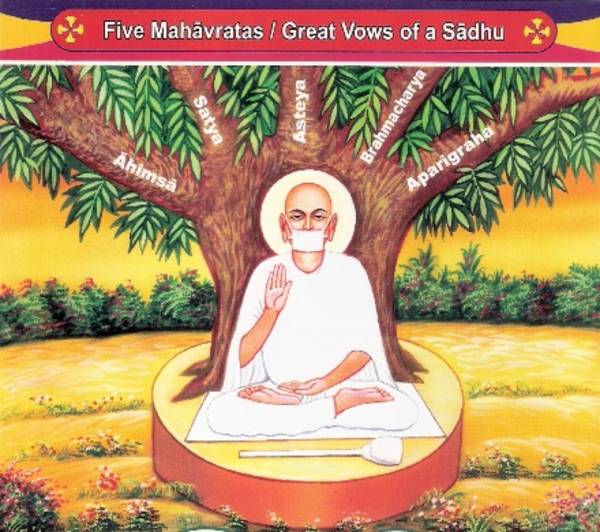 ‘Five Great Vows’
Image by Shree Diwakar Prakashan © public domain
Chapter 1 can be thought of as the base of the building because it deals with understanding, types of knowledge and ways of knowing a given object.
Chapter 7 is central to Jain ethics because it deals with the vows – vrata – of the ascetics and householders. Placing it between chapters on how karma enters and is bound to the soul is justified by the fact that the way one behaves or the vows one observes decide karmic inflow and binding.
In this sense, they foreshadow the spiritual exercises that are covered in later chapters. These spiritual exercises are ways of destroying karmic particles or preventing the inflow of new ones.
Sectarian versions
There are four main differences between Digambara and Śvetāmbara editions of the text.| Digambara | Śvetāmbara |
|---|---|
| the substance of ‘time’ – kāla – is a separate class within the category of ‘substances’ – dravya | ‘time’ is included in the general category of ‘substances’ |
| number of heavenly beings | number of heavenly beings |
| certain types of karma are included among those that can have a good or non-destructive effect | other types of karma are included among those that can have a good or non-destructive effect |
| understanding of the sūtras | understanding of the sūtras |
Commentaries
 Monk and pupils
Image by Chandu Shah © Chandu Shah
Understanding the meaning of each and every word of the aphorisms is not an easy task and thus the Tattvārtha-sūtra has sparked considerable activity in the form of commentaries. Both Digambara and Śvetāmbara scholar-monks have contributed to this body of work, ranging from simple explanations to, more often, very learned commentaries.
The earliest commentary is called Bhāṣya. According to the Śvetāmbaras, Umāsvātī himself created it, so they call this Bhāṣya svopajña, that is Written by [the author of the text] Himself.
The Digambaras dispute this and consider the Bhāṣya to be much later.
Among the prominent commentaries the Digambaras have written are:
- the Sarvārthasiddhi, written by Pūjyapāda in the 6th century
- Akalaṅka’s Rājavārttika, composed in the 8th century
- Vidyānanda’s 9th-century Ślokavārtika.
- Siddhasena-gaṇi or Gandhahastin’s 8th-century work
- the commentary by Haribhadra, written in the 8th century
- Pandit Sukhlalji’s text, composed in the 20th century.
Translations into Western languages
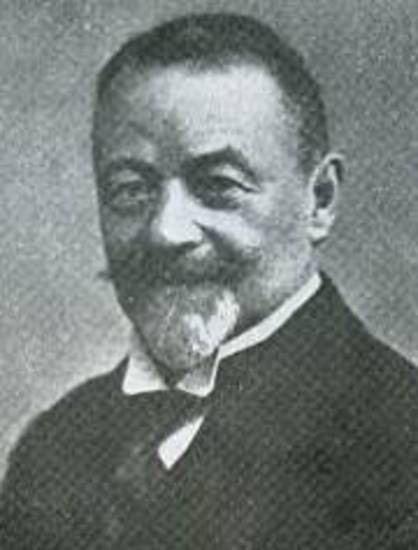 Hermann Jacobi
Image by unknown © unknown
The first translation of the Tattvārtha-sūtra into a Western language was a German edition published in 1906 by Hermann Jacobi, one of the pioneering Western scholars in the field of Jain studies.
There are other significant texts in the Jain faith but several descriptions of Jain philosophy found in various European manuals are based on the Tattvārtha-sūtra because it gives the essence of Jain belief and presents it in a sūtra style. An example is Frauwallner’s 1956 presentation of Jain philosophy in his German-language publication, Geschichte der indischen Philosophie – History of Indian Philosophy.