Terms
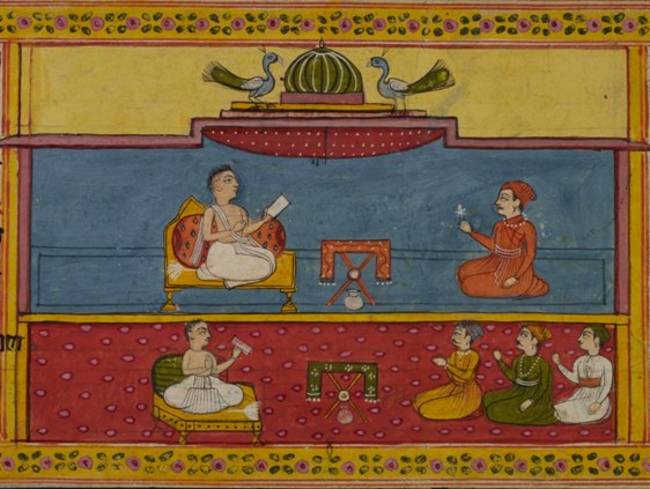
Lay men listen to monks
Image by British Library © CC0 1.0 (Creative Commons Public Domain)
Digambara Jains tend to commonly use the following Sanskrit words for a ‘sect’:
- saṅgha – community
- gaṇa – mendicant group
- panth – path
- gaccha – group.
The label saṅgha can refer to two concepts. Firstly, saṅgha can mean the ‘fourfold community’, which comprises monks, nuns, lay men and lay women. Its second meaning describes the ‘monastic community’ – sādhu-saṅgha or muni-saṅgha.
Both meaning ‘group’, the words gaṇa or gaccha are most commonly used for ‘monastic orders’. Most Digambaras tend to prefer gaṇa.
Main characteristics
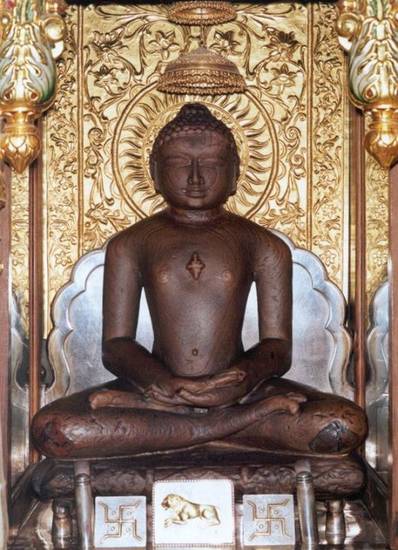
Idol of Mahāvīra
Image by Dayodaya © CC BY-SA 3.0
The Digambara sect is named after one particular practice of its monks.
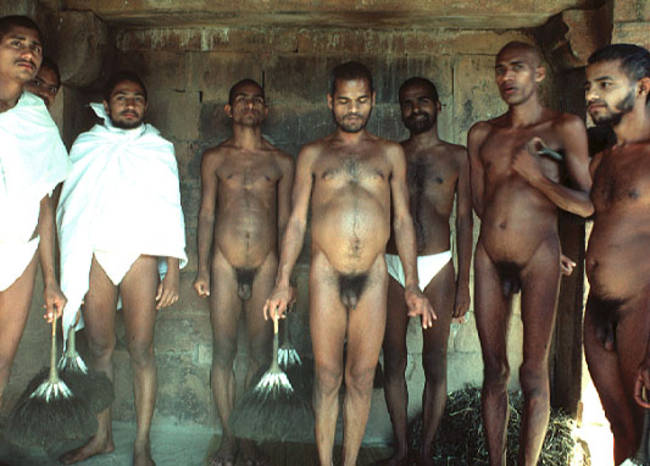
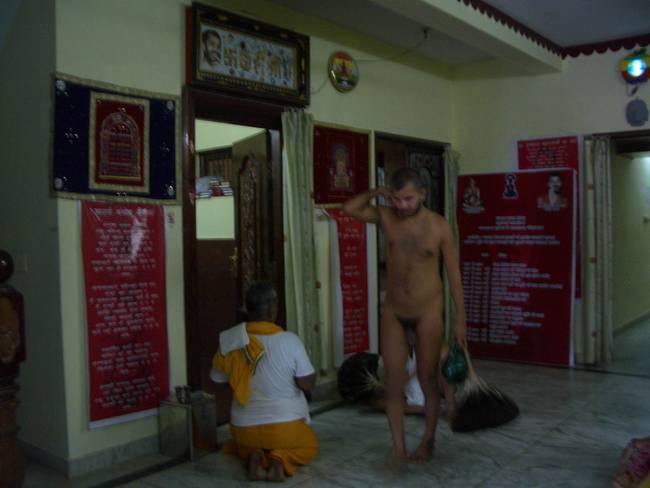
The monks live naked, following the example of the Jinas and their monastic disciples, who they believe rejected clothing as part of their renunciation of all worldly attachments. They are thus ‘clothed’ – ambara – in ‘the directions’ or ‘the sky’ – dik or dig. The sect is therefore known as Digambara, from the Sanskrit phrase meaning ‘sky-clad’. Only full monks – munis – go naked, as it is recognised as a test of complete detachment. Novice monks wear some clothing.
Female ascetics wear white garments. Forbidden to go naked, they are unable to renounce as fully as men so they are technically lay women who have taken advanced vows.
|
Male mendicant clothing |
|
|---|---|
|
Female mendicant clothing |
|
|
|
|
Siddhānta:
|
|
|
Women |
cannot achieve liberation |
|
Sex of Jinas |
all Jinas are male |
|
Images of Jinas |
|
Digambara sectarian traditions

Digambara monks and novices
Image by Takeo Kimiya © Takeo Kimiya
Full Digambara monks are rare these days. The early tradition of an individual monk’s gathering pupils continues in the present day. Digambara monks ‘seem to have an especially weak sense of standard training, of a line of pupillary succession, or of allegiance to an order’ (Carrithers 1989: 230). Junior monks follow a muni, who guides them in their spiritual development. An individual monk is expected to influence junior mendicants and lay people through his learning, personal example and charisma rather than through an official post or discipleship to a famous monk.
The emphasis on individual leaders rather than rule-based succession is likely to have been the case in the past too, though it would have been more complex when monks were more common. Establishing mendicant relationships of the past is even more complicated when the evidence for many Digambara monastic orders is so fragmentary. However, geographical location seems to be a strong factor in the foundation of sects. Dundas (2002: 121) highlights ‘the complexity of medieval Digambara ascetic organisation in which a plethora of sects and subsects, many of them totally obscure to us today, emerged on the basis of preceptorial association and geographical connection with particular regions and towns’.
The institution of the bhaṭṭāraka intensifies the involved nature of Digambara sectarian development. The various bhaṭṭārakas each have their own lineage. Attached to particular places, the bhaṭṭārakas cut across the influence of the wandering mendicants. Their longstanding presence tended to consolidate the Digambara tradition in certain areas and helped ensure its long-term survival.
Historical lineages
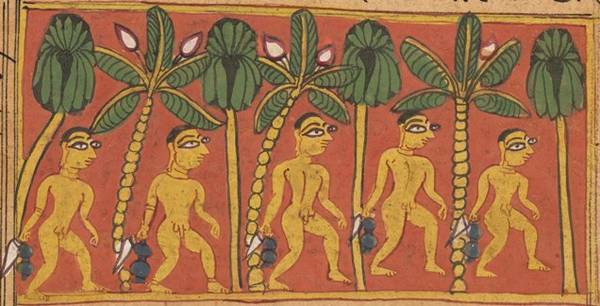
Digambara monks walking
Image by Wellcome Trust Library © Wellcome Library, London
The earliest Digambara community was the Mūla-sangha – ‘the Root Assembly’. It is said to go back to the 24th Jina, Mahāvīra, through Kundakunda, the most authoritative teacher for the Digambaras, who lived around the second to third centuries CE.
Available accounts, however, show that this main lineage split into four groups – gaṇas:
- Sena-gaṇa
- Deva-gaṇa
- Siṃha-gaṇa
- Nandi-gaṇa.
These four groups fractured into subdivisions. Each of these produced lineage texts – paṭṭāvalis – that are rather complex because they often reflect different traditions for the same sections of mendicant orders. One of the most developed monastic lineages is the Sarasvatī-gaccha.
The Mūla-sangha seems to have been influential in all the regions where Digambara communities existed from around the fifth to sixth centuries until very late. This is borne out by inscriptions, manuscript colophons and monastic lineages.
Another group was the Drāviḍa-sangha – ‘Dravidian Assembly’. It was founded by Vajranandin in the fifh century CE at Madurai, in Tamil Nadu. There are hints that mendicants of this group may have given up the traditional wandering life.
The Kāṣṭhā-sangha was another group that might have arisen in the seventh century. Its title could be related to a place name. One of their characteristics seems to have been the use of cow-tail brooms instead of the peacock-feather brooms of other Digambara mendicants.
Contemporary lineages
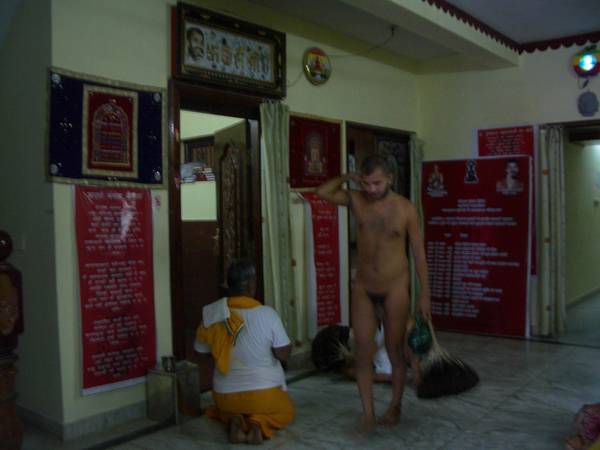
Digambara monk seeks alms
Image by Nalini Balbir © Nalini Balbir
Information on today’s lineages and their organisation is scarce. But these earlier divisions do not seem to be in force nowadays. Today’s Digambara monastic community goes back to six groups that existed in the late 19th to early 20th centuries. Of these only the following three have survived to the present time (Flügel 2006: 350):
- Śānti Sāgar ‘Dakṣiṇ’
- Śānti Sāgar ‘Chāṇī’
- Muni Ādi Sgar ‘Ankalīkar’.
The following table, giving the numbers of Digambara monks and nuns in 2000 and 2001, is based on the information on page 355 of Flügel 2006.
|
Year |
Male ascetics |
Female ascetics |
Total |
|---|---|---|---|
|
2000 |
453 |
365 |
818 |
|
2001 |
508 |
394 |
902 |
Bhaṭṭāraka monks
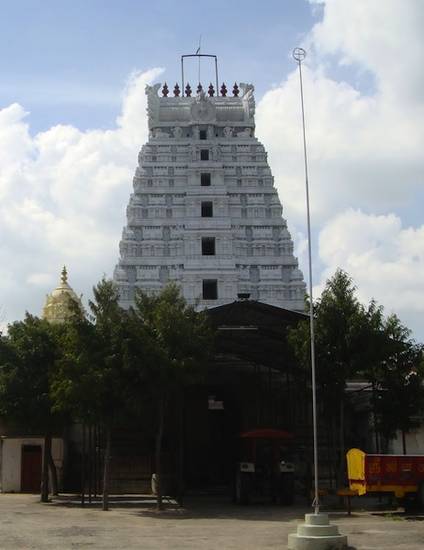
Maṭha in Melsittamur
Image by Vijayan Teacher © CC BY-SA 3.0
Among Digambaras in southern India, where this sect was historically concentrated, along with central India, there is a special type of monk. The bhaṭṭāraka – ‘venerable one’ or ‘learned one’ in Sanskrit – is not bound by the usual mendicant vows.
The bhaṭṭārakas do not practise nudity. They also differ from usual Digambara monks in that they live in a monastery instead of taking up the wandering life, travel using mechanised transport, own lands and estates and act as a kind of community manager.
The longstanding existence of a monastery – maṭha – in an area means that each has developed its own lineage. Successive bhaṭṭārakas have gradually accrued local and influence and have often been a significant regional power. This has contributed to the survival of the Digambara sect, especially when foreign rulers disapproved of the tradition of public nudity.
Lay traditions

Woman praying
Image by Chandu Shah © Chandu Shah
Sects seem to have followed a similar pattern of development as they originated. Most new sects grow up around a mendicant order that emerges. Strictly speaking, lay Jains are not members of sects because only monks and nuns belong to mendicant orders, which form the groupings known as sects. Lay Jains tend to follow mendicants who claim affiliation with certain monastic orders.
Despite this pattern, new sects have arisen that have lay founders or are oriented more towards lay people than mendicants. Some traditions have been established by men who were lay renunciates, not initiated monks. Other traditions have been founded by mendicants but have not produced monastic lineages.
The three lay traditions in the Digambara sect all originated in the northern and central regions of India. As their characteristic features relate to the practice of worship rituals, this was probably an important point in areas where Digambara Jains were smaller in number.
Taraṇ Svāmī Panth

Jain holy texts
Image by Malaiya © CC BY-SA 3.0
Members of the Taraṇ Svāmī Panth are the lay followers of Taraṇ Svāmī (1448–1515), a Digambara thinker who ‘took the vows of a celibate and thereby became a formal renouncer’ (Cort 2006: 265). In a period where full-fledged naked Digambara monks were rare, such celibate renouncers had an important role to play. Taraṇ Svāmī became a full Digambara monk at the end of his life. He has been presented as a ‘Digambara mystic, as Digambara ritual reformer, as trans-sectarian iconoclastic poet, as miracle-worker, and as Jina-to-be’ (Cort 2006: 267).
Taraṇ Svāmī is the author of 14 writings, the main message of which is that one has to realise the ultimate purity of the soul as being the liberated soul. This is in line with the teachings of Kundakunda.
There is, however, no continuous literary tradition, so that nothing is known of the period between Taraṇ Svāmi’s death and the 20th century.
Today followers of this lay path, the Taraṇ Svāmi Panthins, are mainly found in central India, especially in the historical area of Bundelkhand, in Madhya Pradesh. Numbering between 20,000 and 100,000, they do not worship Jina images, although their founder’s writings do not seem to really criticise this. Instead they venerate books by Taraṇ Svāmi and Kundakunda and also other Digambara scriptures, especially those that stress the nature of the soul.
Kundakunda’s Samaya-sāra is a key text so this movement is also called Sāmāiya-panth – ‘the Path of Sacred Books’. Books and not images are the objects of worship in their temples. The most important temple is known as ‘Nisaījī’, near the village of Malhargarh in Guna district. It is a memorial, as it was the place where the founder spent the last years of his life and died.
Rajneesh, alias Osho (1931–90), an internationally known Indian holy man, was born in a family that followed the Taraṇ Svāmī Panth (Cort 2006: 293ff.).
Terā-panth and Bīs-panth
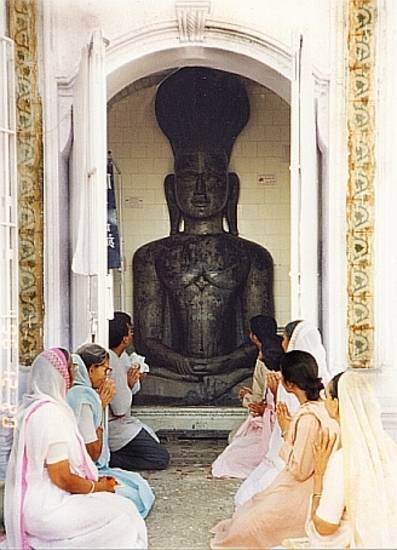
Lay people worship a Jina
Image by Sheetal Shah © Sheetal Shah
These two Digambara groups are found among the lay communities of north India. Since this division refers chiefly to rituals of worship, it does not really apply to Digambara monastic communities. As full renunciates, they do not perform worship in the same way as lay people.
However, there have been cases of Digambara mendicants being associated with a specific monastery headed by a bhaṭṭāraka. The institution of the bhaṭṭārakas started to be challenged and criticised in 17th-century India, when this division between the two sects emerged. The development of the Terā-panthins and Bīs-panthins thus had some impact on mendicants as well. There was no such challenge in south India and therefore these subsects do not exist there.
Comparing the two subsects, Terā-panthins may be regarded as having views that are more radical or less compromising than Bīs-panthins.
|
Terā-panthins |
Bīs-panthins |
|---|---|
|
Reject the authority of the Digambara clerics – the bhaṭṭārakas |
Accept the authority of the bhaṭtārakas |
|
Worship Jina images |
Worship Jina images |
|
Do not worship images of deities that have not achieved liberation, such as yakṣas, yakṣīs and kṣetrapālas |
Worship images of deities, who are unliberated |
|
Worshippers do not use any substance considered to contain life in rituals |
Worshippers offer the eight objects, such as flowers, fruits and sandalwood |
|
The lamp ceremony is not performed |
The lamp ceremony is performed |
|
Followers worship while standing rather than while seated |
Followers worship while seated or standing |