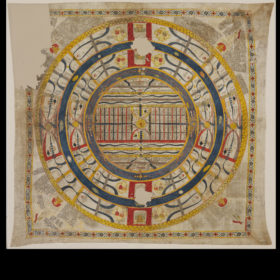
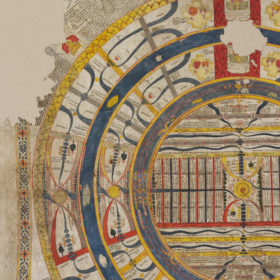
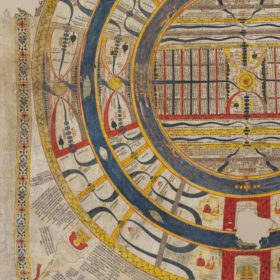
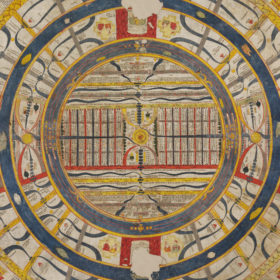
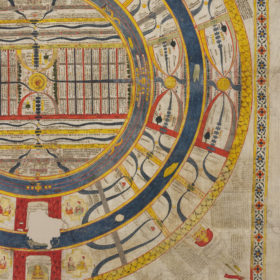
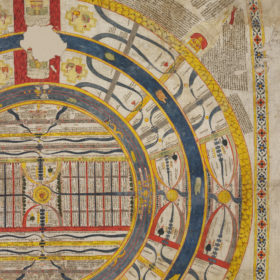
Aḍhāī-dvīpa is the Hindi phrase for ‘Two and A Half Continents‘ and describes the only part of the universe where human beings live in the Middle World of Jain cosmology. Frequently depicted in maps or colourful diagrams, it is the only part of the universe where people can be born so it is also known as ‘the World of Humans‘ – manuṣya-loka.
The Two and A Half Continents is formed of concentric rings of differing size. Every other ring is a continent, which is surrounded by a ring of ocean. Moving from the centre outwards, the order is as follows:
Mount Meru is the centre of the universe in Jain cosmology, at the heart of the central continent of Jambū-dvīpa. Jambū is where human beings live and is in the Middle World, one of the three worlds of traditional Jain cosmology.
The Middle World is the smallest of the three worlds that make up world space – loka-ākāśa. In world space all the souls live in the different body-forms they take according to their rebirths, in the various worlds. Outside world space is the non world space – aloka-ākāśa – which is endless. However, the Middle World is the most important area from the spiritual point of view because it is the only part where human beings can live.
Pictures in cosmological works are not intended to be merely attractive. Spelling out in visual form the complex explanations found in the writings, cosmological paintings form a long-established tradition of artwork in Jain heritage.
Jains cannot advance spiritually without understanding and meditating upon cosmological theories so understanding them is crucial. Certain key religious concepts run through these theories. These include the notion of a physical soul shedding karma by moving through the cycle of rebirth to eventual omniscience and final liberation, along with the cyclical nature of time, the interconnectedness of the universe, and the importance of symmetry, repetition and balance.
Nalini Balbir
Nalini Balbir
Julia A. B. Hegewald
Julia A. B. Hegewald
G. R. Jain
unknown