Background
In the Jain conception of the universe there are several categories of deities. Each category is led by an indra, which means ‘king’ or ‘chief’. All kings have an army of six elements although the kings of certain classes of gods have seven.
The kings of all types of god have six elements in their armies:
- dancers – naṭṭa 1
- musicians – gandharvva 2
- horses – ghoḍau 3
- elephants – hāthī 4
- chariots – ratha 5
- soldiers – subhaṭa 6
The kings of Vaimānika deities have a seventh element – the bull – vṛṣabha 1. However, the kings of the Bhavanavāsin and Vyantara deities have the buffalo – mahiṣa 2 – as the seventh part of their armies.
Dancers and musicians are always available for entertainment. Others are always ready to fight for their master and to serve him.
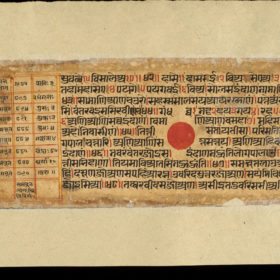
There is no other text apart from captions on this image but the related verse can be found in other manuscripts and editions. It reads:
gandhavva naṭṭa haya gaya, raya bhaḍa aṇiyāṇi savva idāṇaṃ
vemāṇiyāṇa vasahā, mahisā ya ahonivāsīṇaṃ
Musicians, dancers, horses, elephants, chariots, [and] soldiers are the armies of all chiefs. As for [the kings of the] Vaimānikas they have the bull [as the seventh component], whereas [deities] living in lower dwellings have the buffalo [as the seventh].
The Saṃgrahaṇī-ratna belongs to the tradition of Śvetāmbara writings on the Jain universe. The monk Śrīcandra wrote Prakrit verses in the 12th century consolidating previous writings on cosmology. It is called Jewel of Summarised Verses, a phrase which underlines the condensed nature of the work.
Though Saṃgrahaṇī works describe the universe, they are mainly concerned with the beings who live in different parts of the Jain world. They go into detail about their life-duration, karma and spiritual progress much more than the geography.
Cosmological writings have generated numerous commentaries in Sanskrit or the vernacular languages. Teaching and learning cosmology remain an important part of monastic education. A rich pictorial tradition has also grown up round the Saṃgrahaṇī works, as visualisation is part of the transmission of knowledge on the Jain universe and is helpful as a means of understanding.
Jain cosmology is complex. Human beings live in the Middle World, which is the smallest of the three worlds that make up world space – loka-ākāśa. In world space all the souls live in the different body-forms they take according to their rebirths, in the various worlds. Outside world space is the non‑world space – aloka-ākāśa – which is endless. However, the Middle World is the most important area from the spiritual point of view because it is the only part where human beings can live.
Jains cannot advance spiritually without understanding and meditating upon cosmological theories so understanding them is crucial. Certain key religious concepts run through these theories. These include the notion of a physical soul shedding karma by moving through the cycle of rebirth to eventual omniscience and liberation, along with the cyclical nature of time, the interconnectedness of the universe, and the importance of symmetry, repetition and balance.




Bhavanavāsin gods