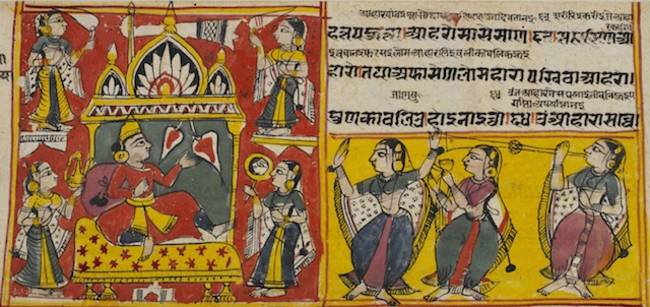
Tattvārtha-sūtra
One of the most concise, comprehensive and earliest accounts of Jain cosmology is the Tattvārtha-sūtra. Written in Sanskrit in the first centuries of the Common Era and the only text considered an authoritative scripture by Śvetāmbaras and Digambaras alike, the Tattvārtha-sūtra summarises the main principles of Jain belief.
After describing the nature of the soul in chapter two, the Tattvārtha-sūtra gives the various places where it can take rebirth in chapters three and four.
Chapter three

Continent of Kuṇḍala
Image by British Library © CC0 1.0 (Creative Commons Public Domain)
The third chapter of the Tattvārtha-sūtra goes into great detail about the lower and middle worlds of the Jain universe.
These areas are two of the regions of world space where souls move through the cycle of birth over many lifetimes. The souls are born into different bodies and lives throughout various parts of the Jain triple worlds according to the karma their behaviour has created in previous births.
The following table summarises the headings in chapter three.
|
The lower region: the seven infernal lands |
The middle region |
|---|---|
|
Dimensions and topography |
Concentric islands and oceans |
|
Strata and dwelling places for the infernal beings |
Jambū Island’s geography |
|
Physical make-up of the infernal beings |
The seven continents of Jambū:
|
|
Sufferings of the infernal beings |
Dhātakīkhaṇḍa Island |
|
Lifespans of the infernal beings |
Puṣkara Island |
|
|
Islands of human habitation |
|
|
The two classes of humans |
|
|
Continents where spiritual effort is possible |
|
|
Lifespans of humans |
|
|
Lifespans of animals and lower organisms |
Chapter four
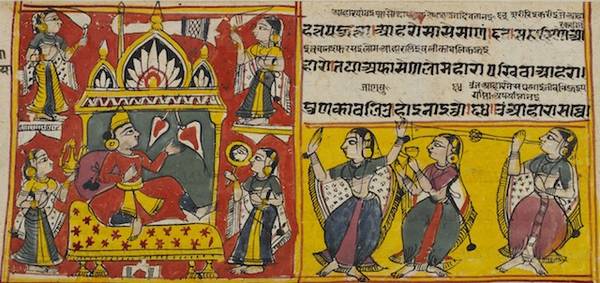
Gods enjoy life in the heavens
Image by British Library © CC0 1.0 (Creative Commons Public Domain)
The fourth chapter provides an immense amount of detail about the upper world of the Jain universe. The upper world is where many deities reside, although gods and goddesses are also found in other parts of the three worlds. The lives of the gods are characterised by pleasure and lack of effort, unlike the lives of human beings in the Lands of Action. The gods are in a higher spiritual condition than human beings but are not liberated souls. Only human beings can reach omniscience and liberation so it is better to be born as a human being in the middle world than a god in the upper world.
The following table summarises the headings in chapter four of the Tattvārtha-sūtra.
|
Colouring of the gods |
|
Types of gods within each class |
|
Chiefs and other grades of gods |
|
Sexual pleasures of the gods |
|
1. The ten types of mansion-dwelling gods |
|
2. The eight types of forest gods |
|
3. The five types of luminous gods
|
|
4. The empyrean gods
|
|
Subhumans (animals, plants, micro-organisms) |
|
Lifespans of the gods
|
|
Lifespans of infernal beings
|
Other writings

Amṛtamati kills Yaśodhara and Candramatī
Image by Wellcome Trust Library © Wellcome Library, London
Although the primary textual sources on Jain cosmology are the scriptures, story literature contains plentiful examples of how these cosmological concepts work in practice.
As well as shorter writings, there are instances of fairly long texts, similar to novels, with narratives embedded in one another, in which cosmology plays an important role. These tales are like theatres where human beings play one life after the other, travelling back and forth among the middle, lower and upper worlds in continuous rebirths until they are spiritually mature enough to reach liberation. A good example is a popular tale known as the story of Yaśodhara, which offers rich scope for illustrations of the workings of karma. One manuscript of the story is one of the highlights of JAINpedia.
Finally, there is the evident familiarity of Jain authors, mainly mendicants, with the details of cosmology. There are frequent precise references or looser allusions in literary works, for example in comparisons.
Śvetāmbara tradition
Three principal types of Śvetāmbara writings describe Jain cosmology. The first type is scriptural, with several scriptures going into immense detail about Jain cosmological concepts, with associated commentaries in various languages.
A huge body of literature in Prakrit focuses on cosmological matters. This can be classified into those texts known as kṣetra-samāsas – ‘condensed exposition of the regions’ – and those known as saṃgrahaṇīs – ‘résumés’. The most influential of other Prakrit-language works on cosmology is the 16th‑century Vicāraṣaṭṭriṃśikā, and also its Sanskrit commentary.
The final type of Śvetāmbara writing to deal with cosmology is Vinaya-vijaya’s Loka-prakāśa. Composed in Sanskrit verse in the 17th century, it is a kind of compendium of cosmology, which quotes extensively from earlier works and was widely copied.
Canonical scriptures
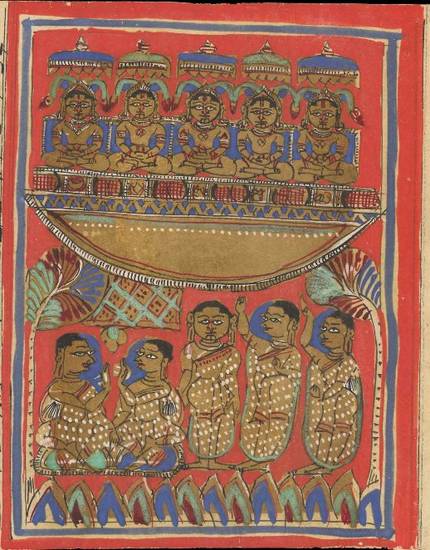
Perfect beings and paths to liberation
Image by British Library © CC0 1.0 (Creative Commons Public Domain)
Written in Ardhamāgadhī Prakrit, the Vyākhyāprajñapti – Exposition of Explanations – is the fifth Aṅga of the Śvetāmbara canonical scriptures. It is a massive book containing virtually everything related to the teachings of Jain doctrine so, although it is not a specialised treatise on cosmology, it holds a lot of cosmological material. Information is also available in other Aṅgas such as the Sthānānga and the Samavāyānga – Aṅgas number three and four.
The Jīvājīvābhigama – Approach to the Animate and Inanimate – belongs to the category known as Upāṅgas. These form the second category of Śvetāmbara canonical scriptures, in which there are 12 texts written in Ardhamāgadhī Prakrit. The Jīvājīvābhigama is the third text, in prose. Its third chapter contains a description of continents and oceans but is considered by some to be a later insertion.
The Jambū-dvīpa-prajñapti – Exposition of the Jambū-dvīpa – is the fifth or sixth of the Upāṅgas. Devoted to Jain cosmology, it is in seven prose sections. The Jambū-dvīpa-prajñapti is an exhaustive description of the ‘Rose-apple continent‘ in an elaborate canonical style. It details all the components of Jambū-dvīpa – encircling wall, mountains, shrines, gardens, ponds, astral bodies, rivers, the surrounding Lavaṇa-samudra. It emphasises its repetitive structure, with microcosmos and macrocosmos replicas of each other. The atmosphere is opulent – gems, gold and silver are the usual materials described – and the depiction often recalls those of royal palaces and gardens or those of holy places and pilgrimage sites. The third section is an account of the region of Bhārata and deals with the legends connected with King Bharata.
The Sūrya-prajñapti – Exposition of the Sun – and the Candra-prajñapti – Exposition of the Moon – are also Upāṅgas. The Sūrya-prajñapti is the sixth and the Candra-prajñapti the seventh. They are works of astronomy, dealing with activities and effects of the sun and the moon (Schubring 2000: 100–103 for details).
All these treatises have been the starting point of a long tradition of commentaries in Sanskrit and in vernacular languages, especially Gujarati.
|
Title |
Sanskrit commentary |
|---|---|
|
Jīvājīvābhigama |
|
|
Jambū-dvīpa-prajñapti |
|
|
Sūrya-prajñapti and Candra-prajñapti |
|
Prakrit treatises

Lavaṇa-samudra and Kālodadhi oceans
Image by British Library © CC0 1.0 (Creative Commons Public Domain)
There is a vast number of specific works in Prakrit on cosmological teachings. These derive from the teachings in the canonical scriptures but can be considered a modernisation for two leading reasons.
Firstly, the language used is now Māhārāṣṭrī Jain Prakrit instead of Ardhamāgadhī Prakrit. Secondly, the form is no longer that of emphatic canonical prose but that of verses. These are often very concise, meant to be memorised. They have given birth to a long tradition of commentaries in Sanskrit and vernacular languages, especially Gujarati. Many such commentaries were written in the 17th century, proving a renewed interest in the topic of cosmology at that point.
Although there is some overlap, there are essentially two categories of Prakrit works:
- kṣetra-samāsas – ‘condensed expositions of the regions’
- saṃgrahaṇīs – ‘résumés’.
To some extent, kṣetra-samāsas are more technical and more geographical, dealing with the description of the continents, the planets and so on. The latter are more concerned with the beings who live in different parts of the Jain worlds, especially their lifespans, karma and spiritual progress.
Among other specialised treatises, at least one has to be mentioned because it is part of the fundamentals of the monastic curriculum. It has been copied many times, demonstrating its popularity. Called the Vicāraṣaṭṭriṃśikā or Cauvīsadaṇḍa, Daṇḍakaprakaraṇa and Laghu-saṃgrahaṇī, it was produced by Gajasāra. He also wrote a Sanskrit commentary in 1522 (Vikrama Saṃvat 1579). In 44 stanzas, it discusses the various limits of cosmological concepts, such as the body size of the classes of gods, their type of knowledge and their physical structure.
Kṣetra-samāsas
There are three kṣetra-samāsas that have been most influential.
The earliest is the Kṣetra-samāsa by Jinabhadra, which is also known as Samayakhitta-samāsa or Bṛhat-kṣetra-samāsa. Written in the sixth century, it gained commentaries by Haribhadra in the eighth century and Malaya-giri in the 12th century.
It was replaced in eminence by Somatilaka-sūri’s Kṣetra-samāsa, composed around 1300 CE.
Finally, there is Ratnaśekhara-sūri’s Kṣetra-samāsa or Laghu-kṣetra-samāsa, produced around 1370 CE. The most popular kṣetra-samāsa, it has been copied many times and plenty of illustrated manuscripts survive.
Saṃgrahanīs

Palaces of hellish gods and demi-gods
Image by British Library © CC0 1.0 (Creative Commons Public Domain)
The most authoritative saṃgrahanīs number three.
The first is the Saṃgrahaṇī or Bṛhat-saṃgrahaṇī by Jinabhadra, authored in the sixth century.
Next is the Jambū-dvīpa-saṃgrahaṇī, composed in Prakrit by Haribhadra in the eighth century (van den Bossche 2007). Sometimes called Laghu-saṃgrahaṇī, it consists of 30 stanzas giving definitions and calculations relating to the description of the ‘Rose-apple continent‘. Prabhāṇanda wrote a Sanskrit commentary in the 13th century.
Śrīcandra-sūri’s Saṃgrahaṇī-ratna was written in 1136 CE (Vikrama Samvat 1193). It is also known as Saṃkṣipta-saṃgrahaṇī or Trailokyadīpikā or by the name Bṛhat-saṃgrahaṇī, which is given to it by some modern Jain editors. One of the most popular treatises, it comprises roughly 273 stanzas, according to the edition, and has commentaries by Devabhadra-sūri and other leading scholar-monks.
Sanskrit manual – the Loka-prakāśa
Written in Sanskrit verse in the 17th century, the Loka-prakāśa by Vinaya-vijaya is a comprehensive cosmological treatise. It has numerous quotations from earlier works on Jain cosmology, which are also discussed in detail, and its popularity is shown by the relatively large number of illustrated manuscripts in existence.
Unfortunately, none is available among the manuscripts currently on JAINpedia. However, as well as a multitude of copies in India, Mette 2010 (392ff.) lists:
- one in the National Library and the University of Strasbourg in France
- one in the National Library of Florence in Italy
- one in the Bavarian National Library, in Munich in Germany.
Digambara tradition
The Śvetāmbara and Digambara sects agree broadly on Jain cosmology but have developed distinct traditions in cosmological writings. The most notable Digambara works are the Tiloyapannatti and the Trilokasāra in Prakrit verse and the Sanskrit-language Trailokyadīpikā. The last is the standard handbook for the Digambara tradition on Jain cosmology but does not seem to have been published.
Tiloyapannatti

Armies of the Bhavanavāsin gods
Image by Victoria and Albert Museum © V&A Images/Victoria and Albert Museum, London
The earliest available Digambara text on cosmology is the Tiloyapannatti. In Śaurasenī Prakrit, it is a verse treatise written by Yativṛṣabha. It is difficult to date, with some scholars placing it in the second century CE while others date it to the sixth century CE. This comprehensive work is a mathematical treatise as much as a cosmological work, full of calculations, rules and definitions.
It is divided into nine chapters, named:
- General nature of the universe
- Hellish regions
- Regions inhabited by the Bhavana-vāsins
- Human world
- Sub-human world
- Regions inhabited by the Vyantaras
- Regions inhabited by the Jyotiṣkas
- Heavenly regions
- The realm of liberation.