
Titles and subjects
To some extent, these ‘appendices’ – the two cūlikā texts – can be considered to run in parallel with one of the main Digambara scriptures, the Ṣaṭkhaṇḍāgama. All these writings:
-
share methodological concerns
-
develop the notion of parameters and methods that can be used to analyse complex concepts from multiple angles.
The approach of considering different factors so as to bring out the multiple shades of meaning of a term or notion is, in a way, anekānta-vāda. Central to Jain thinking, this concept of many-sidedness – in opposition to the idea of a single, absolute meaning – can be applied to virtually everything.
|
Prakrit title |
Sanskrit title |
|---|---|
|
Nandi-sutta |
Nandī-sūtra |
|
Aṇuogaddārāiṃ |
Anuyogadvāra-sūtra |
‘Nandī-sūtra’
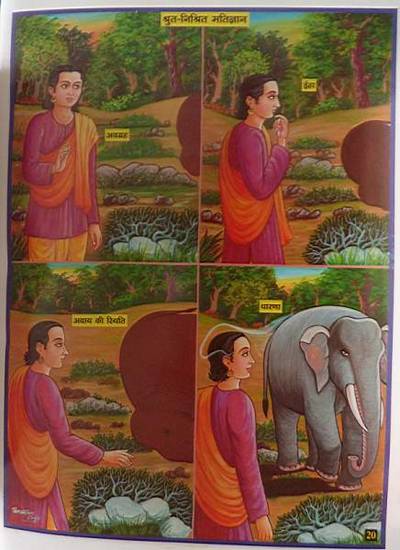
Stages of knowledge
Image by Diwakar Prakashan / Padma Prakashan © Diwakar Prakashan / Padma Prakashan
The Sanskrit term nandī conveys an idea of delight. It is also a technical term in Sanskrit drama for the first stanza of a play, which pays homage to one of the gods. The Nandī-sūtra of the Śvetāmbara canon, which is written in prose and verse, may be regarded as an auspicious beginning from several angles. Indeed, Muni Puṇyavijaya writes that ‘It has secured the position of an auspicious introductory prayer in the beginning of Āgamavācana [the words of the Canon]’ (1968: Introduction p. 31).
According to the Śvetāmbara tradition, the Nandī-sūtra is the work of ‘Devavācaka’, who was the pupil of Dūsa-gaṇi. It is likely that this is the predecessor or the same person as Devarddhi-gaṇi, who oversaw the final redaction of the Śvetāmbara canon during the fifth century. The Nandī-sūtra appears to collect together materials that are partly found elsewhere in the canon.
It discusses the concept of knowledge, which is a vital topic for Jains because proper understanding underpins correct behaviour and, thus, spiritual advance towards liberation.
Introductory matter
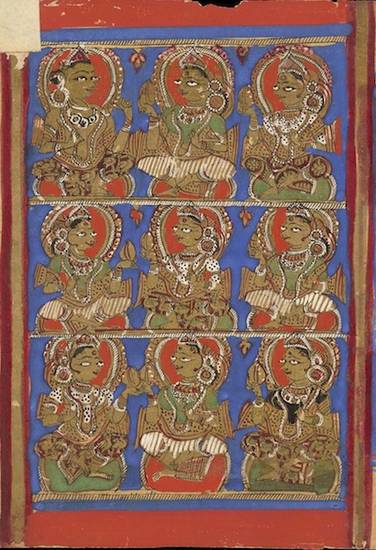
Jambū-svāmin and his eight wives
Image by Wellcome Trust Library © Wellcome Library, London
The Nandī-sūtra starts with verses of homage to:
- the Arhats
- Mahāvīra
- the community – sangha
- the 24 Jinas.
These verses are the usual auspicious formulas found at the beginning of most Jain texts.
The celebration of the community is expressed through images with which it is associated. Many of these images are significant in wider Indian culture, but they all underline the central importance of the notion of community. Symbols linked with community for Jains include:
- city
- wheel
- chariot
- lotus
- moon
- sun
- sea
- mountain.
After these standard introductory elements comes a praise of Mahāvīra’s disciples and the elders who succeeded them. These early Jain teachers are named and celebrated in successive verses. This is what is technically known as Sthavirāvalī or, in the Prakrit form, Therāvalī. Other examples familiar to Śvetāmbara Jains are the second section of the Kalpa-sūtra and the preamble to the Āvaśyaka-niryukti, the fourth Mūla-sūtra.
The list of elders starts with Sudharman and Jambū and closes with Duṣya-gaṇi. Nothing is known about him, but he may have been the predecessor of Devarddhi-gaṇi. This teacher is known as the redactor of the Śvetāmbara canon during the fifth-century council at Valabhī, Gujarat.
One stanza then lists metaphorical terms for the two categories of audience members. Using 14 mnemonic terms the listeners are contrasted as:
- those who are worthy of receiving teaching because they will pay attention and benefit from it
- those who are unworthy of it.
Each of the terms is explained in the commentaries to the Nandī-sūtra as well as in those on the Āvaśyaka-niryukti, where the same stanza is found (Balbir 1993). For instance, the term:
- ‘mosquito’ means a bad pupil because he may learn something, but will inflict pain on his teacher
- ‘sieve’ is the pupil who does not retain anything he has heard.
Knowledge

Shapes of the Bhavanapati gods’ clairvoyance
Image by British Library © CC0 1.0 (Creative Commons Public Domain)
The heart of the Nandī-sūtra deals with the concept of cognition or knowledge in its various divisions and subdivisions. This is also an appropriate topic for a text that transcends all categories in the Śvetāmbara canon, for it can be regarded as a prerequisite to the scriptures.
First comes the list of the five types of knowledge, known from other sources as well, such as the Tattvārtha-sūtra I. 9–33
|
Prakrit form |
Sanskrit form and other names |
English equivalent |
|
|---|---|---|---|
|
1 |
abhiṇibohiya-nāṇa |
abhinibodhika-jñāna or mati-jñāna |
perception or insight |
|
2 |
suya-nāṇa |
śruta-jñāna |
scriptural knowledge or, more broadly, knowledge from what is heard |
|
3 |
ohi-nāṇa |
avadhi-jñāna |
clairvoyance |
|
4 |
maṇa-pajjava-nāṇa |
manaḥ-paryāya-jñāna |
telepathy |
|
5 |
kevala-nāṇa |
kevala-jñāna |
omniscience |
The first two types of knowledge are achieved indirectly – parokkha in Prakrit, parokṣa in Sanskrit – that is, through the five sense-organs and through the mind. The last three kinds of knowledge are defined and dealt with as achieved directly – Prakrit paccakkha, Sanskrit pratyakṣa. This means ‘without the aid of the sense-organs and the mind and on the basis of the capacity of a soul alone’ (Pandit Sukhlalji, Tattvārthasūtra 1974: 20).
Perception or insight
The first variety of cognition, which combines the functions of the five senses with the mind, is itself subdivided into four kinds. These define four types of intelligence or proficiency in general, outside Jain doctrine.
|
Prakrit form |
Sanskrit form |
English meaning |
|
|---|---|---|---|
|
1 |
uppattiyā buddhi |
autpattikī buddhi |
spontaneous intelligence not based on anything heard or seen before |
|
2 |
veṇaiyā buddhi |
vainayikī buddhi |
intelligence coming from humility or modest behaviour |
|
3 |
kammayā buddhi |
karmajā buddhi |
practical intelligence or proficiency coming from mastering a technique |
|
4 |
pāriṇāmiyā buddhi |
pāriṇāmikī buddhi |
deductive intelligence |
No definition of these classes is given in the text. Instead, several verses list mnemonic words referring to examples of story characters who display a given type of intelligence. The elaborate stories featuring these individuals are transmitted in the commentaries on the Nandī-sūtra and even more in the Āvaśyaka-niryukti and its commentaries, where they occupy several pages. These stories are very popular with later Jain authors as well, who give renderings in their own words, whether in Prakrit, Sanskrit or the vernaculars.
Abhaya-kumāra, the minister to King Śreṇika of Magadha, features among those famous for their spontaneous cleverness, the first type of indirect knowledge. A kind of common sense based on observation, this enables him to solve apparently impossible situations, contradictions or riddles. Judges, who are able to solve disputes over ownership between litigants, using visible evidence, are other examples of this ability. Jain versions of the story of Solomon’s judgement fall into this group, as do many other stories in Indian or even world folklore.
Then the four thought processes relating to perception are listed and defined:
- broad grasp of an idea – avagraha
- interrogation and reflection – īhā
- gradual arrival at some conclusion – avaya
- conclusive decision – dhāraṇā.
Comparable divisions are found in the Tattvārtha-sūtra I. 15.
Scriptural knowledge

Sounds
Image by Diwakar Prakashan / Padma Prakashan © Diwakar Prakashan / Padma Prakashan
Next, the Nandī-sūtra deals with the topics of scriptural knowledge and its various divisions at length.
The Sanskrit term śruta-jñāna is first understood in the broadest meaning of knowledge of something that is heard. Hence the first division is between non-language and language sounds. The former refers to musical instruments, the latter to words articulated by a human voice.
The human voice has always been important in transmitting the principles of Jainism. A Jina emits the divine sound containing his message, which his disciples shape into the Jain teachings. These were passed on orally for centuries before being written down as the scriptures. Listening to and understanding a teacher reading from or reciting passages from the scriptures is still an important part of being a Jain, whether mendicant or lay.
There are several important oppositions given in the text, some of which are listed in this table.
|
Prakrit form |
Sanskrit form |
English meaning |
Examples |
|
|---|---|---|---|---|
|
1 |
samma-suya |
samyak-śruta |
right scriptural knowledge |
|
|
|
miccha-suya |
mithyā-śruta |
wrong scriptural knowledge |
|
|
2 |
anga-paviṭṭha |
aṅga-praviṣṭa |
what is ‘inside the Aṅgas’ |
The Aṅga scriptures, which are described in turn. |
|
|
anga-bāhira |
aṅga-bāhira |
what is ‘outside the Aṅgas’ |
|
|
3 |
ukkāliya |
utkālika |
related to when to study scriptures |
|
|
kāliya |
kālika |
related to when to study scriptures |
|
Direct types of knowledge
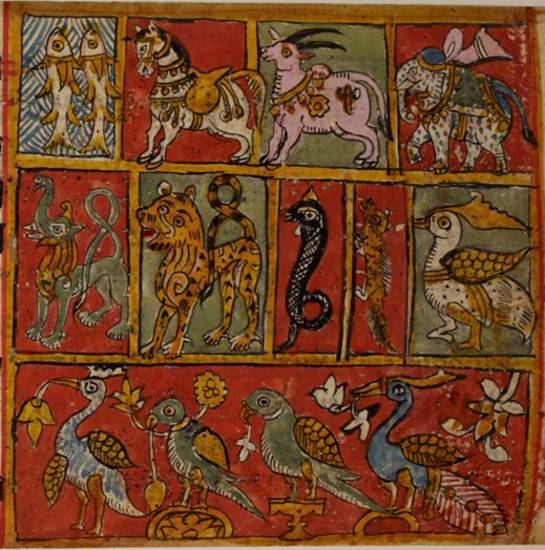
Five-sensed animals
Image by British Library © CC0 1.0 (Creative Commons Public Domain)
The last three kinds of knowledge go by the Prakrit term paccakkha or the Sanskrit term pratyakṣa. These kinds of knowledge can be gained from having the capacity for a soul, and do not depend on the senses or mind. They are:
- clairvoyance – avadhi-jñāna
- telepathy – manaḥ-paryāya-jñāna
- omniscience – kevala-jñāna.
Clairvoyance and telepathy are partly direct, whereas omniscience is totally direct. Gaining these kinds of knowledge requires an increasing degree of purity in mind and conduct. Omniscience is acquired only with perfect purity.
The Nandī-sūtra describes these classes of knowledge in relationship to their prerequisites and possessors. The attributes, durations and scopes of these kinds of knowledge are defined as well, in technical detail.
There are various types of clairvoyance. When considered to relate to one’s own condition – bhava-pratyaya – it is manifested in gods and hell-beings. Humans and animals with five senses can achieve clairvoyance resulting from the ending and destruction of karmas – kṣayopaśama – from ascetic practices.
Telepathy is acquired only by human beings born in the lands of the Jain universe where karma prevails – the karma-bhūmis. This means humans born in the Lands of Enjoyment – bhoga-bhūmi – where the notion of spiritual progress is irrelevant, cannot achieve it. This knowledge implies the possession of right faith – samyag-darśana – and a life of self-control, such as the one led by Jain ascetics. This type of knowledge is divided into various sub-categories depending on what it enables the individual to grasp, such as matter, space or time.
Omniscience is the ability of the soul to grasp everything everywhere relating to past, present and future all at once. It is achieved only when all possible varieties of karmas have been totally destroyed so that total purity is reached.
‘Anuyogadvāra-sūtra’

Units of measurement
Image by Diwakar Prakashan / Padma Prakashan © Diwakar Prakashan / Padma Prakashan
In Muni Puṇyavijaya’s words, ‘the Nandi which is of the form of five Jñānas serves as a mangala in the beginning of the study of the Āgamas; and the Anuyogadvāra-sūtra serves as a key to the understanding of the Āgamas’ (1968: Introduction p. 45). The second Cūlikā is highly technical and not easy to summarise. It can be described as dealing with methods of analysis, providing examples that the reader can use when approaching similar situations in the literature.
Its title can be understood as meaning ‘the doors of exposition’. This stresses that the text focuses on the ways of approaching and understanding concepts. There are four doors:
- commencement – upakrama
- position – nikṣepa
- exposition of concepts and their application in different contexts – anugama
- exposition of different aspects viewed from different angles – naya.
Here, the subject is the concept of ‘necessary duties’ – āvaśyaka. However, out of a total of six, only the first one – ‘equanimity’ or sāmāyika – is treated. The reason is that the Anuyogadvāra is concerned with analytical procedures, not with content or meaning. Hence the first one is taken as an example of a method of analysis.
Such a method implies, for instance:
- explaining in detail the title of a work, chapter or section
- listing synonyms or equivalents of the term to be explained
- considering this term using a list of given parameters – nikṣepa.
This nikṣepa consists of:
- name – nāma
- arbitrary attribution – sthāpanā
- substance – dravya
- essence – bhāva.
This approach is widely found in the Prakrit verse-commentaries, the niryuktis, to which the Anuyogadvāra-sūtra is rather close in spirit.
In the course of the development of a topic, many technical matters are also treated, which relate to:
- measures of space and time, from indefinitely small to indefinitely enormous
- numbers
- quantities
- mathematical concerns in general.
These analyses are motivated by the term anupūrvī – ‘serial sequences’ – which is another understanding of the term ‘commencement’. Hence the Anuyogadvāra-sūtra is also of interest to historians of computation and mathematics in ancient India.
Historians of other areas of knowledge also find interesting material in this text, some of which is presented in the table.
|
Topic |
Detail |
|---|---|
|
grammar |
grammatical congruence in gender or number
|
|
music |
discussion of the seven musical notes – svara – including:
|
|
poetics and dramaturgy |
unique list and description of the ‘nine sentiments’ – nava rasas:
|
|
astrology and prediction |
discussion of elements of physiognomy and prophecy on the basis of observation of signs in the sky |
Commentaries
These two works have been the subject of many commentaries over the centuries, like other categories of the Śvetāmbara canon. The Cūlikās, however, have not attracted all kinds of commentary. Surviving types of commentary that focus on them are:
- the Prakrit prose commentaries – cūrṇis – written over the sixth to seventh centuries by a certain Jinadāsa, about whom nothing much is known
- the Sanskrit commentaries.
|
Cūlikā |
Prakrit prose commentary |
Sanskrit commentary |
|---|---|---|
|
Nandī-sūtra |
cūrṇi by Jinadāsa |
by Malayagiri in the 12th century |
|
Anuyogadvāra-sūtra |
cūrṇi by Jinadāsa |
by Hemacandra Maladhārin in the 12th century |
