Śvetāmbara Mūrti-pūjaka

The Mūrti-pūjak Śvetāmbaras form the largest group within the Śvetāmbaras, one of the two main sects in the Jain faith. Meaning ‘white-clad’ in Sanskrit, the term Śvetāmbara describes the white clothing of monks and nuns in this order. The name Mūrti-pūjaka means ‘worshipper of images’ in Sanskrit, referring to the worship of images of the Jinas. The term arose between the 15th and 17th centuries, chiefly to distinguish members of this sect from Śvetāmbaras who do not worship images, namely the Sthānaka-vāsins and the Terāpanthins.

The largest subsect within the Śvetāmbara sect is the Mūrti-pūjak, who in turn are made up of several smaller subsects.

All Śvetāmbara sects agree on several fundamental areas but hold different beliefs and have diverse practices in some respects. All Jains believe in the central doctrines of the religion, though the sects maintain various interpretations and practices.

Early development of Śvetāmbara sects
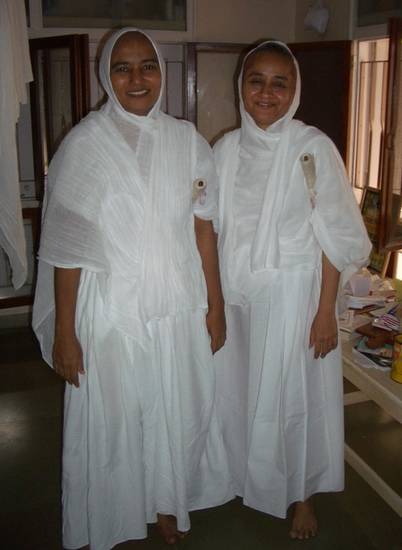
Two Śvetāmbara nuns in white monastic robes – saṃghaḍī – in their lodgings – upāśraya. They are barefoot and hold their monastic brooms – rajoharaṇa or oghā – under their left arms. Jain nuns of all sects wear white robes that cover them from head to toe

Two Śvetāmbara nuns
Image by Nalini Balbir © Nalini Balbir

The earliest development of the sect is found in one of the most important texts for Śvetāmbara Jains. The Kalpa-sūtra lists mendicant lineages – equivalent to sects – in its second section, called the Sthavirāvalī – the String of Elders. This is the main record of sectarian development, which dates back to the time of the 24th Jina, Mahāvīra, according to tradition.

While a monk, Mahāvīra had 11 disciples – gaṇa-dharas – who led groups of mendicants – gaṇas. There were nine gaṇas because there were two gaṇa-dharas simultaneously in charge of two groups. These chief disciples did not have any successors to continue the work of spreading Mahāvīra’s teachings, except Ārya Sudharman. All the Śvetāmbara sects claim monastic descent from him, apart from the Upakeśa-gaccha. This group maintains it originated with Pārśvanātha or Lord Pārśva, the 23rd Jina.

The mendicant lineages in the String of Elders record succeeding religious teachers who claim spiritual descent from a common mendicant ancestor. The latest in the list is Devarddhi Kṣamāśramaṇa. He is the monk who organised the final recitation of the scriptures at Valabhī, in Gujarat, in the fifth century CE. This produced the Śvetāmbara canon.

Even so, later texts on the transition from oral to written scriptures suggest the existence of two different traditions of scriptural recitation. The Gujarati towns of Mathurā and Valabhī appear to have each had separate traditions. This indicates that differing views over certain points of scripture were strongly held even in the first years of the Śvetāmbara sect.

Worship of images

The ritual installing an idol in a temple – pratiṣṭhāmahot-sava – is a key event for image-worshipping Jains. The idol's snake-hood headdress identifies it as Pārśva, the 23rd Jina. The golden śrīvatsa on the chest is prominent on this Śvetāmbara figure

Idol of Pārśva in procession
Image by Chandu Shah © Chandu Shah

All the Śvetāmbara sects agree on the:

The major point of contention relates to the correctness of worshipping images. Disagreements on various matters are likely to have always existed within the Śvetāmbara sect. However, during the late medieval period the notion of image worship became the focus of dispute. In the 15th century this led to those who were against image worship splitting from the main Śvetāmbara sect. This group developed into the sect called the Sthānaka-vāsins. Some members later separated from the Sthānaka-vāsins to form the Terāpanthins, who are also opposed to the worship of images.

The Sanskrit term Mūrti-pūjaka thus only came into use from around the time of the schism with the Sthānaka-vāsins. It means ‘worshipper of images’, which refers to the practice of praying to images of the Jinas and perhaps gods and goddesses. Synonyms are the modern Indian words Derāvāsī – which literally means ‘staying in temples’ – and Mandir Mārgī – ‘temple-followers’.

The aniconic or non-image-worshipping sects also demonstrate other differences from the Mūrti-pūjaks. Examples include the number of sacred texts in the canon and the use of the mouth-cloth for monks and nuns. These differences are likely to have developed gradually, partly as a means to strengthen their identities as separate organisations.

Mūrti-pūjaks

Mūrti-pūjaks form the largest Śvetāmbara sectarian tradition. Within the Mūrti-pūjak tradition there are several subsects called gacchas. They all recognise the authority of 45 canonical scriptures.

Sects within the Śvetāmbara Mūrti-pūjaks

Śvetāmbara monks walk down a Mumbai street accompanied by lay men. The monks are barefoot and holding their mouth-cloths and monastic staffs. Jain mendicants live in small bands and travel most of the year in the traditional wandering lifestyle – vihāra

Śvetāmbara monks
Image by Hoorob – Robert Tyabji © CC BY-NC-ND 3.0

In the medieval period the Mūrti-pūjaks divided into a number of gacchas, which all trace their origins back to Mahāvīra’s disciple Sudharman. Arising in reaction to practices they considered lapses or wrong behaviour, they aimed to re-establish the original purity of the early religion – even when they introduced what can be viewed as innovations. They grew up around certain monastic leaders – sūris – and then developed around monastic lineages. These mendicant lineages themselves sometimes split into branches – śākhās. This is an ongoing phenomenon.

Main Śvetāmbara Mūrti-pūjak subsects

Name

Founded

Early teachers

Details

Mendicants in 1996

Mendicant equipment

Tapā-gaccha

1228

  • Jagaccandra-sūri
  • Devendra-sūri

Largest monastic order. The name emphasises concern with austerities – tapas.

5,568

red alms bowl with black stripe

Añcala-gaccha

1179

Āryarakṣita-sūri

Second largest monastic order and one of the few headed by a single mendicant. Also called Vidhipakṣa, Añcala-gaccha or Acala-gaccha. The second term refers to the rule that lay people use the hem of their garments – ancala – and not the mouth-cloth when performing rites such as repentance and confession. The other names indicate that they wish to see themselves as followers of the true ritual and as steady or firm.

252

black alms bowl

Kharatara-gaccha

11th century

  • Vardhamāna-sūri
  • Uddyotana-sūri
  • Jineśvara-sūri
  • Jinadatta-sūri

Third largest monastic order, with few monks and more nuns. The name means ‘harsh, sharp’. Various legendary accounts date it earlier. They emphasise the four teachers known as Dādā-gurus:

  • Jinacandra-sūri
  • Jinacandra-sūri II
  • Jinadatta-sūri
  • Jinakuśala-sūri.

Statues or pādukās of these men are often found in their temples.

224

black alms bowl with red stripe

Pūrṇimā-gaccha

1093 or 1103

Ācārya Candraprabha-sūri

Residual in contemporary India. The name points to its defining characteristic. This is that fortnightly repentance – pratikramaṇa – should be performed on the days of the new moon and full moon – purṇimā – not on the 14th day as other Mūrti-pūjak subsects advocate.

No information

No information

This table is based on information published in Peter Flügel, Demographic Trends in Jaina Monasticism, 2006.

There are other, minor, subsects, which are still current today. These had a small number of monks and nuns in 1996 and are the:

  • Pārśvacandra-gaccha – 72 mendicants
  • Vimala-gaccha – 42 mendicants
  • Tristuti-gaccha – 175 mendicants.

The first subsect was established ‘in 1516 CE by Pārśvacandra-sūri, the leader of the Nagpur branch of the Tapā-gaccha. He broke off from the main branch of the Tapā-gaccha, arguing that, in contrast to commonly accepted karma theory, some actions are karmically and morally neutral, with no effect on the individual’s soul’ (Cort 1991 : 657).

The latter two subsects are subdivisions of the Tapā-gaccha.

The A(ñ)calagaccha Viewed from Inside and from Outside

Nalini Balbir

History of Jaina Monachism from Inscriptions and Literature

Shantaram Bhalchandra Deo

The Jains

Paul Dundas

The Jaina Path of Purification

Padmanabh S. Jaini

The Unknown Pilgrims: The voice of the sādhvīs – the history, spirituality, and life of the Jaina women ascetics

N. Shāntā

Historical Dictionary of Jainism

Kristi L. Wiley

Parshvanath Vidyashram Research Institute

The Parshvanath Vidyashram Research Institute focuses on research into Śvetāmbara Jainism. Based in Varanasi, in Uttar Pradesh, it has a manuscript library and publishes books and the Śramaṇ journal in Hindi and English.

https://pv-edu.org/

Paryuṣaṇ recipes

Recipes suitable for cooking during the Śvetāmbara festival of Paryuṣaṇ from the ramkicooks blog. During this annual festival of eight days, observant Jains tend to follow stricter than normal rules regarding food. Most families give up fresh vegetables, eating only grains, pulses and dairy produce. Taking additional vows to fast completely or partly for any given day of the festival, particularly the first and last days, is common.

http://bp2.blogger.com/_omh5NVW1jAg/SISQmzlhjKI/AAAAAAAAAW4/LtJQ1uGgr9U/s1600-h/Paryusyan-Jain-recipes.jpg

Svetāmbara Jina emblems

This picture from the Jeevraksha blog gives the emblems – lāñchana – of the 24 Jinas according to the Svetāmbara sect.

http://2.bp.blogspot.com/_xHZFB-N3uug/TNNW_DqmmeI/AAAAAAAAAzw/v43mxT0R1RY/s1600/jain_symbols2.jpg

Bhaktāmara-stotra with yantras – part three

This YouTube slideshow features a recording of the Bhaktāmara-stotra, a famous Sanskrit hymn of praise to the first Jina, Ṛṣabha. The title Devoted Gods comes from the first verse, which describes how all the gods offer homage to Ṛṣabha. The slideshow includes colour-tinted yantras and mantras to help listeners meditate. The yantras in this part begin with the svastika, ancient Asian symbol of well-being and good fortune.

This is the third of four parts of the 44-verse Śvetāmbara hymn, covering stanzas 26 to 38.

http://www.youtube.com/watch?v=X5vxTizyynA

Kārttika Pūrṇimā – part 1

The festival of Kārttika Pūrṇimā marks the end of the rainy season and the start of ordinary activities, which stop during the monsoon period. Men chant and clap loudly before the idol of a Jina from the temple is borne in procession – ratha-yātrā.

This two-part YouTube video records the 2010 Kārttika Pūrṇimā festival celebrated in Kolkata in West Bengal by Śvetāmbara Jains. This is the first part and you can watch the second part.

http://www.youtube.com/watch?v=T5SnSFbxbq4

Bhogilal Leherchand Institute of Indology

The Bhogilal Leherchand Institute of Indology in New Delhi focuses on scholarly research into Śvetāmbara Jainism. With a library of manuscripts for research, it organises academic seminars and publishes scholarly books.

http://blinstitute.org/

Introduction to Jainism – part 1

This extract from a BBC documentary called The Frontiers of Peace introduces the ancient Indian religion of Jainism. A Śvetāmbara monk explains some of the main principles of Jainism, especially non-violence. The programme mentions the influence of Jains in India and on the work of Mahātma Gandhi. This 2010 YouTube video is the first of four parts. See the next part at: http://www.youtube.com/watch?v=UHMQRmRKh_U

http://www.youtube.com/watch?v=IPscKFV5yKU

Mahavir Aradhana Kendra – institute

Based around the pilgrimage site of Mahaviralaya – a temple dedicated to Mahāvīra, the last Jina – Mahavir Aradhana Kendra is a manuscript library and research institute, which publishes academic books, chiefly on Śvetāmbara Jainism. There is also a museum that includes the monastic equipment used by Gacchādhipati Ācārya Śrī Kailāsaāgara-sūrīśvara Mahārāj.

http://kobatirth.org/

Poṣa-daśamī – part 1

The Poṣa-daśamī festival celebrates the birth of the 23rd Jina, Pārśvanātha or Lord Pārśva. Held in late December or early January in the Western calendar, Poṣa-daśamī is also known as Pārśvanātha-jayantī. Typically of many Jain festivals, an idol from a local temple is the centre of a procession through the streets – ratha-yātrā. The procession includes decorated animals, musicians, lay Jains and white-clad nuns. The Jina image is hung with bright flower garlands and is fanned with fly-whisks, symbolic of royalty. Lay Jains dance, sing and clap as the statue is brought into the temple at the end of the procession.

This two-part YouTube video records the 2010 Poṣa-daśamī festival in Jaipur, Rajasthan as celebrated by Śvetāmbara Jains. This is the first part .

http://www.youtube.com/watch?v=YihWayx7NKQ

Watch the second part here
https://www.youtube.com/watch?v=UddsDpAwYAY

Sketch of a siddhacakra

This sketch of a siddhacakra is found in a manuscript held in the National Gallery of Australia. The Svetāmbara yantra or mystical diagram has nine parts, representing key elements of Jain doctrine. In the centre of the stylised lotus flower is a Jina and around him on alternating petals sit the other beings that make up the five highest beings. On the petals between them are phrases representing the ‘four fundamentals’.

http://artsearch.nga.gov.au/Detail-LRG.cfm?IRN=157990&View=LRG

Re-enactment of the story of Candanabālā

This slideshow displays the re-enactment of the story of Candanabālā, who offered Mahāvīra appropriate food to break his fast. Sold into slavery, the beautiful princess has her lovely hair chopped off and is starved for three days. Even so, her first act when released is to offer alms to a passing mendicant. He is Mahāvīra, who becomes the 24th Jina, and he has been fasting for nearly six months. Candanabālā’s act of selfless charity despite her suffering causes her hair to be restored and her true identity revealed. The story of this virtuous woman – one of the soḷa satī – emphasises the importance of offering alms correctly. Acting out such stories is an important part of many Jain festivals. This re-enactment on YouTube was performed by Śvetāmbara Jains in Melbourne, Australia during the festival of Paryuṣaṇ in 2010.

http://www.youtube.com/watch?v=vO4tU0lvVTw

Samavasaran Temple

A recent building, the Samavasaran Temple is in the town of Palitana at the foot of Mount Shatrunjaya, one of the most important pilgrimage sites for Śvetāmbara Mūrti-pūjaka Jains. Built as a stepped circle, the temple recreates the samavasaraṇa or universal gathering. When a Jina reaches omniscience, he sits in the centre of a samavasaraṇa the gods have built for him so all living beings can hear him preach.

The HereNow4U website has images of the temple.

http://www.herenow4u.net/index.php?id=116124

Lalbhai Dalpatbhai Institute of Indology and Museum

Based in Ahmedabad, Gujarat, the Lalbhai Dalpatbhai Institute of Indology is a national centre affiliated to the National Mission for Manuscripts. With a library of manuscripts, it has a specific section for manuscript preservation and cataloguing. In addition to holding seminars for researchers into Śvetāmbara Jainism, the L. D. Institute publishes books and the Sambodhi journal in English, Hindi and Gujarati. The L. D. Museum, on the same site, holds an important collection of Jain artefacts – statues, manuscripts, the N. C. Mehta Collection of paintings and a gallery of monastic equipment that belonged to Muni Puṇyavijaya.

http://www.ldmuseum.co.in/

Introduction to Jainism – part 2

This extract from a BBC documentary called The Frontiers of Peace explores the relationship between Jain traditions and modernity. A Jain lay man tells how he reconciles his faith with his industrial business interests. A Śvetāmbara monk explains the significance of his monastic broom – known as a rajoharaṇa or oghā – including the eight auspicious symbols wrapped around the handle. A nun leads lay followers in the rite of confession – pratikramaṇa. A young woman creates auspicious symbols in rice as an offering as she talks about her decision to become a nun. This 2010 YouTube video is the second of four parts. See the next part at: www.youtube.com/watch

http://www.youtube.com/watch?v=UHMQRmRKh_U

Seven Wonders of India – Palitana Temples

The Svetāmbara pilgrimage centre at Mount Shatrunjaya is showcased in this NDTV video on YouTube. Jain pilgrims are shown climbing the steep hill – some carried in a kind of palanquin called a ḍolī – and worshipping in some of the hundreds of temples on the twin hills. The presenter gives a brief outline of the Jain faith and mentions the navanū – ‘99fold’ – pilgrimage, which is one of the hardest and most demanding ones.

Beginning in 2008, the New Delhi Television show Seven Wonders of India asked viewers to vote for their favourite seven sites in the country over a year. Part of a publicity campaign organised by the Ministry of Tourism, the show’s presenters visited many sites considered potential winners.

http://www.youtube.com/watch?v=pZhDyKqfSUI

Śvetāmbara initation candidates in the crowd

As part of the renunciation ceremony to become a monk or nun – dīkṣā – the initiation candidates pass through a joyful crowd, who throw sandalwood powder over them. The initiates have already shaven and plucked out their hair and wear the white monastic robe of Śvetāmbara mendicants. This undated ceremony on YouTube takes place in Gujarat.

http://www.youtube.com/watch?v=R7KAt5_6HUw

Views of the temple at Ranakpur

One of the foremost Śvetāmbara pilgrimage sites, the main temple at Ranakpur has around 1,400 intricately carved marble columns. This collection of photographs of the Ādinātha temple at Ranakpur in Rajasthan is presented by Professor Frances W. Pritchett of Columbia University in New York.

http://goo.gl/L5SnO

Mahāvīra renounces

This illustration is from a page of the Śvetāmbara scripture of the Kalpa-sūtra in the collections of the Philadelphia Museum of Art. It shows the last Jina, Mahāvīra, performing the rite of keśa-loca – ‘pulling out of the hair’ – which indicates indifference to the body. It is part of the initiation ceremony of dīkṣā, in which an initiate renounces the world and becomes a mendicant. He is watched by Śakra, king of the gods, who takes an active role in the lives of the 24 Jinas.

http://www.philamuseum.org/collections/permanent/105108.html?mulR=656|9

A Śvetāmbara nun descends from Shatrunjaya

A nun from a Śvetāmbara Mūrtipūjaka mendicant order runs barefoot down the steps leading down from Mount Shatrunjaya. This temple-city in Gujarat is one of the most significant Śvetāmbara Mūrtipūjaka pilgrimage sites. The steep path from the foot to the summit, where the principal shrines are found, has around 4000 steps.

http://www.flickr.com/photos/30120194@N02/5070779493/

Lorem ipsum dolor sit amet, consectetur adipiscing elit. Ut elit tellus, luctus nec ullamcorper mattis, pulvinar dapibus leo.

Contents