
Sanskrit epics
Legends, myths and stories have played an important role in Indian culture throughout history. Composed and sung by bards at local courts, songs about legendary kings and heroes were very popular. Some centuries before the Common Era narrative cycles of hymns were combined to form what would become known as the two great Sanskrit epics, the Mahābhārata and Rāmāyaṇa.
According to most scholars, the oldest kernels of both these epics were not particularly religious, but later redactions and additions transformed the Mahābhārata and the Rāmāyaṇa into important scriptures of Hinduism. One reason is that they introduced two important deities:
- Kṛṣṇa in the Mahābhārata
- Rāma in the Rāmāyaṇa.
Mahābhārata

Kṛṣṇa and the Pāṇḍavas
Image by Gift of Doris and Ed Wiener, Brooklyn Museum © No known copyright restrictions
With its title meaning ‘the great [war] of the descendants of Bharata’, the Mahābhārata revolves around a legendary battle between two camps within the same family, the Pāṇḍavas and the Kauravas. Sons of gods, the Pāṇḍavas are five brothers who share one wife, Draupadī. The brothers are supported by their many allies, including the deity Kṛṣṇa, in the brutal war against their cousins. They defeat the 100 Kauravas in a horrific 18-day battle.
Aside from the story of the war, the epic is highly encyclopaedic. It claims to contain all the knowledge in the world, including many legends and stories as well as philosophical treatises. To the main epic an appendix was later added, called the Harivaṃśapurāṇa – Ancient Book about the Dynasty of Hari [=Kṛṣṇa]. This is the first full biography of Kṛṣṇa and is sometimes considered an autonomous work.
With 100,000 verses, the Mahābhārata is thought to be the longest poem in the world. It is traditionally ascribed to Vyāsa. As the grandfather of both the Pāṇḍavas and the Kauravas, he is also the narrator and a character in the story. The text as it stands now came into being over several centuries, between 400 BCE and 400 CE.
Rāmāyaṇa
Translated as the Journey of Rāma, the Rāmāyaṇa recounts the story of Rāma, a prince of Ayodhyā.
Through the intrigues of his stepmother, Rāma is banished to the forest. His beloved wife Sītā decides to accompany him into exile. In the forest Sītā is kidnapped by the demon king Rāvaṇa. He rules the Rākṣasa demons, who inhabit the island of Laṅkā. Together with his younger brother Lakṣmaṇa, Rāma enlists the help of the Vānaras, the monkey people, to rescue Sītā and kill Rāvaṇa. The Vānaras are led by King Sugrīva and his charismatic minister Hanumān. After being reunited with Sītā, Rāma returns to Ayodhyā, where he ascends to the throne.
According to tradition the epic of about 24,000 verses was composed by the legendary seer Vālmīki. This Sanskrit epic waxed into its current form between the sixth century BCE and the second century CE. From an early date other tellings of the Rāma story were composed, such as an abbreviated version found in the Mahābhārata or a Buddhist version in the Dasaratha Jātaka.
Mahābhārata and Rāmāyaṇa in Jainism
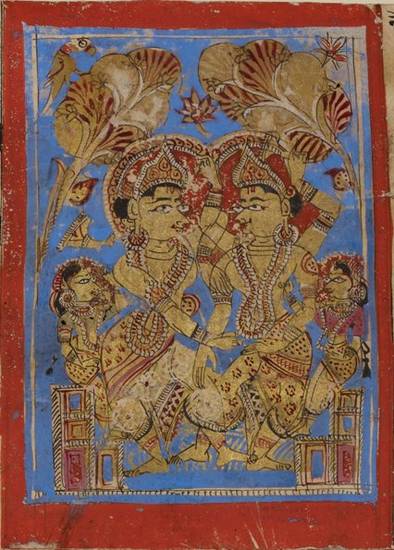
Nemi and Kr̥ṣṇa
Image by British Library © CC0 1.0 (Creative Commons Public Domain)
Even though the stories in these two great epics of Indian culture are certainly the most well-known and authoritative versions, many other tellings have been composed over the past 25 centuries. Poets from different social, ideological, geographical and cultural backgrounds have brought their own concerns and experiences to the tales. Jainism too incorporated these legends into its own world view and, from the first centuries of the Common Era onwards, poets began creating Rāmāyaṇas and Mahābhāratas from a Jain perspective.
The Jain Mahābhārata and Rāmāyaṇa underline some key ideas of Jain doctrine in their concern for non-violence and karma and the desirability of renouncing the world to become Jain ascetics. A good example is the story of Neminātha or Lord Nemi, the cousin of the Jain Kṛṣṇa, who is so repulsed by the violent death of the animals that will provide food for his wedding feast that he becomes a monk.
Paralleling the high status of the Mahābhārata and Rāmāyaṇa among Hindus, Jains accord honoured places to these narratives and their main characters, integrating them into Jain Universal History. The heroes and their principal enemies are categorised as śalākā-puruṣas or mahā-puruṣas – ‘great men’.
According to Jain Universal History, each progressive and regressive half-cycle of time, nine Baladevas and their nine half-brothers – the Vāsudevas – battle their mortal enemies, the Prati-vāsudevas. The main characters in the Jain epics are assigned specific roles in the Jain trios, which comprise a Baladeva, a Vāsudeva and a Prati-vāsudeva.
|
Epic |
Character |
Role as ‘great man’ |
|---|---|---|
|
Rāmāyaṇa |
Rāma |
eighth Baladeva |
|
his younger brother Lakṣmaṇa |
eighth Vāsudeva |
|
|
his enemy Rāvaṇa |
eighth Prati-vāsudeva |
|
|
Mahābhārata |
Kṛṣṇa |
ninth and final Vāsudeva |
|
his older brother Balarāma |
ninth and final Baladeva |
|
|
his enemy Jarāsaṃdha |
ninth and final Prati-vāsudeva |
References in Jain literature
In the Śvetāmbara canonical texts references are made to the categories of śalākā-puruṣas, but there is no trace of an actual Jain telling of the Rāmāyaṇa in this corpus. The god Kṛṣṇa, on the other hand, is mentioned several times in the canonical texts and episodes of his life are narrated in a number of places. However, his complete biography is absent from the canon, along with those of the other characters of the Mahābhārata.
The biographies of the 63 great men typically form the subject of Jain Purāṇic literature, which arose during the first centuries of the Common Era. The Purāṇic context places the stories of the śalākā-puruṣas in the mouth of Mahāvīra or his first disciple, Indrabhūti Gautama. This grants them very high authority and status.
|
Title |
Author |
Details |
|---|---|---|
|
Paüma-cariyam – Acts of Padma |
Vimala-sūri |
written in Māhārāṣṭrī Prākrit, before the fifth century |
|
Padma-purāṇa – Purāṇa of Padma |
Raviṣeṇa |
written in Sanskrit in 678 |
|
Paüma-cariu – Acts of Padma |
Svayaṃbhū-deva |
written in Apabhraṃśa in the 9th to 10th century |
Jain retellings of the Rāmāyaṇa and the Mahābhārata are numerous but some have been particularly influential. The tales are also often found in other Jain repositories of stories, such as the kathākośas – ‘treasures of stories’.
|
Title |
Author |
Details |
|---|---|---|
|
Harivaṃśa-purāṇa |
Jinasena Punnāṭa |
783 |
|
Riṭṭhaṇemi-cariu – Biography of Nemi |
Svayambhū-deva |
written in Apabhraṃśa in the 9th to 10th century |
|
Pāṇḍava-carita – Acts of the Pāṇḍavas |
Devaprabha-sūri |
1214 |
|
Pāṇḍava-purāṇa – Purāṇa of the Pāṇḍavas |
Śubhacandra |
1552 |
