Outside sectarian traditions
The two movements connected with Rājacandra and Kānjī-svāmī lay great emphasis on practising asceticism and focusing on developing the soul. They highlight how lay people can live by ascetic principles, which Jains believe help spiritual progress, without completely rejecting the householder status.
The development of these movements contrasts with the standard pattern of founding a new sect or religious organisation within the Jain faith. Most Jain sects have been initiated by a charismatic individual monk, who establishes his followers in a new group. This band usually disagrees with the views held by the majority of their original sect. The breakaway group has gradually developed a mendicant lineage, around which lay followers gather. Though they may differ on certain points, they probably remain loosely affiliated to the broader sect, with whom they agree in many areas of scriptural interpretation and religious practice.
However, these new movements are not affiliated with any sect. Although inspired by historical writers and thinkers who may be associated with certain sects, mainly Digambara, their founders did not believe that the answers to spiritual questions lie with one group or another. Indeed, these movements explicitly reject divisions such as sectarian groupings, mendicant or lay status and caste. This attracts followers from all kinds of background, who may believe that they can find greater religious fulfilment and spiritual freedom outside the traditional sectarian system.
Rājacandra movement
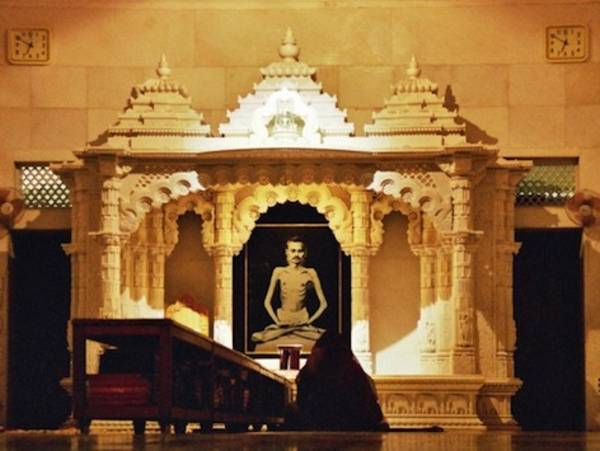
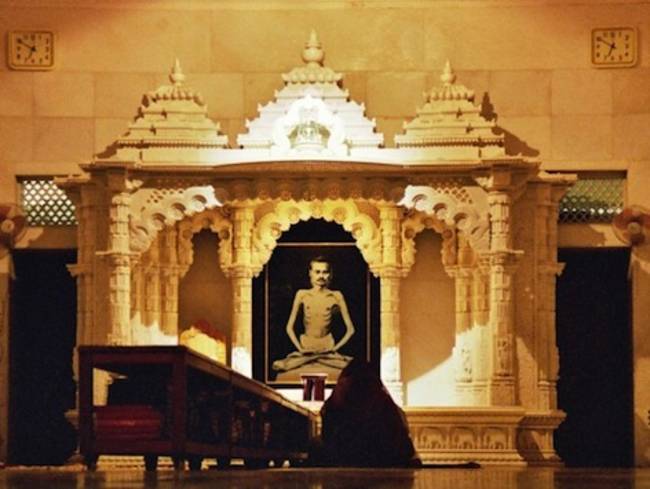
Shrimad Rajchandra temple
Image by Ravin Mehta © Ravin Mehta
Śrīmad Rājacandra was a well-known lay figure of the late 19th century, inspired by the Digambara mystical tradition. Associated with Gujarat, he lived as a lay man, never taking initiation as a monk. The keywords of his teachings are:
- asceticism
- understanding the deeper meaning of Jainism beyond sectarian differences
- the ultimate goal of full realisation of the soul.
Technically Rājacandra did not found any group or sect, although he attracted devotees of his works and personal example in his lifetime. However, a large number of followers revere him, especially among the diaspora, and his ashram in Agās in Gujarat has become a sort of pilgrimage centre. Of late, ‘there are signs that a lay guru lineage is evolving’ (Dundas 2002: 265). His disciples are loosely organised in the Rāj Bhakta Mārg, which means ‘Path followed by the devotee of Rājacandra’.
Kānjī-svāmī-panth

Kānjī-svāmi lecturing
Image by unknown © unknown
This is a Digambara-based non-sectarian tradition of the 20th century founded by Kānjī-svāmī (1889–1980).
Born into a Śvetāmbara Sthānaka-vāsin family, Kānjī-svāmi became a monk in this tradition. But when he discovered Kundakunda’s works, with their emphasis on the nature of the soul, he had a change of heart. In 1934, he publicly disrobed and turned to the Digambara path, which he considered the only true one. Stressing the higher level of truth, Kānjī-svāmi was a charismatic preacher and attracted many followers.
The Kānjī-svāmī-panth is a good instance of a non-sectarian Jain movement that attracts people from all religious backgrounds. It has no association with monastic orders even though Kānjī-svāmi was a monk. Songadh in Gujarat was the first centre linked to the Kānjī-svāmī movement and new centres are appearing regularly in India. Kānjī-svāmi’s spiritual path is also successful among the Jain diaspora.
Contemporary appeal

Fourfold community
Image by Wellcome Trust Library © Wellcome Library, London
The divisions between the principal Jain sects of Digambara and Śvetāmbara date back to the early Common Era. New movements that ignore sectarian differences seem to draw the Jain diaspora in particular. A large proportion of the followers of Rājacandra and Kānjī-svāmi are Jains who live in the West. Naturally, these movements also have numerous devotees in India but they appear to better meet the needs of Jains outside India in some respects.
Firstly, these movements are less formal in nature than sects in India, whose members may not have much contact with Jains of other sects. Jains outside India tend to downgrade sectarian concerns, preferring to find areas of common agreement with other Jains. Their shared Jain values and concerns override any sectarian differences.
Secondly, the new movements also place greater reliance on personal practice. Monks and nuns do not usually travel outside India because of the restrictions on their using mechanical transport. Therefore diaspora Jains will have far fewer chances to meet any mendicants. The concept of the ‘fourfold community’ underlines the interdependence of lay and mendicant Jains in maintaining the Jain faith.
Thirdly, these movements allow the laity to express their religiosity without going as far as renouncing worldly concerns entirely. Becoming a mendicant is a joyous event but it is generally acknowledged that it is not for everyone and that life as a householder is valuable too. Since Jains who live outside India are overwhelmingly lay people, these movements honour the lay practice of faith. Without mendicants, some of the traditional practices do not meaningfully exist, such as the giving of alms. The lack of opportunity for close contact with the mendicant elements of the fourfold community forces Jains of the diaspora to continue with their faith in fresh ways.
The popularity of such movements may indicate that a wider Jain identity feels more comfortable to contemporary Jains living outside India, who may face greater difficulty in maintaining Jain values.