
Story of Rājīmatī
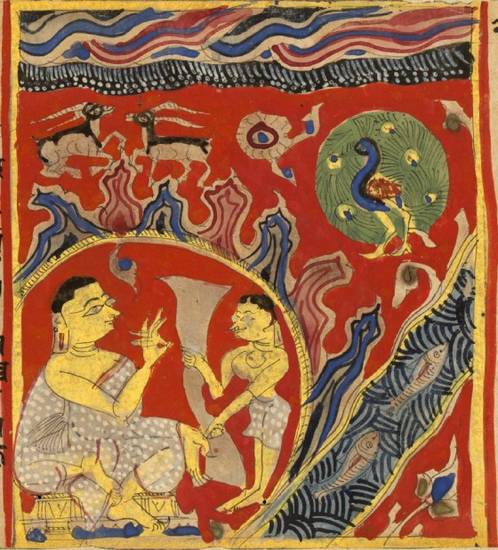
Rājīmatī and Rathanemi in the cave
Image by Victoria and Albert Museum © V&A Images/Victoria and Albert Museum, London
Rājīmatī’s tale was originally found within the narrative of the life of the 22nd Jina, Neminātha or Lord Nemi. The different Jain sects largely agree upon core incidents of the story but the Śvetāmbara and Digambara sects differ on the course of events after Nemi leaves his bride. The tale has probably been adapted partly to support conflicting views on the religious position of women in the two sects.
Prince Nemi had wanted to become an ascetic from an early age. After much cajoling, however, the Jina-to-be Nemi was engaged to Princess Rājīmatī, the daughter of King Ugrasen. When Nemi’s wedding procession arrived at Rājīmatī’s home on the day of their wedding, her mother blessed him at the threshold of the door.
But when Nemi heard the crying of the animals that were to be killed for the wedding feast he felt deep compassion for them and disgust for the world. He decided to renounce the life of the householder at once. He turned around and left his bride standing at the threshold of her house.
Rājīmatī lamented her fate but, when it was clear that Nemi would not be returning, she decided to follow Nemi to Girnār and renounce with him.
In Śvetāmbara versions, after announcing her intention to renounce, Rājīmatī travels to Mount Girnār to join Nemi. On the mountain she is caught in the rain and ducks into a cave to dry off. She removes her clothing to let it dry. The monk Rathanemi, who is also Nemi’s elder brother, sees her. He approaches Rājīmatī begging her to have an affair with him and then become a nun after they have enjoyed all the worldly pleasures of this rare human birth. Rājīmatī does not accept Rathanemi’s proposal but instead gives him a sermon about the vileness of her own body, comparing herself to vomit. Rathanemi remembers his vows and is transformed into an ideal monk. Rājīmatī renounces the world and becomes a nun.
Finally, according to Śvetāmbara versions Rājīmatī and Nemi achieved liberation at their deaths on the same day and were, in a sense, reunited.
In Digambara versions, Rājīmatī does not become a nun but is still recognised as a satī. Likewise, she and Nemi die on the same day and Nemi achieves omniscience and liberation while Rājīmatī is born again as a male god in heaven.
References in Jain writings
Rājīmatī’s story appears as early as the Uttarādhyayana-sūtra, which dates back hundreds of years, and has been retold many times in medieval and modern Jain tales, poems and hymns. Over the centuries the focus of the tale has changed. It is still a significant story of inspirational renunciation but has also become strongly associated with love, fidelity and marriage. As with the tales of the other 16 satīs – soḷ satī – the themes are believed to be particularly important for women.
The Uttarādhyayana-sūtra contains the earliest surviving version of the story of Nemi and Rājīmatī. In this version, the underlying themes are:
- celebration of compassion
- glorification of renunciation
- vilification of the body, especially the female body.
This telling is the key source for the basic story. Later versions of the Rājīmatī story by monks are clearly influenced by this early and authoritative account.
Love, fidelity and marriage in poetry

Rājīmatī awaits her fiancé
Image by British Library © CC0 1.0 (Creative Commons Public Domain)
By the medieval period, Rājīmatī’s love for Neminātha or Lord Nemi becomes central to the story, linking the Jain and Hindu genres of love poetry. In medieval phāgus – four-month rainy-season poems – and bārahmāsa – twelve-month poems – Rājīmatī waits four months or twelve months for Nemi to return before resigning herself to renunciation.
The oldest known phāgus and viraha bārahmāsās – four and twelve-month poems of separation – are Jain works dedicated to the story of Nemi and Rājīmatī. One of the two oldest phāgus, Rājaśekhara-sūri’s 14th-century Neminātha-phāgu was dedicated to Rājīmatī’s laments after her rejection. The oldest bārahmāsā is Dharma-sūri’s 13th-century Bārah navaū and the oldest viraha bārahmāsa is Vinayacandra-sūri’s 14th-century Rājal Bārahmāsā.
Most of these Jain bārahmāsā poems retell the story of Nemi’s renunciation on his wedding day and the suffering of his jilted fiancée. The phāgu and bārahmāsā poetic forms describe each month in turn, linking the natural environment and seasons with the emotions of the protagonist. Bārahmāsā poems sometimes describe the religious or agricultural year or form a narrative epic lasting a year, but Jain versions focus instead on the suffering of the separated lover and the trials of chastity. In these medieval tellings the Rathanemi episode is not the central scene. Instead, Rājīmatī’s renunciation is presented as the perfect example of not abandoning love. Rathanemi gives up the world of marriage yet stays true to her husband, although in a different way from traditional notions of marital faithfulness.
The most significant later telling is Devcand’s 18th-century text, Nemanāth Saloko. This text is recited publicly at temple celebrations on the day of Nemi and Rājīmatī’s unfinished wedding and that of Nemi’s renunciation.
The story of Nemi and Rājīmatī has been the subject of a multitude of hymns including sajjhāys and stavans. In particular, the genre of veil songs – cunḍaḍī gīt – is almost exclusively dedicated to the story of Rājīmatī. These hymns are performed in temples dedicated to Nemi and on days associated with Nemi’s life but these hymns are also part of the standard repertoire of devotional hymns known to devout Jains. The veil songs are popular at night-singing sessions, especially those led by Marwari Jains, whether or not there is any connection between the performance and Nemi.
In more recent times, many versions of the story have been told in novels and comic books and on audio recordings, such as audio cassettes.
Related rituals
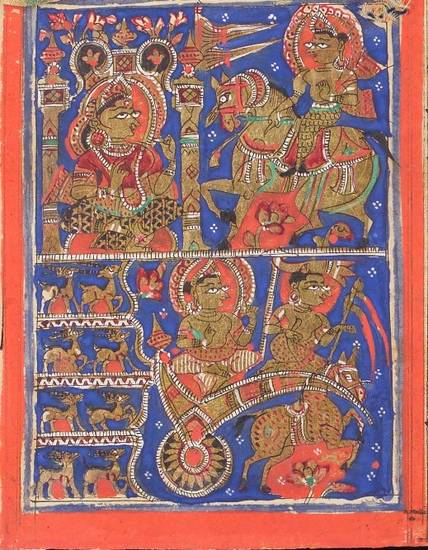
Nemi’s renunciation
Image by Wellcome Trust Library © Wellcome Library, London
The story of Nemi and Rājīmatī has strong associations with renunciation and marriage, clearly brought out in rituals performed each year and frequently at weddings. At first glance the two concepts of renunciation and marriage might seem to be direct opposites, but they can be thought of as complementary states for Jains within the notion of the fourfold community.
Devcand’s 18th-century text, Nemanāth Saloko, is recited annually on Śrāvaṇ bright fifth, the day on which Nemi and Rājīmatī were to be married and on which Nemi renounced the world.
The annual recitation is linked to the Saubhāgya Pañcami Tap – ‘Auspiciousness Fifth Fast’ – which blesses a woman with a long and healthy marriage. Nemanāth Saloko has also been recited at weddings, as this act is widely believed to bless marriages.