Authority and number

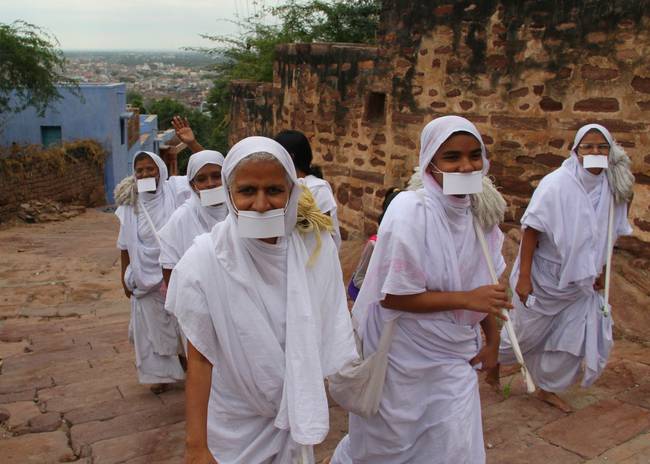
Śvetāmbara Sthānaka-vāsin or Terā-panthin nuns
Image by arjunstc – Arjun © CC BY-NC-ND 3.0
The three main sects of Śvetāmbara Jainism have slightly different canons of holy texts. All of them recognise the Cheda-sūtras as an integral part of their canon.
But the Sthānaka-vāsins and the Terāpanthins, who accept canonical 32 scriptures, have fewer Cheda-sūtras than the Mūrti-pūjaks. The Mūrti-pūjaks count 45 scriptures as canonical and include two additional texts among their Cheda-sūtras. The number of the Cheda-sūtras therefore fluctuates between four and six.
Lists and titles
Four Cheda-sūtras are accepted by all Śvetāmbaras.
|
Name in Prakrit |
Name in Sanskrit |
Meaning |
Details |
|---|---|---|---|
|
Āyāra-dasāo or Dasāo |
Ācāra-daśāḥ or Daśā-śruta-skandha |
‘Ten [chapters] about monastic conduct’ |
10 chapters, of which chapter 8 is the Kalpa-sūtra. |
|
(Bihā)Kappa |
(Bṛhat)Kalpa |
‘[Great] Religious code’ |
6 chapters |
|
Vavahāra |
Vyavahāra |
‘Procedure’ |
10 chapters |
|
Nisīha |
Niśītha |
‘Interdictions’ (title unclear) |
20 chapters |
In the recent Sthānaka-vāsin edition of the Cheda-sūtras, published under the authority of Pravartak Amar Muni, the Niśītha is not included. This is because Pravartak Amar Muni considers that there are ‘differences of opinions’ regarding this text (Illustrated Chhed Sūtra, Hindi introduction, page 8). Even so, according to personal communication from people connected with this project, this text will be published at a later stage.
To reach the number of 45 Āgamas, which has become a sectarian marker for the Śvetāmbara Mūrti-pūjaks, two Cheda-sūtras are added to the four core texts.
|
Name in Prakrit |
Name in Sanskrit |
Meaning |
Details |
|---|---|---|---|
|
Jīya-kappa |
Jīta-kalpa |
Customary rules |
103 verses written by Jinabhadra-gaṇi in the 6th century |
|
Mahā-nisīha |
Mahā-niśītha |
Large Niśītha |
8 chapters in prose and verse |
Ācārya Ānandasāgara-sūri was a monastic leader of the 20th century who edited the Āgamas for publication and made them known to a large audience. He recognised these works in his edition of the Śvetāmbara holy scriptures. This list was also adopted in the 2000 edition of the 45 Śvetāmbara Āgamas by Muni Dīparatnasāgara.
In this context the colophon of a Mahā-niśītha-sūtra manuscript copied in 1777 is significant. It shows how a Śvetāmbara Mūrti-pūjak monk suggested that a copy of the text be made to complete the fast called ‘45 Āgamas’. A group of lay women in Surat, Gujarat, thus commissioned the manuscript. From the 17th century onwards there is evidence that special fasts and ceremonies developed around the worship of the Śvetāmbara Mūrti-pūjaks’ 45 canonical scriptures. The canon and the associated ceremonies are thus public statements of sectarian identity. This copy is a strong gesture in support of the Mahāniśītha-sūtra, the authority of which is not admitted or is disputed by other Śvetāmbara sects.
Finally, the Pañca-kalpa is another text that belongs to this category, although it is not strictly included in it. This is because it is a commentary rather than the scripture about which a commentary is written.
Accessibility
The Cheda-sūtras deal with technicalities of monastic life. Their technical character explains why, in practice, mendicants read and use these texts. But restrictions in readership have also developed in the course of time.
In modern times, some lay people or scholars who are not mendicants have reported being forbidden access to these works. Among some Śvetāmbara monastic orders, such as the Kharatara-gaccha, nuns are not encouraged to read them, though monks can do so.
On the other hand, it is noteworthy that a nun has produced a remarkable scholarly achievement, which includes a translation into Hindi. Samaṇi Kusumaprajñā of the Terāpanthin monastic order has provided one of the most recent editions and studies of one Cheda-sūtra, the Jīta-kalpa (2010). The Terāpanthins are among the Jain monastic orders where nuns are given every encouragement to pursue academic work. The samaṇis, in particular, focus on higher educational attainments.
Language and form
The four Cheda-sūtras recognised by all Śvetāmbaras are written in the variety of Prakrit known as Ardhamāgadhī, like the main categories of the Śvetāmbara canon, such as the Aṅgas and Upāṅgas. This suggests that they may date from the same period, the fifth century.
The first one, the Āyāra-dasāo, is somewhat different from the three other Cheda-sūtras in its form, as it contains verse chapters with lists of terms. The three others are written in prose in the form of aphorisms. They are thus interrelated and, to some extent, have common material. It is likely that they are the result of ‘a process of growth’ (Dixit 1978: 46), perhaps collecting rules that were elaborated in various religious centres at slightly different periods.
The additional Cheda-sūtras demonstrate mixed form and language.
|
Name in Sanskrit |
Details |
|---|---|
|
Jīta-kalpa |
A single sūtra of 103 verses, written by Jinabhadra-gaṇi, a 6th-century author |
|
Mahā-niśītha |
In prose and verse, it combines archaic features found in the Ardhamāgadhī Prakrit and Jaina Māhārāṣṭrī languages |
|
Pañca-kalpa |
A verse commentary – bhāṣya – written in Jaina Māhārāṣṭrī Prakrit, using the metre known as āryā |
These features may indicate that these works do not belong to the core of the canonical scriptures. They explain, at least partly, why their status is a matter of controversy and difference among Mūrti-pūjaks on the one hand and the non-image-worshipping Śvetāmbara sects on the other hand.
Generally speaking, all the Cheda-sūtras make use of considerable technical terminology. They often take these terms for granted and do not provide basic definitions, giving the idea that they are meant for specialists. These specialists would be mendicants, who know the special language. The texts assume knowledge of the other Cheda-sūtra works.
The Cheda-sūtras also use set modes of reasoning, which are used throughout the literary network that these texts build. For example, the text often contrasts situations in which general rules are applied with exceptional situations that need the rules to be adjusted. These exceptional conditions fall into two main types:
- those relating to the mendicant’s individual situation, such as illness, old age or being too young
- external circumstances, such as famine, political disturbance, climatic disaster.
Another common framework in the Cheda-sūtras is the establishment of rules and penalties based on the motivations behind a transgression. If a mendicant breaks the rules, the breach is considered to be of varying degrees of seriousness. depending on whether it is committed:
- out of carelessness
- involuntarily
- knowingly.
Contents of individual texts

The ‘true monk’
Image by British Library © CC0 1.0 (Creative Commons Public Domain)
In the main the Cheda-sūtra texts appear to rely on the reader’s familiarity with other writings in the Śvetāmbara canon. Much of the canon is concerned with rules for mendicant lifestyle and the concept of the perfect ascetic. These technical topics are also the focus of most of the Cheda-sūtras.
The texts go into great detail about the rules monks and nuns must follow and the potential lapses in ideal behaviour and thought. Making up for any transgressions is explored thoroughly and the importance of atoning correctly is stressed. This requires the culprits to:
- recognise their mistakes
- accept penalties from their superiors
- complete the atonements or penances they are given.
The atonements always begin with confession. An atonement itself, confession of a wrong or fault is believed to be the first step in proper atonement. Common atonements are fasting and isolation or exclusion. The results of not atoning properly are also dealt with, which is primarily a spiritual punishment in the form of karma producing unfavourable births in the future.
The Cheda-sūtras’ emphasis on a transgressor’s confession to and accepting punishment from a teacher or superior strengthens mendicant hierarchy. Atonement can only be proper if it involves confessing to one’s teacher and accepting the punishment.
Weight is also laid on the appropriateness of an atonement. A program of atonements is set out for various lapses but adapting the punishments to a particular situation is stressed. In particular, senior mendicants should consider the motives and knowledge of the culprit when deciding on the correct atonements.
Two elements of the Cheda-sūtra texts are unusual. The sixth chapter of the Ācāra-daśāḥ discusses lay people instead of monks and nuns. The eighth chapter of the same work has become important in its own right and occupies a central role in the principal Śvetāmbara festival. Though the Kalpa-sūtra deals with mendicant life during the rainy season, it gains some of its significance from the fact that it covers things that have become characteristic of Śvetāmbara Jain identity and tradition.
The texts that the Sthānaka-vāsins and the Terāpanthins do not accept as Cheda-sūtras also demonstrate some unusual features, which are the reasons they are disputed. Unlike most canonical scriptures, the Jīta-kalpa has a named author. It is also written in verse. Finally, the Pañca-kalpa is a commentary, not a scripture in the strict sense.
Ācāra-daśāḥ

Monk and pupils
Image by Chandu Shah © Chandu Shah
Also known as the Daśā-śruta-skandha, the title Ācāra-daśāḥ means Ten [Chapters] about [Monastic] Conduct. Several of the chapters centre on a notion expressed by a technical term implying a specific number of components.
Chapter 1 describes 20 kinds of wrong behaviours which disturb equanimity or control in ascetic life – asamādhi-sthāna. Instances are:
- walking very fast, which does not allow the mendicant to behave with due forethought
- causing harm to living beings
- speaking without purpose or knowing the reality
- quarrelling.
The second chapter describes 21 kinds of major faults – śabala-doṣa – which are offences against the major monastic vows. Examples of these breaches relate to:
- sexual activity, such as masturbation
- absence of restraint when eating food
- behaviours that imply violence.
Chapter 3 deals with 33 offences, cases of disrespect or irreverence – āśātanās. This relates to rules of seniority between mendicants and situations where junior mendicants do not behave as they should with senior monks. Examples include a junior monk’s:
- walking ahead of a senior
- bringing food back to the monastic lodgings and inviting the head monk to eat after first asking another monk
- interrupting when a senior monk is speaking.
Chapter 4 is concerned with eight qualities required from a mendicant who leads a group – gaṇi-sampayā. They are:
- wealth of right conduct
- wealth of right knowledge
- wealth of impressive physical body
- wealth of eloquence
- wealth of teaching orally
- wealth of proper understanding
- wealth of proper application of knowledge and experience
- expertise in collection and distribution(Illustrated Chhed Sutra, 2005: 35).
Then it explains how this proper leader is able to train younger mendicants.
Chapter 5 deals with proper position of the mind – citta-samāhi. This is the logical consequence of proper behaviour as described in earlier chapters. There are ten stages of mind relating to transcendent cognition, a type of knowledge mendicants hope to attain. A set of 17 verses is appended to this chapter.
Curiously, the next chapter is concerned with lay people instead of mendicants. It describes the 11 successive stages of their spiritual progress – upāsaka-pratimā. This is a vital concept, which is complementary to the lay man’s vows – aṇuvrata (Williams 1963: 172–181). It takes him from being a believer to a monk, through stages where he progressively renounces all that makes up the life of a lay person engaged in worldly life. The upāsaka-pratimā steps are the:
- stage of right views – darśana-pratimā
- stage of taking the vows – vrata-pratimā
- stage of practising the sāmāyika – sāmāyika-pratimā
- stage of fasting – poṣadha-pratimā
- stage of ascetic posture and self-restraint – kāyotsarga-pratimā
- stage of absolute chastity – brahmacarya-pratimā
- stage of giving up certain foods normally allowed to a lay man – sacitta-tyāga-pratimā
- stage of giving up violent activities – ārambha-tyāga-pratimā
- stage of giving up ties to household life – preṣya-tyāga-pratimā
- stage of giving up specially prepared food and commodities – uddiṣṭa-tyāga-pratimā
- stage of becoming a mendicant – śramaṇa-bhūta.
Chapter 7 provides the 12 stages on the path of a mendicant’s spiritual progress. They imply the increased practising of self-discipline, austerities, restrictions and meditation. Their names correspond to durations. In the last stage, the mendicant attains omniscience.
The eighth chapter is the famous Kalpa-sūtra. Its third section deals with specific aspects of proper religious conduct – sāmācārī – during the rainy season.
Chapter 9 is presented as a sermon Mahāvīra delivers to people gathered in the city of Campā. Taking the form of 39 verses, it describes 30 important factors that cause the ‘deluding karma’ – mohanīya-karma. The causes relate to seriously violent or malevolent actions. Examples of this deluding karma causes include someone’s:
- using a weapon to hit the head or neck of a living being, with ill intent, piercing or cutting it
- falsely accusing others
- conspiring against other people.
The final chapter is set in a narrative frame. King Śreṇika and Queen Cellanā show off their magnificence when they sit in their chariot and come to Mahāvīra’s sermon. At this sight some monks and nuns wish that they may enjoy the same wealth and ease in a future birth. Such wrong wishes are called nidāna, a title sometimes given to this chapter. Another title is ‘Points Relating to the Future’ – āyāti-sthāna. On this occasion, Mahāvīra equates such wishes with inner thorns and explains their negative consequences, as they hinder monastic practice and spiritual progress.
Bṛhat-kalpa

Lodgings forbidden to mendicants
Image by Diwakar Prakashan / Padma Prakashan © Diwakar Prakashan / Padma Prakashan
The term br̥hat means ‘great, large’. This adjective distinguishes this work from the other Kalpa-sūtra, the work connected with the festival of Paryuṣaṇ. This text belongs to the oldest books of the Śvetāmbara canon. The Bṛhat-kalpa deals with rules to be followed by monks and nuns in their daily life or with things forbidden to them.
The rules are expressed in the form of sentences that are ‘often linked by rather loose associations of ideas’ (Caillat 1975: 14). The most common phrasing starts with what is not permitted, then states what is permitted, like this:
- no kappai nigganthāṇa vā nigganthīṇa vā – ‘Monks or nuns are not allowed to…’
- kappai nigganthāṇa vā nigganthīṇa vā – ‘Monks or nuns are allowed to….’
An instance is provided at the very beginning of the text:
Monks or nuns may not accept as alms the unripe shoots of the Palmyra palm unless they have been cut open. Monks and nuns may accept as alms the unripe shoots of the Palmyra palm only if cut open
1.1–2, Bollée’s translation 1998, volume 1: xii and xiii
The Bṛhat-kalpa is organised in six chapters. They are not easy to characterise individually as each one deals with a variety of matters, in a sequence that is not always clear. For translations of the sūtra see Schubring 1905, Bollée 1998 and Illustrated Chhed Sūtra 2005. For a detailed summary of the contents of the bhāṣya, which is extensive, see Bollée 1998. Commentarial techniques in the verse commentary and their purpose are surveyed in Jyäväsjarvi 2010.
The terms the Bṛhat-kalpa uses for monks and nuns are typical of the earliest Śvetāmbara canonical scriptures. There are specific rules and heavier restrictions for nuns, such as not being allowed to move around alone.
These rules cover all areas of monastic life, such as:
- wandering
- staying in one place, including suitable places and how long to stay
- procedures regarding acceptance or non-acceptance of food
- monastic equipment
- atonements for various lapses, dealt with in chapters 4 and 5.
One of the major concerns is that objects given to mendicants should not have been prepared specially for them. The idea is that there should not be any pressure on the lay community. This is connected to an important motivation behind the rules, which is concern for the reputation of the monastic community in society (Granoff 2012). This text puts more emphasis on this issue than any other Cheda-sūtra (Dixit 1978: 45).
Vyavahāra

Nature of confession
Image by Diwakar Prakashan / Padma Prakashan © Diwakar Prakashan / Padma Prakashan
Like the Br̥hat-kalpa, this work belongs to the oldest books of the Śvetāmbara canon. Its similarities to the Br̥hat-kalpa have been acknowledged by the Jain tradition itself. But, as its name – Procedure – suggests, the Vyavahāra emphasises how to apply the system of atonements – prāyaśicttas. This system regulates the ways in which mendicants make amends for lapses in their conduct. Application of the correct penalty is its major concern.
Beyond the general rules, the text insists on the fact that the atonements must take into account details of the:
- circumstances in which when the faults took place
- culprits, especially their monastic rank.
The idea is that an atonement will not help if it is not adjusted or suitable to the person.
The Vyavahāra has ten chapters, which are hard to describe because they cover diverse subjects in ways that are not obviously logical. The main topic is atonement, which is detailed in the verse commentary – bhāṣya. The traditional list has ten atonements in ascending order of severity.
|
Number |
Sanskrit |
Details |
|---|---|---|
|
1 |
ālocanā |
confession |
|
2 |
pratikramaṇa |
repentance |
|
3 |
miśra |
‘mixed’ – which means a combination of confession and repentance, the latter following immediately |
|
4 |
viveka |
restitution – which means giving back alms received in good faith after learning that they are impure |
|
5 |
vyutsarga |
abandonment of the body, which is the same as kāyotsarga, and basically refers to the ascetic posture where one has no regard for the body |
|
6 |
parihāra |
isolation from other mendicants |
|
7 |
cheda |
partial suppression of religious seniority |
|
8 |
mūla |
radical suppression of religious seniority |
|
9 |
anavasthayā |
demotion |
|
10 |
pārāncita |
exclusion or expulsion from the monastic group |
Confession is stressed as being both the first atonement and the preliminary for proper atonement. Because stating one’s fault in clear terms is a prerequisite for getting a proper cure, atonements are often said to be like a medicine.
Numerous related situations in the life of monastic groups, including those of nuns, are discussed in the Vyavahāra, such as:
- relations between junior and senior mendicants
- expulsion of a member from the group
- reintegration of expelled members within the group
- reasons for leaving one group and joining another
- religious hierarchy, namely appointments to religious posts
- procedure regarding the collection of food.
Despite this emphasis on how to apply penalties for breaking rules, the Vyavahāra-sūtra also consists of aphorisms of rules relating to monastic behaviour, without reference to atonements. One of the major concerns is how a mendicant should behave with other mendicants.
Niśītha
The title ‘appears to be a mixture of Prakrit niseha – ‘interdiction’ – and nisīhiyā – ‘place of study’ (Schubring 1962: 112). In relative chronology, this work is much later than those already described. It is organised in 20 chapters, which form ‘a huge compilation’ (Dixit 1978: 44). The main subject is the atonement called parihāra – ‘isolation’ or ‘exclusion’. Isolation may be total or partial – reduced – or with additional punishment.
The whole work is structured around the topic, with the degrees of penance organised in chapters.
|
Chapter |
Detail of isolation penance |
|---|---|
|
1 |
one month without reduction – aṇ-ugghāiya in Prakrit |
|
2 to 5 |
one month with reduction – ugghāiya in Prakrit |
|
6 to 11 |
four months without reduction |
|
12 to 19 |
four months with reduction |
|
20 |
‘additional punishment – ārovaṇā in Prakrit – when previous transgressions have been concealed or new ones were committed’ (based on Schubring 1962: 112). |
Jīta-kalpa
Unlike the other Cheda-sūtras, the Jīta-kalpa is not anonymous. It was written by Jinabhadra-gaṇi, a famous religious teacher who lived in the 6th century CE and is the author of various sophisticated Prakrit commentaries. This prestigious authorship could be one of the reasons why the Jīta-kalpa is included in this category, though it is much later than the other Cheda-sūtras.
Another feature which makes this work different from others in the same category is that the sūtra is not in prose, but in verse.
The Sanskrit word jīta – jīya in Prakrit – in the title is a technical term. It refers to a theoretical list of procedures towards a transgressor. Five of them are recorded and jīta is the fifth.
|
Prakrit term |
Sanskrit term |
English translation |
|---|---|---|
|
āgama |
||
|
suya |
śruta |
tradition |
|
āṇā |
ājñā |
rule |
|
dhāraṇā |
dhāraṇā |
charge |
|
jīya |
Jīta |
custom |
It is not easy to determine exactly what these terms mean. But it is thought that the other Cheda-sūtras described above define atonements on the basis of traditional teaching, whereas the Jīta-kalpa is based on custom and practice.
This work starts with a list of the ten atonements, and then describes each of them in turn in its 103 verses. Special emphasis is laid on the sixth one, ‘fast’ – tava – which occupies about half of the text. Fasts are categorised based on the type of food consumed or given up and on their durations. They are described in highly technical language. The Jīta-kalpa is the basis for later texts dealing with monastic atonements, such as the Yati-Jīta-kalpa, written in 1399 CE.
It has to be read along with the:
- extensive verse commentary – bhāṣya – also composed by Jinabhadra-gaṇi
- Prakrit prose commentary – cūrṇi – by Siddhasena-sūri
- Sanskrit commentary written by Śrīcandra.
Jīta-kalpa on JAINpedia
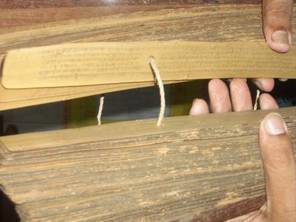
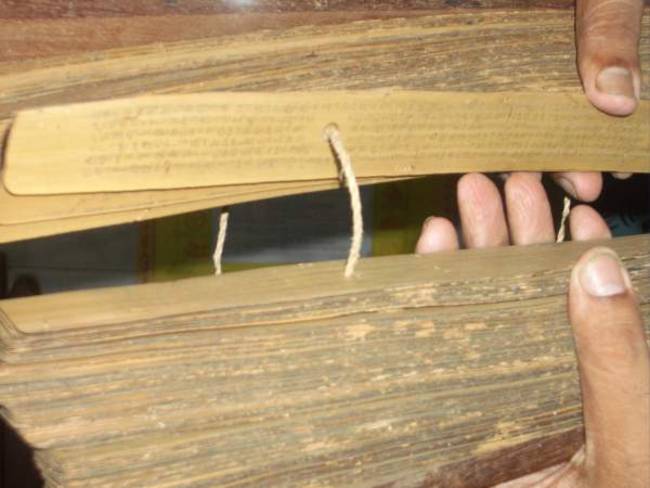
Palm-leaf manuscript
Image by Nalini Balbir © Nalini Balbir
Except for the verse commentary – bhāṣya – all the texts connected with the Jīta-kalpa have been digitised on JAINpedia. They are in the form of two palm-leaf manuscripts dating back to the 12th century, held in the British Library. This is worth noting because:
- manuscripts of the Jīta-kalpa and its commentaries are not very common, even in India
- palm-leaf manuscripts produced in western India are extremely rare in libraries outside India.
The digitised manuscripts contain:
- the Jīta-kalpa-sūtra from the first verse up to the final 103rd stanza
- a brief supplement devoted to the lay man’s atonements, called the Sāvaya-pacchitta (unpublished; Balbir 2012 forthcoming), which begins immediately after the Jīta-kalpa proper
- Siddhasena’s cūrṇi
- Śrīcandra’s commentary, called Bṛhac-cūrṇi-vyākhyā.
Mahā-niśītha

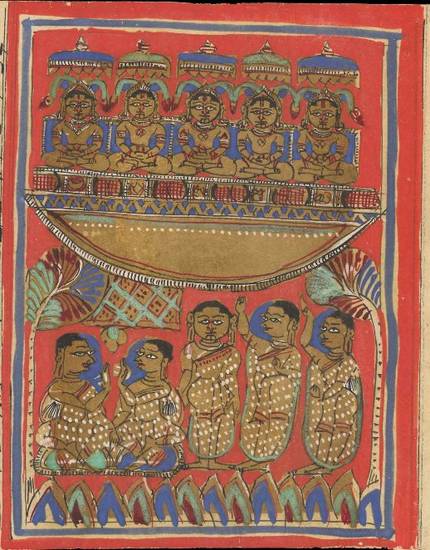
Teacher instructs a monk
Image by Victoria and Albert Museum © V&A Images/Victoria and Albert Museum, London
The Mahā-niśītha-sūtra’s eight chapters mainly deal with:
- confession
- contrition
- atonement
- monastic hierarchy
- definitions of accomplished and imperfect monks.
These topics are found in other Cheda-sūtras. The title echoes the Niśītha-sūtra, which belongs to the same category, and, because its title means ‘great niśītha-sūtra’, it suggests that this is a full version of the work. But its style is quite different. Instead of the expected concise aphoristic style, it alternates discursive parts in prose and long verse portions. Many of these verses can be found in other Jain works of various dates. On the other hand, several chapters are narrative in character. Thus this work contains disparate styles.
All these characteristics may explain why the Mahā-niśītha-sūtra has aroused suspicions of its credibility, both among Sthānaka-vāsin Jains and modern scholars.
Additional reasons for suspicion are the:
- ‘references to goddesses and magic spells not found elsewhere in the canon’ (Dundas 2002: 76)
- mention of image-worship, which is rejected by non-Mūrti-pūjak Śvetāmbaras.
The general frame of the text, however, is close to that found in the Aṅgas and Upāngas. The whole work is introduced against the background of a question-and-answer format between two individuals. The thrust of the work then appears within a dialogue between Mahāvīra and his chief disciple Indrabhūti Gautama.
The Mahā-niśītha-sūtra also contains a ‘story of the rescue and restoration of a dilapidated manuscript of the work from a temple in Mathurā’ (Dundas 2002: 76), which is hard to trust.
Thus, in some respects, the Mahā-niśītha-sūtra can be described as pseudo-canonical. It is not old, but displays an archaic bent.
|
Chapter |
Name |
Meaning |
Details |
|---|---|---|---|
|
1 |
Sall’-uddharaṇa |
‘Extraction of Thorns’ |
prose introduction and 222 verses, mainly ślokas |
|
2 |
Kamma-vivāga-vivaraṇa |
description of the maturation of karma |
209 ślokas and a long prose passage |
|
3 |
no title |
|
divided into 31 sections, 122 verses and prose passages |
|
4 |
no title |
|
prose and 14 āryā verses |
|
5 |
Duvālas’anga-suyanāṇassa Navaṇīya-sāra |
‘Cream of scriptural knowledge in the form of the 12 Aṅgas’ |
121 verses and prose |
|
6 |
Gīyattha-vihāra |
‘Life of an Experienced Monk’ |
411 verses then a predominantly narrative chapter |
|
7 |
Pacchitta-sutta |
Atonements |
verse and prose |
|
8 |
Susaḍha-kahā |
story of Sujjhasirī and Susaḍha |
prose and a few verses |