Number and status
The Upāṅgas total 12 but there is some confusion regarding texts number 5 and 7, which deal with related topics on astral bodies.
According to tradition, each Upānga is connected with a specific Aṅga, either because they have common themes or because they supplement each other. This connection, however, is far from obvious in all the pairings.
|
Number |
Name in Prakrit |
Name in Sanskrit |
Rough translation |
Connection with Aṅgas |
||
|---|---|---|---|---|---|---|
|
1 |
Uvavāiya-sutta |
Aupapātika-sūtra |
‘Places of rebirth’ – uvavāiya – according to one’s deeds, dealt with in the second part |
|||
|
2 |
Rāya-paseṇaijja or Rāyapaseṇiya |
Rāja-praśnīya |
Questions of the king |
|||
|
3 |
Jīvājīvābhigama |
Jīvājīvābhigama |
Classification of animate and inanimate entities |
|||
|
4 |
Pannavaṇā |
Prajñāpanā |
Enunciation on topics of philosophy and ethics |
5. Vyākhyā-prajñapti |
||
|
5 |
Sūriya-pannatti |
Sūrya-prajñapti |
Exposition on the sun |
|||
|
6 |
Jambūdvīpa-pannatti |
Jambūdvīpa-prajñapti |
||||
|
7 |
Canda-pannatti |
Candra-prajñapti |
Exposition on the moon and the Jain universe |
|||
|
8 |
Nirayāvaliyāo or Kappiya |
Narakāvalikā |
Series of stories on characters reborn in hells |
|||
|
9 |
Kappāvaḍaṃsiāo |
Kalpāvataṃsikāḥ |
Series of stories on characters reborn in the kalpa heavens |
|||
|
10 |
Pupphiāo |
Puṣpikāḥ |
‘Flowers’ refers to one of the stories |
|||
|
11 |
Puppha-cūliāo |
Puṣpa-cūlikāḥ |
Title based on the name of the nun Puṣpacūlā |
|||
|
12 |
Vaṇhi-dasāo |
Vṛṣṇi-daśāh |
Stories on characters from the legendary dynasty known as Andhaka-Vṛṣṇi |
The Upāṅgas are regarded as both subordinate and secondary to the Aṅgas, which make up the primary category in the Śvetāmbara scriptures. However, by referring frequently to other works in these two groups, these texts rely on the reader’s familiarity with all of the Aṅgas and Upāṅgas to fully understand each one. The two sets of closely connected scriptures must therefore be considered as forming a larger network of writings.
Similarly, there are intertextual relations between certain Upāṅgas, which borrow passages from one another or include similar passages.
Teaching through dialogue and stories

Indrabhūti Gautama
Image by British Library © CC0 1.0 (Creative Commons Public Domain)
The literary forms of the dialogue and question-and-answer format have important places in the Upāṅgas. Even though these literary approaches may be formalised, their frequent use immerses the reader directly in the issues being debated. They also highlight the significance of oral transmission in spreading the teachings of the Jinas.
The Upāṅgas present Mahāvīra as the main teacher. These texts show him replying to questions asked by his first disciple, Indrabhūti Gautama. Gautama’s curiosity has no boundaries and he always seems eager to know the whys behind what he sees. This format is used extensively in nearly all the Upāṅgas.
One of the best instances of an exchange with arguments and counter-arguments is the Rāja-praśnīya. The second part features a king and a Jain monk debating the topics of body and soul.
The Upāṅgas numbered 6, 7, 8, 9 and 11 are predominantly narrative. Although the central part of Number 2 is a philosophical dialogue, it also has a narrative setting and is a conversion story. Mahāvīra gives explanations and details about previous and future rebirths of the characters in answer to questions from his disciple.
Contents of the Upāṅgas
The 12 Upāṅgas demonstrate a wide range of literary approaches to passing on the key Jain beliefs. Most of the texts use the framework of Mahāvīra’s universal gathering to open a discussion on the karmas that determine the types of bodies a soul inhabits and its experiences during the cycle of rebirth. The form tends to have the Jina’s main chief disciple, Indrabhūti Gautama, asking questions about attendees at the universal gathering. Then his master answers, describing their behaviour in past lives and predicting the course of future births. Mahāvīra may tell stories or parables or recount dialogues within this literary frame.
This device allows Mahāvīra to discuss more specific aspects of these Jain concepts, including ascetic behaviour and rebirth, and the relationship between body and soul. This issue is famously explored in the second part of the second Upāṅga, the Rāja-praśnīya. This tale features a dialogue between the King Pradeśi with the monk Keśi, who eventually persuades the king of the true doctrine. The main topics that Mahāvīra discusses are concerned with the cycle of rebirth and karma. The final Upāṅga features a different teaching Jina. Here it is the 22nd Jina, Ariṣṭanemi or Lord Nemi, who answers the questions of his main disciple Varadatta on rebirth and karma.
Another theme that features heavily in the Upāṅgas is the Jain universe, which is also closely connected to the transmigration of souls. Important works on astronomy and philosophy contain a high level of detail while the first text can be thought of as a source book of literary descriptions that are found elsewhere in the Śvetāmbara scriptures. Large parts of a key work in Jain philosophy, the fourth Upāṅga, Prajñāpanā – Enunciation – are identical to passages in the Ṣaṭkhaṇḍāgama, one of the two chief scriptures of the Digambara canon.
Information on other subjects is also found in the Upāṅgas. Detailed descriptions of architectural features, dramatic performances, music and education form important passages in the works.
Upāṅga 1 – source-book of descriptions

Mahāvīra and the universal gathering
Image by British Library © CC0 1.0 (Creative Commons Public Domain)
The first Upāṅga – known as Uvavāiya-sutta in Prakrit, Aupapātika-sūtra in Sanskrit – is divided into three sections.
The first is called ‘Samavasaraṇa’ and provides full details of everything connected with Mahāvīra’s universal gathering in the city of Campā, in eastern India. It is a source-book for standard patterns of description, which are often referenced in other parts of the Śvetāmbara scriptures. These descriptions are in canonical prose, characterised by long compound words and stereotyped formulas. Among the main topics of description are:
- the city of Campā
- the open sacred place – ceiya – its garden and main tree
- the king and the queen
- a report of Mahāvīra’s body from head to toe, describing all the auspicious physical marks of a Jina’s body – lakṣaṇas
- the various categories of ascetics who assemble to attend the preaching, which leads to descriptions of related notions, such as ascetics’ special powers and a standard account of asceticism as both external and internal, the former concerned with fasting and other penances relating to food while internal penances are atonements, respectful attitude, service to others, study, meditation and rejection of the body in the kāyotsarga posture
- the four main classes of gods – Bhavanavāsins, Vyantaras, Jyotiṣkas and Vaimānikas
- King Kūṇika’s journey to the preaching place, including a list and sketch of the eight auspicious symbols.
The second section deals with the spontaneous birth of gods or hell-beings, technically known as upapāta. This is the title of this section. Mahāvīra deals at length with Indrabhūti Gautama‘s questions on matters relating to the modes and places of rebirths of various types of beings. These rebirths depend on how one behaved in the former existence. Among the types of people considered are those who observe vows, hermits in the forest and initiated ascetics. This exposition includes a review of categories of non-Jain ascetics – parivrājaka – and their scriptures. They are Brahmins who believe in the authority of Vedic scriptures. Then comes the story of Ambaḍa, one of these ascetics, and questions about his rebirth, as well as about the rebirth of other kinds of ascetics.
The very final section of the text deals with ‘explosive annihilation of karmas’ – samudghāta – which leads to the abode of final emancipation – siddhi.
Upāṅga 2 – relationship between body and soul
Heavenly pleasures
Image by British Library © CC0 1.0 (Creative Commons Public Domain)
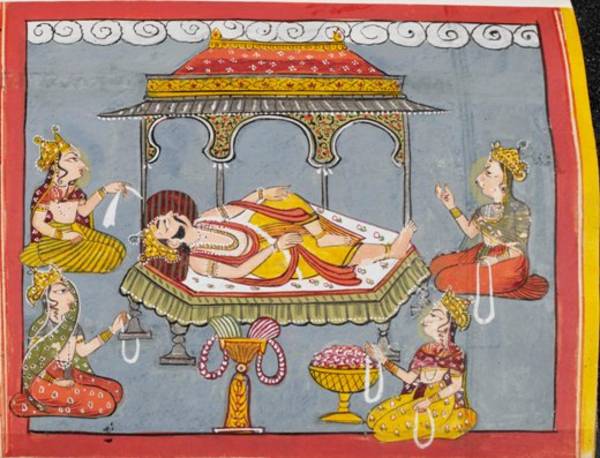
The general frame of the Rāya-paseṇaijjaor Rāyapaseṇiya in Prakrit – Rāja-praśnīya in Sanskrit – is that of numerous stories. The second Upāṅga follows a character through his three rebirths.
The setting of the tale is, again, Mahāvīra’s universal gathering. A god named Suryābha arrives there, displaying his celestial powers and staging before him 32 types of dramas. He then returns to his abode for his coronation ceremony. Wondering about the cause of such powers, Indrabhūti Gautama asks Mahāvīra about their origin.
The Jina narrates the god’s previous existence, when he was King Pradeśi – also called Paesi or Prasenajit. The king has wrong views about the relationship between the body and the soul, which he expresses during talks with the monk Keśi, a chief disciple of the 23rd Jina, Pārśvanātha or Lord Pārśva. Later on, Pradeśi becomes convinced by Keśi’s views, takes the vows of a Jain lay man, fasts unto death and is then reborn as the god Sūryābha.
In answer to Gautama’s next question about Sūryābha’s future destiny, Mahāvīra explains that he will be reborn as a son in a prosperous family living in the Mahā-videha. Because of his resolute faith in Jainism, he will have the name Dṛḍha-pratijña – ‘who is firm in his resolution’. He will have a perfect education but, instead of living the life of a wealthy youth, he will give up worldly life, become a monk, lead the life of a perfect ascetic, become omniscient and finally be emancipated.
In the first part of the Rāja-praśnīya there are lengthy descriptions of the celestial vehicle – vimāna – Suryābha uses to descend from his heavenly abode to the earth. This vehicle resembles a town. Hence, this part of the work is important for all the architectural data it includes, as all the parts of this vimāna, from the gates to the temples, pillars and platforms are described precisely.
In this part, there is also technical information about dramatic performances and music, whereas the third part of the work provides information about the subjects taught in education.
Dialogue between Pradeśi and Keśi
The second part of the Rāja-praśnīya is the central one. It stages the dialogue of King Pradeśi with the monk Keśi on the relationship between the body and the soul. The king argues that body and soul are identical. He is presented ‘as a kind of naïve empiricist’ (Dundas 2002: 94), who puts forward cruel and extreme tests he has carried out personally to support his point. For instance,
my city guards brought me a thief, [his hands] tied behind his neck, and together with him witnesses, stolen goods and a garland. I had that man thrown alive into a metal vessel, had it covered with a metal lid, had it soldered together with [the same] metal and tin, and watched by men loyal to me. Then some time later I went where the metal vessel stood, had it opened, saw that man myself, but [there was] no fissure, opening, hole or crack whatsoever in that metal vessel, from where his soul from within had escaped outside. Now if, Venerable Sir, in this metal vessel there had been a fissure […], from where his soul from within had escaped outside, then I might believe, put my faith in, approve of [the teaching of the Jains] that the soul and the body are different
Bollée 2005: 113–114
Among Pradeśi’s other experiments several others involve thieves. Examples include:
- a thief who weighs the same when alive and dead, showing that the soul has not left the body on death
- the corpse of a dead thief that is cut into whatever number of pieces does not show anything other than bits of flesh.
On another occasion, the king takes the example of a young person and an old person. He asserts that the old person does not have the same capacities as the young one. According to him, this proves that the body is the only active factor in the process and that therefore body and soul are the same.
The monk Keśi replies to Pradeśi’s points using comparisons that show the body is only a vessel. Considering the thief’s constant weight, he reminds the king that there is no change in the weight of a leather bag before and after it has been inflated with air. In the case of the young and old, he uses that of a basket. Someone cannot carry a heavy load of iron in an old basket, but is able to do so with a new one.
The discussion goes on because the king considers the comparisons, clever though they are, are not factual. The situations he describes can be observed by one’s own eyes, which he believes makes them more valid.
Finally, the king is convinced by the comparison Keśi uses to argue that the soul contracts and expands to fit the body in which it is located. Keśi states that the soul of the smallest insect – a kunthu – and the largest animal – the elephant – are the same size. He compares the souls of these two very different physical beings with a lamp, which can brighten a small or large space depending on whether it is in a basket, a pot, a room and so on. The monk also explains that there are things that can be seen only by omniscient beings (Dundas 2002: 94).
Upāṅga 3 – understanding living and non-living

Plants and two-sensed beings
Image by British Library © CC0 1.0 (Creative Commons Public Domain)
Employing the question-and-answer format, the third Upāṅga is divided into nine sections – pratipattis. The Jīvājīvābhigama deals with the animate and the inanimate, more with the former than with the latter. Living beings are considered from all possible angles, such as beings classified:
- as going through the cycle of rebirths and those who are fully liberated
- according to the number of senses they have, ranging from one to five
- depending on their mode of rebirth – hell-beings, animals or plants, humans, gods
- according to their capacities of cognition, self-control, salvation, activity, colours of their souls – leśyā – and other parameters.
Upāṅga 4 – encyclopaedia of Jain philosophy
The Prajñāpanā – Enunciation – is ‘a master-piece of Jaina philosophy’ (Kapadia 1941: 139). The fourth Upāṅga goes with the fifth Aṅga, the Vyākhyā-prajñapti, which incorporates some parts of it. Cross-references in the two works are an additional sign of their connection. It also shares a lot of content with the Ṣaṭkhaṇḍāgama, one of the fundamental scriptures of the Digambara canon.
The fourth Upāṅga is organised into 36 sections called padas, defined by a heading term that is highly technical. This table mostly reproduces the translations given in Nagin J. Shah’s English introduction to Muni Puṇyavijaya’s 1972 edition of the Prajñāpanā.
|
Chapter number |
Chapter contents |
|---|---|
|
1 |
General description of Jambū-dvīpa, where the land of Bharata is located. |
|
2 |
Time in Bharata:
For example in the third period of the descending cycle, those who maintain law and order are the patriarchs – kulakaras. The last of them, Nābhi, has a son Ṛṣabha, who becomes a Jina. His life is narrated in terms close to those in the Kalpa-sūtra. An important passage describes the collection of physical remains after the Jina’s death and the construction of a kind of memorial. |
|
3 |
Description of the land of Bharata and the life story of King Bharata, the first universal monarch – cakravartin. His progressive conquest of the world is narrated at length. The king acquires the 14 jewels – ratna – and the nine treasures – nidhi – that are typical of this status. |
|
4 |
Descriptions of other parts of Jambū-dvīpa, such as:
|
|
5 |
How a newborn Tīrthaṃkara is honoured by deities, especially the goddesses of the directions – dik-kumārīs. The report of the groups of deities who come for the event is similar to the retinue of god Sūryābha as described in the second Upānga, the Rāja-praśnīya (Alsdorf 1947). |
|
6 |
Statistical survey of the geographical details of Jambū-dvīpa. |
|
7 |
Astronomical matters, such as details of:
|
Upāṅgas 8, 9, 10, 11 and 12 – story scriptures
Upāṅgas numbering 8 to 12 form a group of connected texts, which are presented as five sections of a single work. They all deal with stories of rebirths, recounting tales of births in the hells – in number 8 – to the highest heavens – number 12.
Upāṅga 8 – Narakāvalikā

Infernal tortures
Image by British Library © CC0 1.0 (Creative Commons Public Domain)
The eighth Upāṅga contains ten stories. According to the usual pattern in Jain story collections, only the first one is narrated in detail. The others are identical, except for changes in character names and minor details.
The setting is Magadha in eastern India, as the protagonists are the ten sons of King Śreṇika and their mothers. Characters who are part of the Śreṇika family, such as Kūṇika, Cellanā, Abhaya-kumāra, are also present. The prevalent atmosphere is one of death and tragedy because the story is that of an enormous battle, in which Śreṇika’s sons by different mothers are killed. They are fighting on the side of Kūṇika in his war against King Cetaka of Vaishali.
The 24th Jina Mahāvīra features in the stories as the teacher who explains the future destinies of the sons. All will be reborn in the fourth hell as a consequence of their aggressive behaviour – hence the title of the work, which means ‘Series of Hells’. They will then be born in the Mahā-videha area of the Jain universe and from there will reach emancipation.
The previous births of the characters form an important part of the text. Mahāvīra narrates them as explanations for the present situation.
Upāṅga 9 – Kalpāvataṃsikā

Pairs of gods in their heavenly palaces
Image by British Library © CC0 1.0 (Creative Commons Public Domain)
The ten stories in the ninth Upāṅga feature King Śreṇika’s grandsons.
After listening to Mahāvīra’s teaching, they all enter the monastic life. They are exemplary ascetics, following the rules and practising austerities. Mahāvīra predicts that, as a consequence, they will be reborn deities in ten out of the 12 lower heavens – the kalpas – hence the title of the work. Next they will be reborn in the Mahā-videha and reach emancipation.