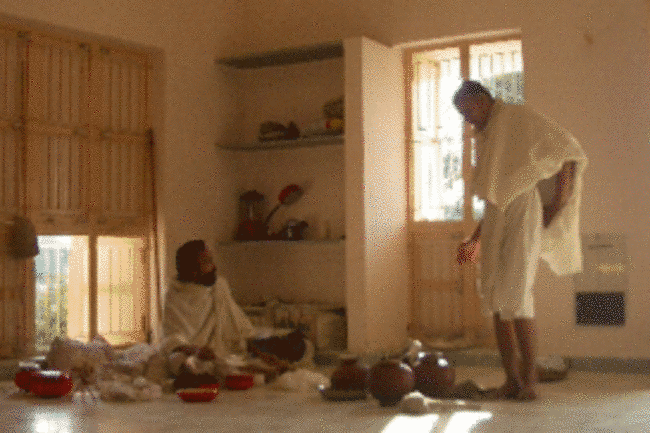
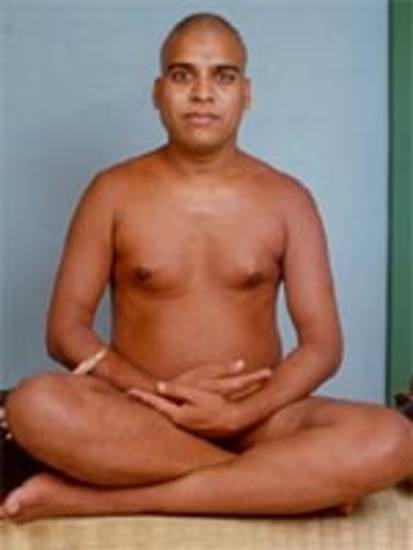
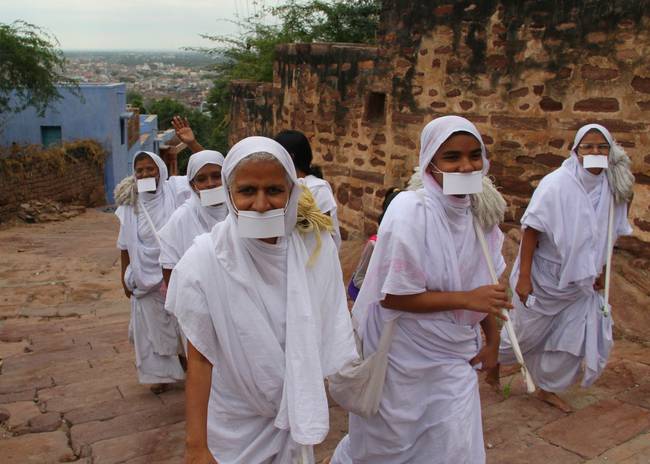
The items that Jain ascetics carry around are known as upadhi in earlier texts, or, more commonly, as upakaraṇa. It is important to understand that these are not possessions of the monks and nuns, because the principle of non-attachment or non-possession – aparigraha – is a crucial one for Jain mendicants. They do not own these items, which are given to them, and they aim to avoid feelings of attachment or possession towards them. These items are considered necessary for living and, in particular, for living according to religious principles.

This monastic equipment has tended to become an identity marker of asceticism. These items also mark out Digambara mendicants from Śvetāmbara ones. Even among Śvetāmbara mendicants, there are some differences in the practices of various monastic orders – gacchas. The equipment has been the starting point of numerous discussions that parallel the emergence of monastic orders in the medieval period. A vast body of literature is devoted to such topics, which are not as superficial as they may look. These sources are still being explored by scholars today.

These daily utensils are simple. But these days it is not forbidden to embellish them in various ways. Śvetāmbara nuns, in particular, may spend a lot of time in such manual activities and transform some of the implements into true artistic objects. The Terāpanthins are especially proud of this and have collected a number of such objects in the museum of the Jain Vishva Bharati, Ladnun in Rajasthan.

In all sects, the implements are normally not private or individual property. Mendicants get them from the laity. They are parts of the religious gifts – dāna – lay people can offer. Other monks or nuns can also pass on implements to their colleagues. There is a tendency, however, to consider the implements that belonged to a famous monastic figure as kinds of relics.

Inspecting the implements – Sanskrit pratilekhanā, Prakrit paḍilehaṇā – is part of the mendicant’s daily activities. There is a specific rule of behaviour which concerns carefulness in taking and putting down monastic equipment – ādāna-nikṣepa-samiti. The reason is the constant concern of non-violence. It is part of the general attitude of vigilance which a mendicant must have.

The use of the broom and of the mouth-cloth often figure in the accounts of European travellers in the 16th and 17th centuries who happened to cross the path of Jain mendicants and were amazed by them. Even now, these two implements are striking for outsider observers, who see them, often with a slightly mocking condescension, as an extreme application of non-violence.

Le bâton monastique jaina: functions, symbolisme, controverses

Nalini Balbir

History of Jaina Monachism from Inscriptions and Literature

Shantaram Bhalchandra Deo

Historical Dictionary of Jainism

Kristi L. Wiley

Introduction to Jainism – part 2

This extract from a BBC documentary called The Frontiers of Peace explores the relationship between Jain traditions and modernity. A Jain lay man tells how he reconciles his faith with his industrial business interests. A Śvetāmbara monk explains the significance of his monastic broom – known as a rajoharaṇa or oghā – including the eight auspicious symbols wrapped around the handle. A nun leads lay followers in the rite of confession – pratikramaṇa. A young woman creates auspicious symbols in rice as an offering as she talks about her decision to become a nun. This 2010 YouTube video is the second of four parts. See the next part at: www.youtube.com/watch

http://www.youtube.com/watch?v=UHMQRmRKh_U

Five Great Monastic Vows

Pravin K. Shah writes about the Five Great Vows taken by Jain monks and nuns. The information is provided by the Jainism Literature Center, associated with the Faculty of Arts and Sciences at Harvard University.

http://www.fas.harvard.edu/~pluralsm/affiliates/jainism/jainedu/5greatvows.htm

Terāpanthin monks and nuns

This YouTube video shows Śvetāmbara Terāpanthin monks and nuns walking down a street in New Delhi in July 2009. Clad in white and wearing the mouth cloth – muṃhpatti – they walk barefoot, carrying their monastic equipment in bags and bundles. They are accompanied by lay Jains, many of the women dressed in orange, which is a holy colour in India. Among the monks is Ācārya Mahāprajña, the tenth ācārya or leader of the sect, who died in May 2010.

http://www.youtube.com/watch?v=UzZ_SHDSrAI

Mahavir Aradhana Kendra – museum

The museum at the Mahavir Aradhana Kendra displays the equipment used by Gacchādhipati Ācārya Śrī Kailāsaāgara-sūrīśvara Mahārāj, among other exhibits. Information about opening hours, holdings and directions to the institute in Koba, near Ahmedabad in Gujarat, is on the website.

http://www.kobatirth.org/jainmuseum.aspx

Group initiation of Digambara monks – part 3

Towards the end of their group ceremony of renunciation – dīkṣā – 25 new Digambara monks have their heads anointed with sandalwood paste. The monk Vidyāsāgar, who is initiating them, traces the auspicious symbols of swastikas and four dots on their heads and palms. Then he blesses the new monks and newly initated novices – kṣullaka – who are dressed in white. He also consecrates their water pots – kamaṇḍalu. Both groups of mendicants hold their characteristic peacock-feather brooms – piñchī. Found on YouTube, this collective ceremony in Hindi took place on 21 August 2004 in the so-called Dayoday Tirth, Delwara Ghat, in the town of Jabalpur in Madhya Pradesh on the bank of the river Narmada. Watch the final part at http://www.youtube.com/watch?v=6QCfjoyWbLk

http://www.youtube.com/watch?v=K0WeUJici30&NR=1

Group initiation of Digambara monks – part 4

At the end of their group ceremony of renunciation – dīkṣā – 25 new Digambara monks are blessed by their teacher Vidyāsāgar. He also consecrates their water pots –kamaṇḍalu – and blesses some newly initated novices – kṣullaka – who are dressed in white. Both groups of mendicants hold their characteristic peacock-feather brooms – piñchī. The new monks have ritually taken off their clothes, which is a sign of advanced spirituality in Digambara Jainism. Then Vidyāsāgar preaches to the assembly of lay Jains. White-clad nuns – āryikā – are at the front of the crowd. Found on YouTube, this collective ceremony in Hindi took place on 21 August 2004 in the so-called Dayoday Tirth, Delwara Ghat, in the town of Jabalpur in Madhya Pradesh on the bank of the river Narmada. Watch the first part of the ceremony at http://www.youtube.com/watch?v=txYBw9ke-aU

http://www.youtube.com/watch?v=6QCfjoyWbLk

Lorem ipsum dolor sit amet, consectetur adipiscing elit. Ut elit tellus, luctus nec ullamcorper mattis, pulvinar dapibus leo.

Contents