Number and titles

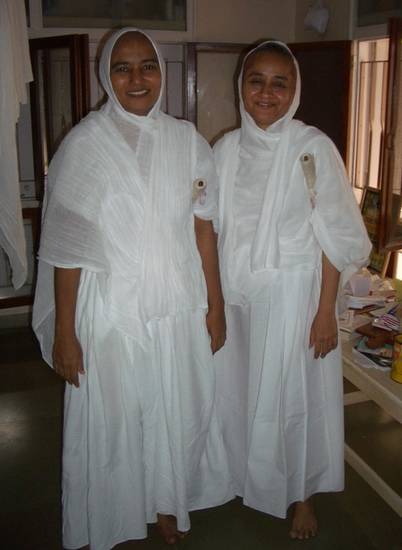
Śvetāmbara monks
Image by Hoorob – Robert Tyabji © CC BY-NC-ND 3.0
There are 12 Aṅgas in the Jain tradition, although one of them – known as the Dṛṣṭi-vāda – has been considered lost since early times. Therefore only 11 Aṅgas were first written down by the forerunners of the Śvetāmbara sect. Rejected as canonical scriptures by the Digambara sect, these 11 Aṅgas are emblematic of Śvetāmbara Jain identity.
The titles of the Aṅgas can be understood in various ways. This table gives rough equivalents.
|
Number |
Prakrit title |
Sanskrit title |
Translated meanings |
|---|---|---|---|
|
1 |
Āyāraṃga |
Ācārāṅga |
‘On monastic conduct’ |
|
2 |
Sūyagaḍa |
Sūtrakṛtāṅga |
‘On heretical systems and views’ |
|
3 |
Ṭhāṇaṃga |
Sthānāṅga |
‘On different points [of the teaching]’ |
|
4 |
Samavāyaṃga |
Samavāyāṅga |
‘On “rising numerical groups”’ (Kapadia 1941: 126) |
|
5 |
Viyāha-pannatti or Bhagavaī |
Vyākhyā-prajñapti or Bhagavatī |
‘Exposition of explanations’ or ‘the holy one’ |
|
6 |
Nāyā-dhamma-kahāo |
Jñāta-dharmakathānga |
‘Parables and religious stories’ |
|
7 |
Uvāsaga-dasāo |
Upāsaka-daśāḥ |
‘Ten chapters on the Jain lay follower’ |
|
8 |
Antagaḍa-dasāo |
Antakṛd-daśāḥ |
‘Ten chapters on those who put an end to rebirth in this very life’ |
|
9 |
Aṇuttarovavāiya-dasāo |
Anuttaropapātika-daśāḥ |
‘Ten chapters on those who were reborn in the uppermost heavens’ |
|
10 |
Paṇha-vāgaraṇa |
Praśna-vyākaraṇa |
‘Questions and explanations’ |
|
11 |
Vivāga-suya |
Vipākaśruta |
‘Bad or good results of deeds performed’ |
Story works
There are five Aṅgas that are narrative works. These demonstrate the significance of stories in the passing on of the teachings of the Jinas.
The following Aṅgas may be described as ‘story Aṅgas’:
- Number 6 – Nāyā-dhamma-kahāo or Jñāta-dharmakathānga
- Number 7 – Uvāsaga-dasāo or Upāsaka-daśāḥ
- Number 8 – Antagaḍa-dasāo or Antakṛd-daśāḥ
- Number 9 – Aṇuttarovavāiya-dasāo or Anuttaropapātika-daśāḥ
- Number 11 – Vivāga-suya or Vipāka-śruta
Forms of the ‘story Aṅgas’
These works take the form of short parables, or, mostly of life sketches featuring men and women from various backgrounds. The purpose is to show how one’s own behaviour determines results in future births and is determined by past lives as well. Apart from exceptional cases when one has the ability to remember one’s own past life, the mediator, who knows both about past and future, is a Jina, especially Mahāvīra.
Repetition is used as a pervading narrative technique (Bruhn 1983). In the second parts of Aṅgas 6 and 11, only the first story is narrated at length. The other ones are identical, with minimal changes of names, location, numbers and so on. This method is a way to increase the population of Jain heroes and heroines.
Contents of the ‘story Aṅgas’
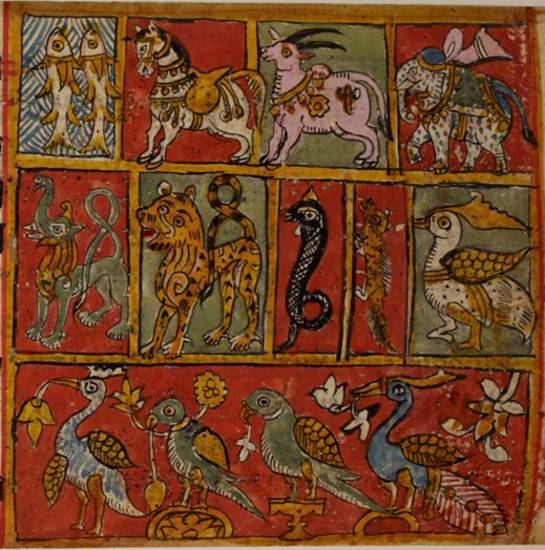
Five-sensed animals
Image by British Library © CC0 1.0 (Creative Commons Public Domain)
The Aṅgas demonstrate the workings of the core Jain beliefs, particularly how karma plays out in the cycle of rebirth. The soul is trapped in a succession of different bodies in the cycle of rebirth according to the karma it gathers until it is pure enough to be liberated.
In Aṅga Number 8, all the characters ‘put an end’ to the cycle of rebirths in their present existence. Generally, however, they have to undergo one or more rebirths before they can reach emancipation. The stories show how living beings circulate in the various levels of the Jain universe, from hells to the highest heavens, from animals to humans. These are the practical applications of knowledge of cosmology.
The stories throw light on features of Jain ideals and practices, such as:
- listening to an ascetic or a Jina preaching produces the wish to renounce worldly life and to become initiated as a monk or a nun
- the decision to take initiation – dīkṣā – is never accepted immediately by reluctant parents but is finally granted, so strong is the candidate’s resolve
- some characters, who are instances of perfect ascetics and can cope with monastic rules without difficulty and practise strong austerities
- others are unable to face the hardships of monastic life, temporarily or permanently
- fasting unto death – sallekhanā – appears the best practice to end one’s life in a pious way
- practising penance is recommended, but the good effects of asceticism are liable to be annihilated if one does not repent or atone for past transgressions at the hour of death.
Instances of difficulties mendicants face include:
- nuns who long for children
- nuns who are too concerned with body care and stylishness,
- ascetics who are unable to resume the wandering life after having been nursed during illness
- a young monk whose sleep is disturbed by the incessant going and coming of his fellow monks.
The story Aṅgas feature a number of characters whose adventures are retold, readjusted, shortened or amplified by later authors, whether they write in Prakrit, Sanskrit or any of the modern languages. Thus these Aṅgas provide a repertoire of tales that may be used freely. In addition, Aṅga Number 6 features the first Śvetāmbara biography of the 19th Jina, Mallinātha or Lord Malli.
Aṅga 6 – parables
Aṅga Number 6 is called the Nāyā-dhamma-kahāo in Prakrit, the Jñāta-dharma-kathānga in Sanskrit. The first part is the longer part, containing 19 parables. The second part of the Jñāta-dharma-kathānga has a single story repeated several times, each version showing minimal changes in names, location and so on.
All stories are told by Mahāvīra in answer to the questions of his chief disciple, Indrabhūti Gautama. In the first part, the main pattern is binary – one main character illustrates good behaviour and the second bad behaviour. These characters represent various social backgrounds. They serve as analogies for good and bad ascetic conduct.
Some parables in the first section are short while others are similar to novellas or small epics, such as the 16th one. These epics tend to be of two kinds. One features characters who go through numerous adventures while the second type are tales with narrative ‘motifs’ found in tales around the world.
Parable 1 – Ukkhitta

Elephant
Image by British Library © CC0 1.0 (Creative Commons Public Domain)
This text is the standard place to find:
- the dialogue between the candidate for initiation and his parents
- details of the initiation ceremony to become a Śvetāmbara monk
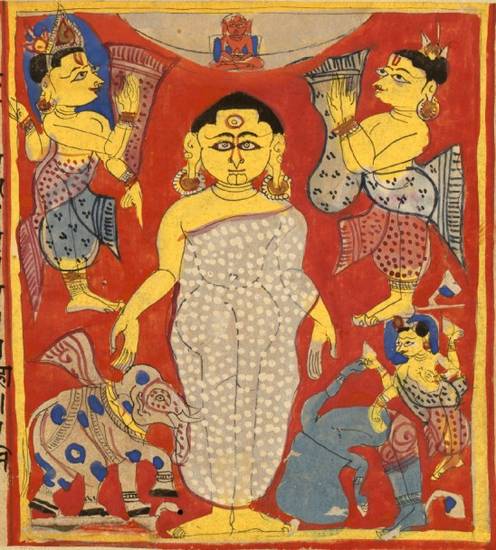
After listening to Mahāvīra’s discourse, the young Megha, son of King Śreṇika and Queen Dhāriṇī, wants to become a monk. Despite the sorrow and reluctance of his parents, he insists on taking initiation.
At night, the new ascetic is allotted a place to sleep, near the entrance of the mendicants’ lodgings. Constantly disturbed by other ascetics’ comings and goings, he cannot sleep at all. Next morning, the young monk goes to Mahāvīra, who guesses everything. He contrasts Megha’s reaction to these slight disturbances with what he had achieved in one of his former births.
In that previous life he had been born as an elephant named Meruprabha. In order to escape a terrible fire, all the animals in the forest took refuge in a large circle the elephant had prepared for this purpose. The place was packed with animals, with barely room for them to move. Meruprabha lifted one of his legs to scratch but when he wanted to put his leg back on the ground he realised a little rabbit was occupying the space. Out of compassion for living beings, the elephant kept his leg lifted – ukkhitta – for two and a half days, until the fire was over. However, he died in severe pain as soon as he put his leg back on the ground. As a result of this exemplary behaviour, he was born as Prince Megha.
The young ascetic asks Mahāvīra to give him a second initiation. After this, he practises rigorous fasts and eventually fasts unto death, repenting for all past transgressions.
The tale ends with a prediction that Megha will be reborn as a god in the ‘Five Unsurpassable’ heavens – Pañca Anuttara – before being born as a human being in the Mahā-videha area of the Jain universe and reaching emancipation.
Parable 2 – Saṃghāḍaga
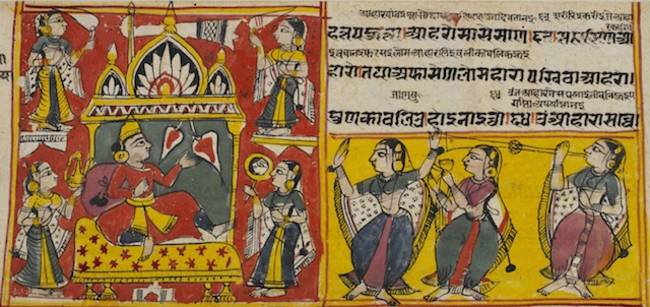
Right monastic behaviour
Image by Victoria and Albert Museum © V&A Images/Victoria and Albert Museum, London
After a long married life without children, the wife of the merchant Dhanya gives birth to a son, as a result of praying to a god. The infant is cared for by a young boy servant. While the servant plays with other children, the richly adorned baby attracts the attention of the thief Vijaya. He kidnaps the baby, kills him and throws the body in a well. The police discover the child’s body and arrest the thief, who is put in jail.
It so happens that Dhanya, who has been accused of offending the king by fellow merchants, has been jailed as well. Dhanya and Vijaya are chained together as a pair – saṃghāḍaga – and cannot move without each other. The first time Dhanya is brought food, he eats alone and refuses to share it with the thief. However, when he wants to go to relieve himself Vijaya refuses to go unless Dhanya shares his food with him.
Later on, Dhanya is released from jail on the payment of a fine. His wife is angry that he has shared food with the thief who murdered their son. The merchant explains that the only reason he had done so was to satisfy the needs of his body. Similarly, ascetics take food only to sustain their bodies, not for any other purpose, such as pleasure.
The thief is later reborn in the hells, while Dhanya takes monastic initiation after hearing the teachings of a Jain ascetic.
Parable 3 – Aṇḍaga
Two friends happen to discover two peahen eggs in a garden and bring them home to hatch.
Out of impatience, one man moves the egg. This disturbance kills the chick inside.
The other man just waits peacefully and patiently. In due course a chick is safely born, which is brought up and trained. It develops into a beautiful bird that wins competitions.
Parable 4 – Kumma
Two jackals seek prey near a pond where two turtles live. When the turtles see them, they draw in their limbs so the jackals go away.
However, the jackals do not really leave, but hide instead. After some time, one of the turtles extends a flipper. The hiding jackals tear it to pieces, then go away.
Again, the jackals hide instead of truly leaving. Eventually, the injured turtle extends one flipper after the other, and the jackals eat her up entirely.
Since the other turtle keeps her limbs retracted, the jackals have to give up hope of eating her too. The second turtle remains safe. The cautious turtle is an analogy for ascetics who keep their five sensory organs disciplined.
Parable 5 – Selaga

Behaviour of a ‘bad monk’
Image by British Library © CC0 1.0 (Creative Commons Public Domain)
The story takes place in the time of the 22nd Jina, Ariṣṭanemi or Lord Nemi. Involving his cousin Kṛṣṇa, it unfolds in several episodes.
After hearing Ariṣṭanemi’s teaching, Thāvaccāputra, the son of a wealthy lady, decides to renounce worldly life. Despite his entourage’s lack of encouragement, he believes that becoming a monk is only the way to get rid of karmas.
During his wandering life as an ascetic, Thāvaccāputra reaches the town of Śailakapura, which is ruled by King Śailaka and his minister Panthaka. After listening to the monk’s sermon, the king and his minister decide to adopt the minor vows of Jain lay men.
Next, Thāvaccāputra’s wandering life leads him to the town of Saugandhikā, where a merchant called Sudarśana lives. Sudarśana has listened to the teaching of the Hindu ascetic Śuka, a follower of the Sāṃkhya philosophy, and has become a follower. Then Sudarśana hears Thāvaccāputra deliver a sermon on the fundamentals of Jain faith. He is convinced and becomes a lay Jain disciple.
When the Hindu ascetic returns, Sudarśana does not pay attention to him. He explains his change of heart to Śuka. The Hindu and the Jain ascetics then discuss their beliefs face to face. Thāvaccāputra answers all the questions his opponent asks, persuading him of the rightness of Jain doctrine. Śuka asks to be initiated as a disciple of the Jain monk, which is granted.
Śuka, now a Jain monk, travels to Śailakapura. After hearing him preach, King Śailaka wishes to become a monk and entrusts the kingdom to his eldest son, Maṇḍuka. The former king is initiated alongside other people, including his minister, Panthaka.
During his ascetic life Śailaka becomes seriously ill. Treated with medicines appropriate for a monk, he is cured. But somehow, after this he is unable to follow the rules of ascetic conduct, eating a lot of food and developing all of the characteristics of a bad ascetic. Once, while he is sleeping comfortably, Panthaka touches his feet to ask forgiveness before starting the ritual of repentance – pratikramaṇa. Śailaka wakes in anger. Panthaka’s apology leads Śailaka to realise that he has gone astray. He resumes the proper wandering ascetic life. Later on, Śailaka, Panthaka and other disciples reach emancipation on Mount Puṇḍarīka, that is Śatrunjaya.
Parable 6 – Tumba
A gourd covered with eight layers of fibres and mud will sink to the bottom of water. If these layers are removed, it will rise to the surface. In the same way, a soul loaded with the eight varieties of karma will be heavy and will go to the hells. When it is released from the karmas it will go straight to emancipation.
Parable 7 – Rohiṇī

Women fetching water
Image by British Library © CC0 1.0 (Creative Commons Public Domain)
This is also known as the parable of the five rice grains.
A merchant gives five rice grains each to his four daughters-in-law to test them, saying that they will have to return them when asked.
The first one throws them away. She thinks that when she needs to return them she can take another five grains from the huge quantity of rice in the storehouse.
The second one thinks the same, but swallows the grains.
The third one thinks there is some reason behind this strange gift and condition. She carefully wraps the grains in a piece of cloth in her jewellery box, near her bed. She checks it three times a day
The fourth one, Rohiṇī, thinks that she should not only preserve the rice grains but increase them. She arranges for the grains to be sown at the proper time and cultivated properly. A large quantity of rice is harvested from these original five grains year after year.
When five years have gone by the merchant asks the young ladies to return the rice grains he had given them. Each of them is rewarded according to her deeds, with:
- the first one being put in charge of menial duties in the house
- the second one appointed to prepare food
- the third one put in charge of precious things in the house
- Rohiṇī’s being appointed the head of the family.
This famous text has a parallel in the Biblical tradition (see Roth 1973):
- Matthew chapter 25
- Luke 19.
In the Jain context, the five rice grains are equated with the five great vows – mahā-vratas – which mendicants may spoil or develop appropriately.