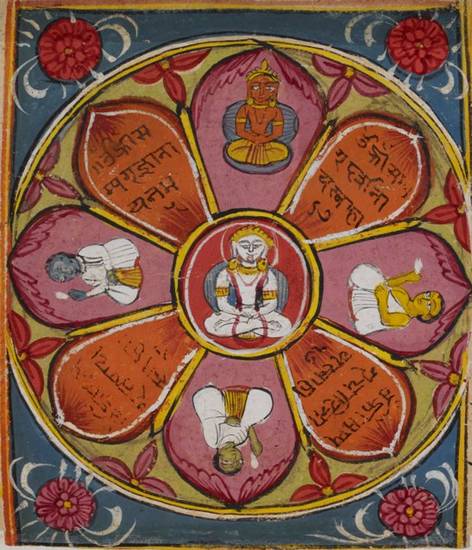
The siddhacakra is the mystical diagram – yantra – associated with the Navkār-mantra in the Śvetāmbara tradition. Digambara Jains call it the navpadjī. It consists of nine parts, representing each of the Five Highest Beings and ‘three jewels’ of Jain tradition, along with a quality often called the ‘fourth jewel’.

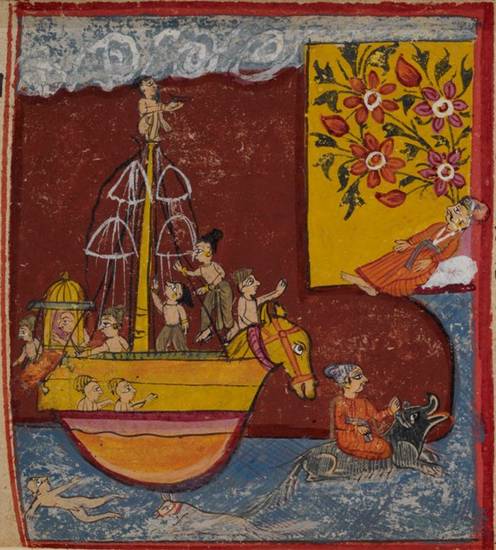
The yantra is venerated in a variety of ceremonies, including those associated with the Āyambil Oḷī festival and fast. The siddhacakra is particularly linked with the story of Śrīpāḷ and Mayṇāsundarī. It is the most commonly used yantra in contemporary Jainism.

Absent Lord: Ascetics and Kings in a Jain Ritual Culture

Lawrence A. Babb

Organizing Jainism in India and England

Marcus Banks

Jains in the World: Religious Values and Ideology in India

John E. Cort

The Archetypal Actions of Ritual: A Theory Illustrated by the Jain Rite of Worship

Caroline Humphrey, James Laidlaw

Singing to the Jinas: Jain Laywomen, Maṇḍaḷ Singing and the Negotiations of Jain Devotion

M. Whitney Kelting

Negotiating Karma, Merit, and Liberation: Vow-taking in the Jain Tradition

M. Whitney Kelting

Heroic Wives: Rituals, Stories and the Virtues of Jain Wifehood

M. Whitney Kelting

Riches and Renunciation: Religion, Economy and Society among the Jains

James Laidlaw

Honour, Nurture and Festivity: Aspects of Female Religiosity amongst Jain Women in Jaipur

Josephine Reynell

Women and the Reproduction of the Jain Community

Josephine Reynell

Religious Practice and the Creation of Personhood among Śvetāmbar Mūrtipūjak Jain Women in Jaipur

Josephine Reynell

Sketch of a siddhacakra

This sketch of a siddhacakra is found in a manuscript held in the National Gallery of Australia. The Svetāmbara yantra or mystical diagram has nine parts, representing key elements of Jain doctrine. In the centre of the stylised lotus flower is a Jina and around him on alternating petals sit the other beings that make up the five highest beings. On the petals between them are phrases representing the ‘four fundamentals’.

http://artsearch.nga.gov.au/Detail-LRG.cfm?IRN=157990&View=LRG

Navapada mahāyantra

The siddhacakra or navapada mahāyantra is the most popular Jain yantra, believed to be highly auspicious. It is a mystical diagram representing the major parts of the path to liberation from the cycle of rebirth. With a key role in worship rituals, the siddhacakra has a central position in the Āyambil Oḷī festival. The picture is found on the HereNow4U website.

http://www.herenow4u.net/index.php?id=73573

Explaining the siddhacakra

Lay woman Heeral Shah explains the different elements of a siddhacakra mahā-yantra. Provided by the Victoria and Albert Museum in London, this video also includes a transcript.

http://www.vam.ac.uk/content/videos/p/video-painting-of-siddhachakra-yantra-heeral-shah/

Parts of a siddhacakra

Academic K. V. Mardia has created a diagram describing the different parts of a siddhacakra or navapada. The foremost Jain yantra, the siddhacakra summarises some of the holiest elements of the Jain religion.

The Yorkshire Jain Foundation in the UK provides a downloadable and printable PDF. You will need to have Adobe Acrobat Reader on your computer to open PDF files.

http://www.yjf.org.uk/YJain7thAnniversary1F.pdf

Siddhacakra mahāyantra

The Herenow4U website provides a picture of a siddhacakra or navapada mahā-yantra, the most popular yantra among contemporary Jains. This mystical diagram presents some of the main elements of Jainism. King Śrīpala and Queen Mayṇāsundarī, who are closely associated with it, are shown at the bottom demonstrating worship of the yantra.

http://www.herenow4u.net/index.php?id=73107

Sacred colours

Acharya Shri Shushil Muni explains the sacred colours of Jainism, which are found in several holy symbols, including the siddhacakra, the Namaskāra-mantra and the Jain flag. The information is provided by the Jainism Literature Center, associated with the Faculty of Arts and Sciences at Harvard University.

http://www.fas.harvard.edu/~pluralsm/affiliates/jainism/jainedu/colorscience.htm

Siddhacakra

The siddhacakra or navapada is a flower with nine sections representing the Five Supreme Entities and the ‘Four Jewels’. It is thus a visual summary of key elements of Jain belief. Often known as a navpad nowadays, the siddhacakra is a mystical yantra used in worship rites. This photo on Flickr shows a Śvetāmbara siddhacakra, with an ornately bedecked Jina in the centre.

http://www.flickr.com/photos/yashphotography/6078103409/

Story of Śrīpāḷa and Mayṇāsundarī

The Jain eWorld website provides the well-known tale of Śrīpāḷa and Mayṇāsundarī. The story illustrates that accepting karma, worshipping the siddhacakra or navapada and staying true to religious beliefs are crucial to being a good Jain and moving towards liberation. The tale is part of the epic Śrīpāḷ Rājāno Rās, which recounts Śrīpāḷa’s adventures after he is cured of leprosy. The story is a major element in the festival of Āyambil Oḷī, which focuses on religious devotion, especially revolving around the siddhacakra yantra, and marital happiness.

http://www.jaineworld.com/jain-stories/king-shripal-and-mayana-sundari/5/

Lorem ipsum dolor sit amet, consectetur adipiscing elit. Ut elit tellus, luctus nec ullamcorper mattis, pulvinar dapibus leo.

Contents