Category:Kalpa-sūtra (IM 08-1931)

Birth of Mahāvīra


Description

On the left, a lady is on her couch in her bedroom. It is the kṣatriya lady, Queen Triśalā, into whom Mahāvīra’s embryo was transferred. She is holding the newborn Mahāvīra in her arms and looking at him tenderly. On the right side is a female attendant, fanning the queen with a fly-whisk.

This is the standard scene of Mahāvīra’s birth, and, more generally, is used for the births of all Jinas.

The long protruding eye is a typical iconographic feature of western Indian painting. Its origin is not clearly known.

Note the painter’s care for details of the figures as well as of the furniture and decorative elements.

Other visual elements

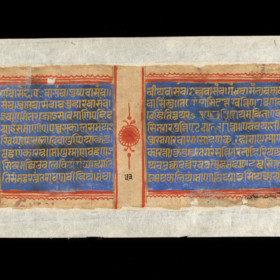
As with many Kalpa-sūtra manuscripts, there is a clear intention to make the manuscript a valuable and remarkable object in itself. This aim is signalled by the:

  • shape and style of the script, which is close to calligraphy
  • blue background for the text
  • gold ink instead of the standard black ink for the writing
  • gold in the paintings instead of ordinary colours
  • borders of red arabesques
  • division of the text into two parts by a column holding an ornamental red disk vertically flanked by arrows.

Script

The elaborate script used is the Jaina Devanāgarī script, which is here like calligraphy.

It is an old type in the way the sounds e and o are notated when used with a consonant, and is known as pṛṣṭhamātrā script.


Background

The Kalpa-sūtra is the most frequently illustrated Jain text of the Śvetāmbara sect. It is read and recited by monks in the Śvetāmbara festival of Paryuṣaṇ, which takes place in August to September each year.

The first part of the Kalpa-sūtra deals with the lives of the Jinas, especially Mahāvīra, Pārśva, Nemi and Ṛṣabha. It features almost identical stories of their births, lives as princes, renunciation, enlightenment and final emancipation.

The second part – Sthavirāvali – is a praise of the early teachers of Jainism. The third part – Sāmācārī – deals with particular monastic rules to be followed during the rainy season.


Transcription

1. //tehi ya / uppayaṃtehi ya / ujjovayā vi hotthā //
2. jaṁ rayaṇiṁ ca ṇaṁ samaṇe bhagavaṁ Mahāvīre jāe taṁ ra-
3. yaṇiṁ ca ṇaṁ bahūhiṁ devehiṁ devīhi ya uvayaṃtehi
4. uppayaṃtehiṁ uppiṁ-jalamāṇa-bhūyā kahakaha-bhū-
5. yā yāvi hotthā // jaṃ rayaṇiṃ ca ṇaṃ samaṇe bhagavaṃ Mahā-
6. vīre jāe taṃ rayaṇiṃ ca ṇaṃ bahave Vesamaṇa-kuṃḍa-
7. dhārī / tiria-jaṃbhagā devā Siddhattharāya-bhavaṇaṁsi
8. hiraṇṇa-vāsaṁ ca / vaira-vāsaṁ ca vattha-vāsaṁ ca ābhara///


Translation

[In that night in which the Venerable Ascetic Mahāvīra was born,] there was light originated by [many] descending and ascending [gods and goddesses]. In that night in which the Venerable Ascetic Mahāvīra was born, there was noise and confusion originated by many ascending and descending gods and goddesses. In that night in which the Venerable Ascetic Mahāvīra was born, many demons in Vaiśramaṇa’s service belonging to the animal world rained down on the palace of [Mahāvīra’s father] King Siddhārtha a great rain of gold, a rain of diamonds, a rain of clothes [, ornaments, leaves, flowers, fruits, seeds, garlands, perfumes, colours, powder, and riches]

Translation by Hermann Jacobi

Kalpa Sûtra

Kalpa Sūtra of Bhadrabāhu Svāmī

Bhadrabāhu

The Kalpa Sûtra of Bhadrabâhu

Bhadrabāhu

A Descriptive and Illustrated Catalogue of Miniature Paintings of the Jaina Kalpasūtra as executed in the Early Western Indian Style

W. Norman Brown

Catalogue of the Jain manuscripts at the British Library: including the British Museum and the Victoria and Albert Museum

Related Articles

Mahāvīra

Related Manuscripts

Mahāvīra as an infant

Birth of Mahāvīra

Mahāvīra’s birth and ritual bath

Mahāvīra’s birth