
Description
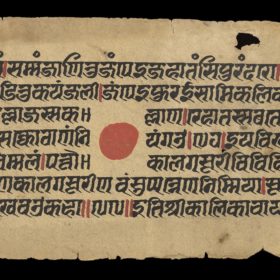
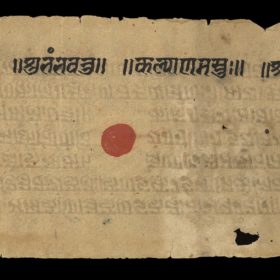
In Jain manuscripts, as in other Indian manuscripts, the end is the place to look for information on the title of the work, the author, the date of composition and so on. This is the case here, although no date is given.
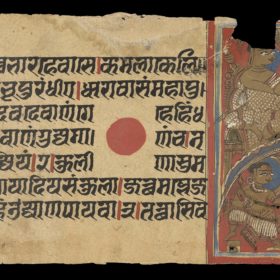
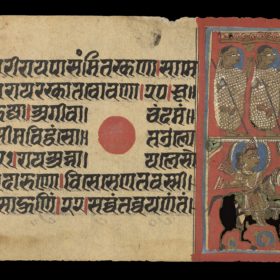
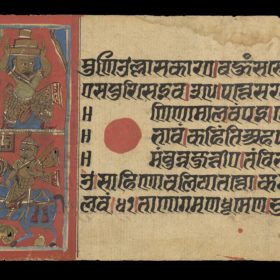
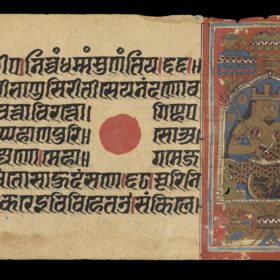
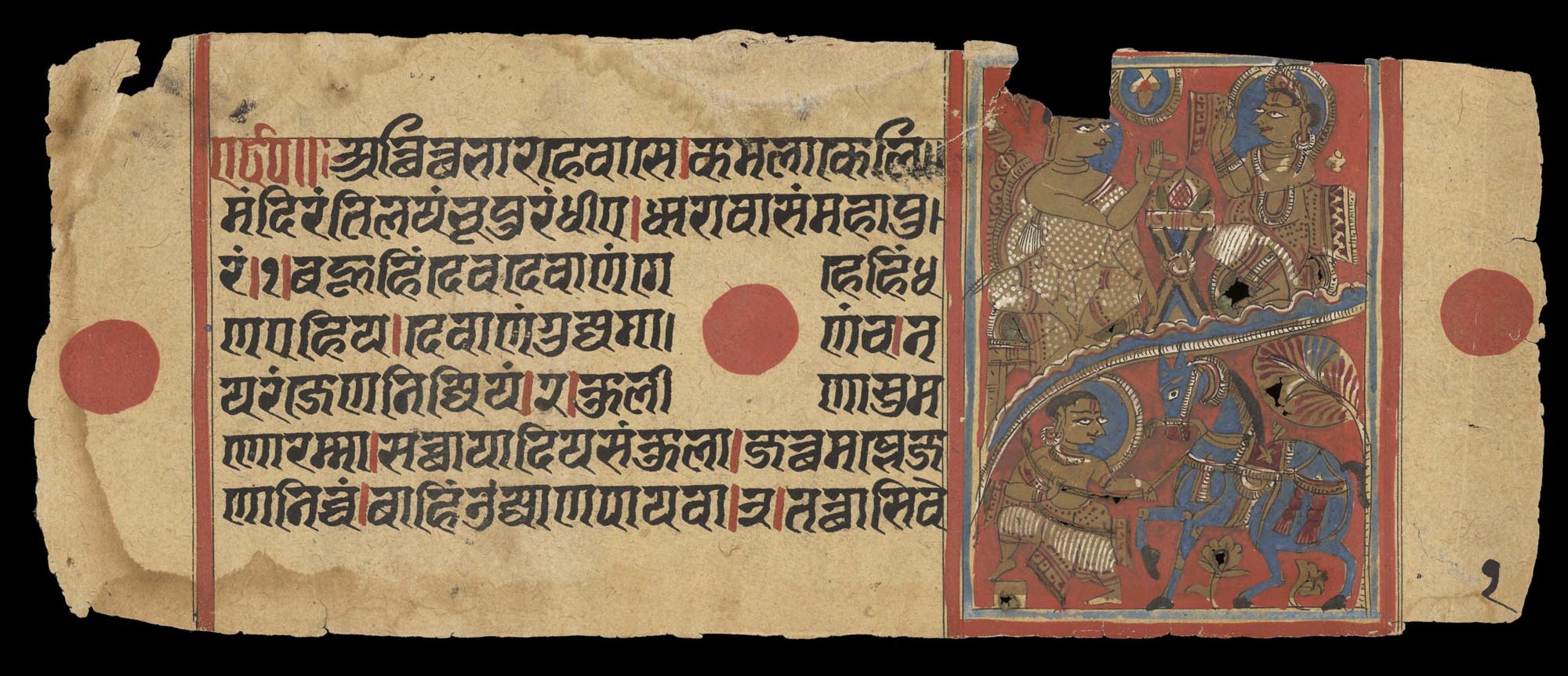
The illustration contains two scenes at different levels, both featuring Kālaka.
On the upper level the figure on the right is Prince Kālaka. His hands are folded in a respectful gesture. The figure on the left is a Jain monk wearing the typical Śvetāmbara monastic robe. He is seated on a slightly raised seat and holds the cotton broom under his arm. In one of his hands he holds the mouth-cloth, which he has taken off to talk. In between them is the sthāpanācārya, a kind of tripod that symbolises the Jain teaching and is a substitute for the teacher.
Below is a river, which means that the scene takes place in a natural landscape. The tree and the flowers on the bottom level also point to this.
On the bottom level the figure on the left is again Prince Kālaka. His face and costume are different from those in the top scene. It is so in most paintings of these scenes. He is training his horse, which is shown on the right. Both figures are full of movement. The colour of the horse is not realistic though its form, trappings and expression are.
This painting first depicts Prince Kālaka in his everyday life, at the bottom. It then shows the prince listening to a Jain ascetic, the first step towards his renunciation of the householder life.
The long protruding eye is a typical feature of western Indian painting. Its origin is unclear.
Other visual elements
There is no visible caption on this folio, where the edge is torn. But its presence on other folios of the same manuscript shows that there must have been one.
There are several notable things about this page, namely that:
- the original paper is slightly torn at the top and has water stains
- the bottom of the right margin contains the number 1, which is the folio number
- the red sign inside red vertical lines right at the beginning, at the top left, is an auspicious symbol known as bhale, often used at the start of a manuscript
- this version of the Kālaka story is in verse, with numbers at the end of each stanza, often between two vertical lines, like here, which on this page are:
1 at the beginning of line 3
2 in the middle of line 5
3 at the end of line 7.
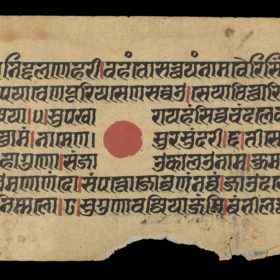
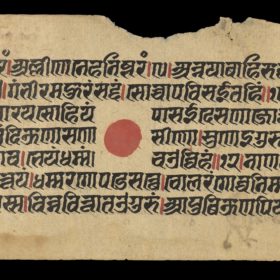
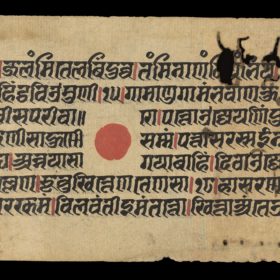
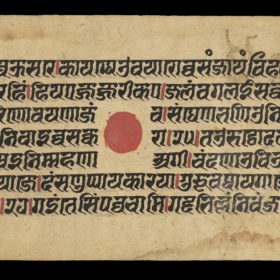
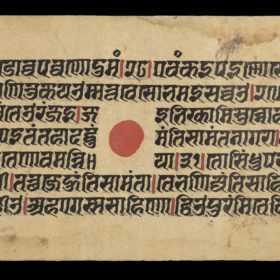
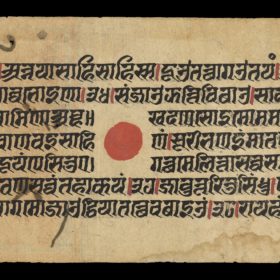
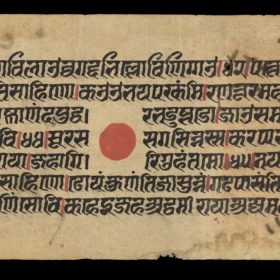
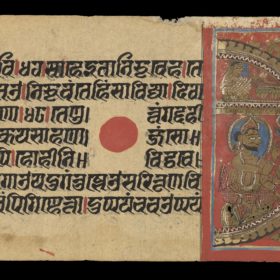
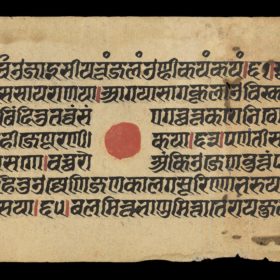
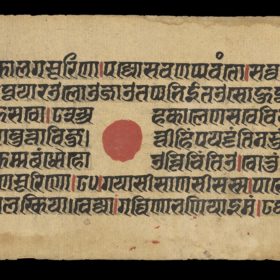
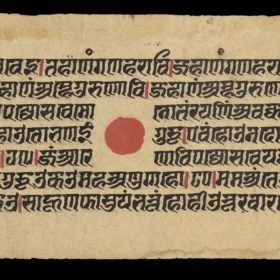
The three red circles along the central horizontal plane are symbolic reminders of the way in which manuscripts were bound when they were on palm-leaf. Here the central one is in a square blank shape. Strings through three holes were used to thread together the loose folios so the reader could turn them over easily. The circles are in the places where the holes would once have been.
Script
The elaborate script is the Jaina Devanāgarī script, in a form which recalls calligraphy. It is used for writing numerous Indian languages, here for Jain Māhārāṣṭrī Prakrit.
There are a few notable features of this script, which are that:
- it is an old type in the way the sounds e and o are notated when used with a consonant, known as pṛṣṭhamātrā script
- the red vertical lines within the text divide the long sentences into smaller parts, but are not necessarily punctuation marks.