Category:Kālakācārya-kathā (Beta 365)

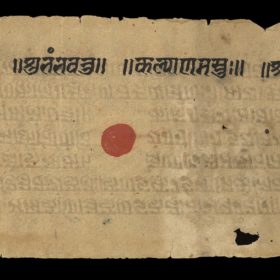
Final line of colophon


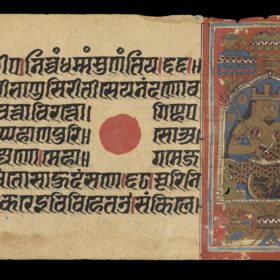
Description

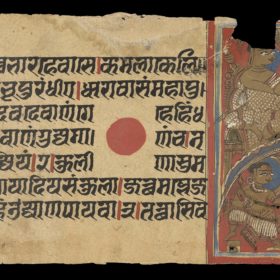
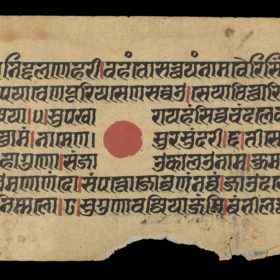
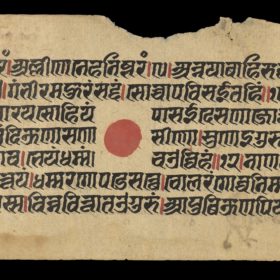
In Jain manuscripts, as in other Indian manuscripts, the end is the place to look for information on the title of the work, the author, the date of composition and so on. This is the case here, although no date is given.

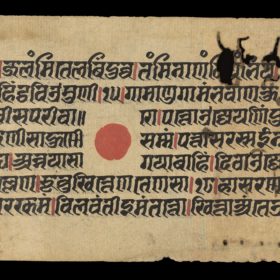
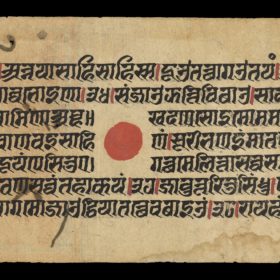
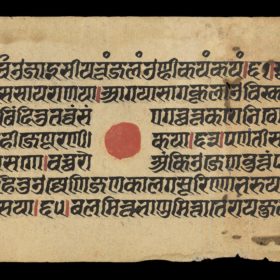
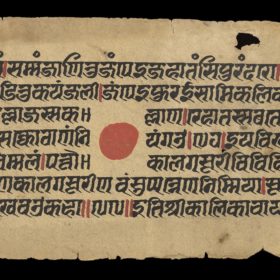
This verso page contains the final part of the colophon of the manuscript, which is not necessarily the author’s creation. It is mostly written by the scribes who copy texts. Sanskrit is often the language of colophons, even when the language of the work is different, which is the case here.

The colophon starts on the final line of the previous page and continues on this page.

Other visual elements

There are several notable things about this page, namely that:

  • the original paper is slightly torn and has water stains
  • the bottom of the right margin contains the number 12, which is the folio number.

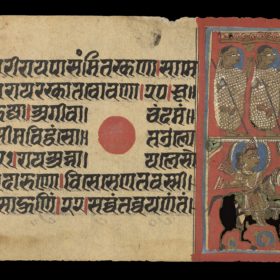
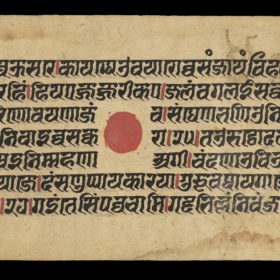
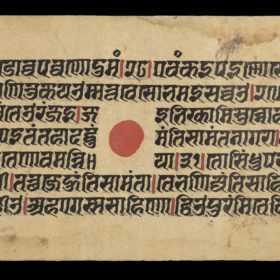
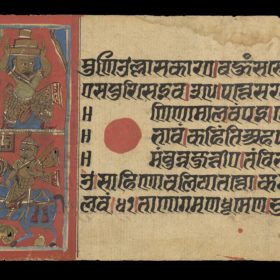
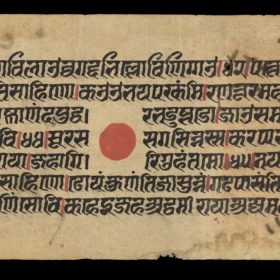
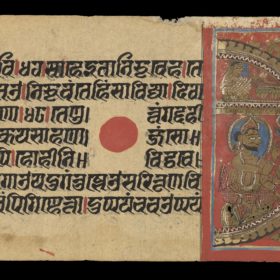
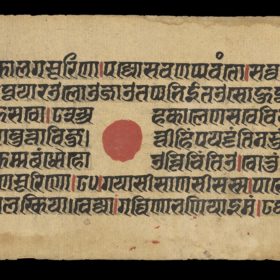
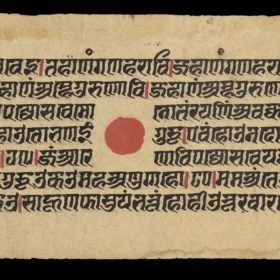
The three red circles along the central horizontal plane are symbolic reminders of the way in which manuscripts were bound when they were on palm-leaf. Here the central one is in a square blank shape. Strings through three holes were used to thread together the loose folios so the reader could turn them over easily. The circles are in the places where the holes would once have been.

Script

The elaborate script is the Jaina Devanāgarī script, in a form which recalls calligraphy. It is used for writing numerous Indian languages, here Prakrit.

There are a few notable features of this script:

  • it is an old type in the way the sounds e and o are notated when used with a consonant, known as pṛṣṭhamātrā script
  • the red vertical lines within the text divide the long sentences into smaller parts, but are not necessarily punctuation marks.


Background

The Kālakācārya-kathā – ‘story of the religious teacher Kālaka’ – emphasises the connection between religious practice and magical abilities. As an accomplished Jain teacher, Kālaka can master various magical sciences and transmute brick into gold. He uses his powers to help the Śakas, a foreign population. In exchange, the Śakas help him destroy the wicked king Gardabhilla.

This eventful tale belongs to the Śvetāmbara Jain tradition. It is known in several versions in various languages and is often illustrated.

The story is frequently found as an appendix to the Kalpa-sūtra because the last part of the story explains how Kālaka changed the date of Paryuṣaṇ. This annual festival was moved from the fifth day of the bright half of the month Bhādrapada – roughly equivalent to August to September – to the fourth. The Kalpa-sūtra has a central role in Paryuṣaṇ.

The version of the story here is that of Bhāvadeva-sūri, a Jain Śvetāmbara author of the 13th century CE. It is written in Jaina Māhārāṣṭrī Prakrit and represents a short recension, where the story is told in simple language without poetical embellishments.


Transcription

This verso page contains the colophon, which is not necessarily the author’s creation. It is mostly written by the scribes who copy texts. Sanskrit is often the language of colophons, even when the language of the work is different, which is the case here.

Colophon

The colophon starts on the final line of the previous page and continues on this page of the folio. It reads:

[12 recto line 7: iti śrīKālikācāryakathānakaṃ saṃ-]
12 verso line 1: pūrṇaṃ samāptaṃ // //śubhaṃ bhavatu// kalyāṇam astu: // śrīr astu: // // ccha


Translation

This verso page contains the colophon, which is not necessarily the author’s creation. It is mostly written by the scribes who copy texts. Sanskrit is often the language of colophons, even when the language of the work is different, which is the case here.

Colophon

The colophon starts on the final line of the previous page and continues on this page of the folio. It means:

Thus the story of Kālikācārya [variant spelling of Kālakācārya] is completed, is finished// // May there be good! May there be welfare! May there be prosperity. ccha

This kind of wish for good fortune is extremely common. It is addressed to the reader or any person who will have the manuscript in his hands.

What is transcribed as ccha is a letter symbol found at the end of chapters or at the end of works. It indicates that the chapter or the work is finished.

The Story of Kālaka: Texts, History, Legends, and Miniature Paintings of the Śvetāmbara Jain Hagiographical Work, the Kālakācāryakathā

W. Norman Brown

Das Kālakācāryakathānakam

A Note on the Heterodox Calendar and a Disputed Reading in the Kālakācāryakathā

Paul Dundas

Related Articles

How to read a Jain manuscript

What is a Jain manuscript?

Related Manuscripts

Blank first page of the Kalpa-sūtra

Cardboard manuscript holder – front