

Description
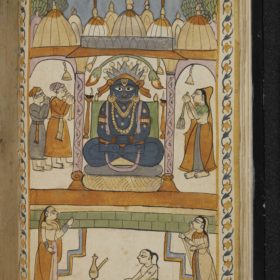
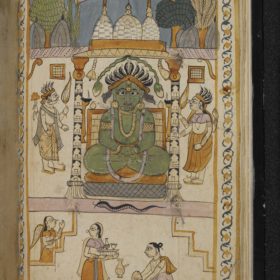
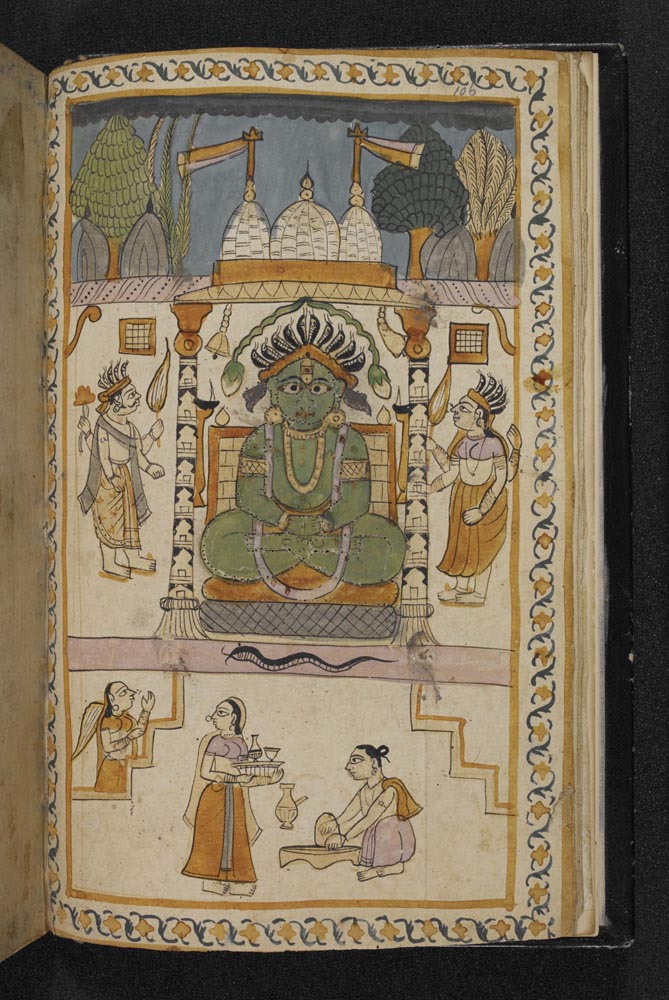
A large green figure sits on a throne in a three-domed temple structure, flags flying from the outer domes. Sitting in the lotus posture of meditation, he wears an intricate headdress and jewellery. He sits under small bells and is flanked by male and female figures wearing snakehoods. A snake slithers below the throne. Above his head is a kind of double-ended lotus stalk, which is an ornament and probable symbol of purity.
The man and woman either side of the large figure each have four hands, one of which raises a fly-whisk. There are gratings above them on both sides.
Below on the left a woman is climbing steps.
On the right, a man squats to grind something while in front of him a woman holds various jugs and tools on a tray. She is looking over her shoulder towards the woman going up the stairs.
Thus this lively painting features two scenes in one, namely the:
- interior of a temple
- landscape surrounding the temple, depicted through the sky and trees.
Inside the main cella of the temple is the 23rd Jina, Pārśvanātha or Lord Pārśva, enthroned. This Jina is clearly identified through his body’s typical green colour, the nine snakehoods above his head and the snake as his symbol below his throne.
The two figures with snakehoods are the pair of attending deities each Jina has. On the left is the yakṣa and on the right the yakṣī. They are named Dharaṇendra and Padmāvatī. Their four hands show that they are non-humans. The fly-whisk – cāmara – they each hold is used in non-religious contexts as a royal insignia, so this implement underlines the equivalence between a Jina and a king. The male figure also holds a flower in one of his hands. These attending deities are clearly depicted as devotees to the Jina, whom they serve.
Beneath them on the right, the man with an uncovered torso and a plait is a temple servant – pujārī – who is usually a Jain Brahmin. His job is to prepare ingredients for worship and to clean the temple and images. Here he is shown grinding something, probably sandalwood powder, as an ingredient of worship. The small jug in front of him is meant for water or milk. Such implements are used in worship rituals – pūjā – to sprinkle liquids on the statue of the Jina. The tray is used to transport the implements and may also carry flower petals to be placed in front of or on the Jina image. These preparations take place in the courtyard outside the temple.
The painter does not use perspective, but does represent the journey through the court to the temple and then inside. The temple court, where the temple servant is working, is presented first, followed by the interior of the temple.
Other visual elements
This is a full-page painting. The elaborate floral border of the picture underscores the decorative nature of the image.