




Description
The caption in the upper right corner says: Pā° ja°. This is an abbreviation for Pārśvajanma – ‘Pārśva’s birth’.
The newborn Pārśvanātha or Lord Pārśva is lying on the couch near his mother. The queen lies on her couch in her bedroom, fanned and waited on by a female servant.
The long protruding eye is a typical feature of western Indian painting. Its origin is unclear.
Other visual elements
The bottom of the right margin contains the number 54. This is the folio number.
The original paper has been pasted onto a new base. As with many Kalpa-sūtra manuscripts, there is a clear intention to make the manuscript a valuable and remarkable object in itself. This aim is signalled by the:
- use of gold in the paintings, margins and ornamental motifs
- decorated border with blue floral motifs
- three diamonds filled with gold ink and surrounded by blue ornamental motifs.
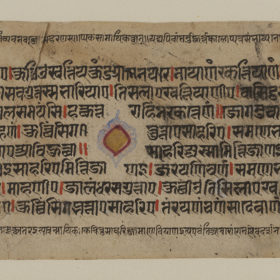
The three golden diamonds along the central horizontal plane are symbolic reminders of the way in which manuscripts were bound at one time. Strings through one or more holes in the paper were used to thread together the loose folios so the reader could turn them over easily. The shapes are in the places where the holes would once have been.
Three diamonds mean a verso side.
Script
The elaborate script used is the Jaina Devanāgarī script, which is here like calligraphy. It is used for writing numerous Indian languages, here for Ardhamāgadhī Prakrit.
There are a few notable features of this script, which:
- is an old type in the way the sounds e and o are notated when used with a consonant, known as pṛṣṭhamātrā script
- contains red vertical lines that mark out verse divisions, with a single line dividing a verse in two while double lines are found at the end of the verse.
The number 54 at the beginning of line 4 is a paragraph number.
The lines in smaller script above and below the main text and in the margins are explanations in Sanskrit of phrases found in the central part.