
Description
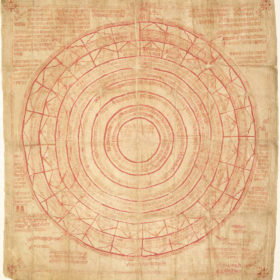
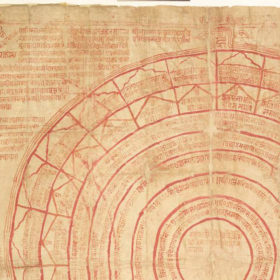
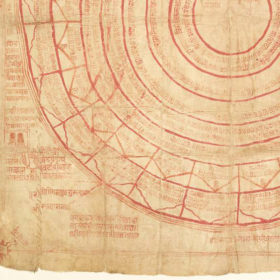
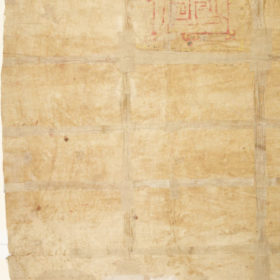
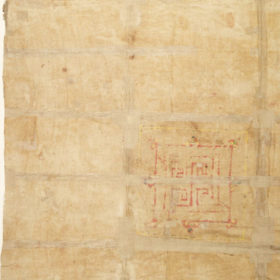
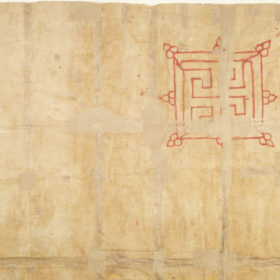
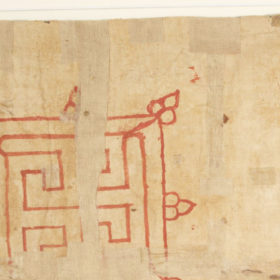
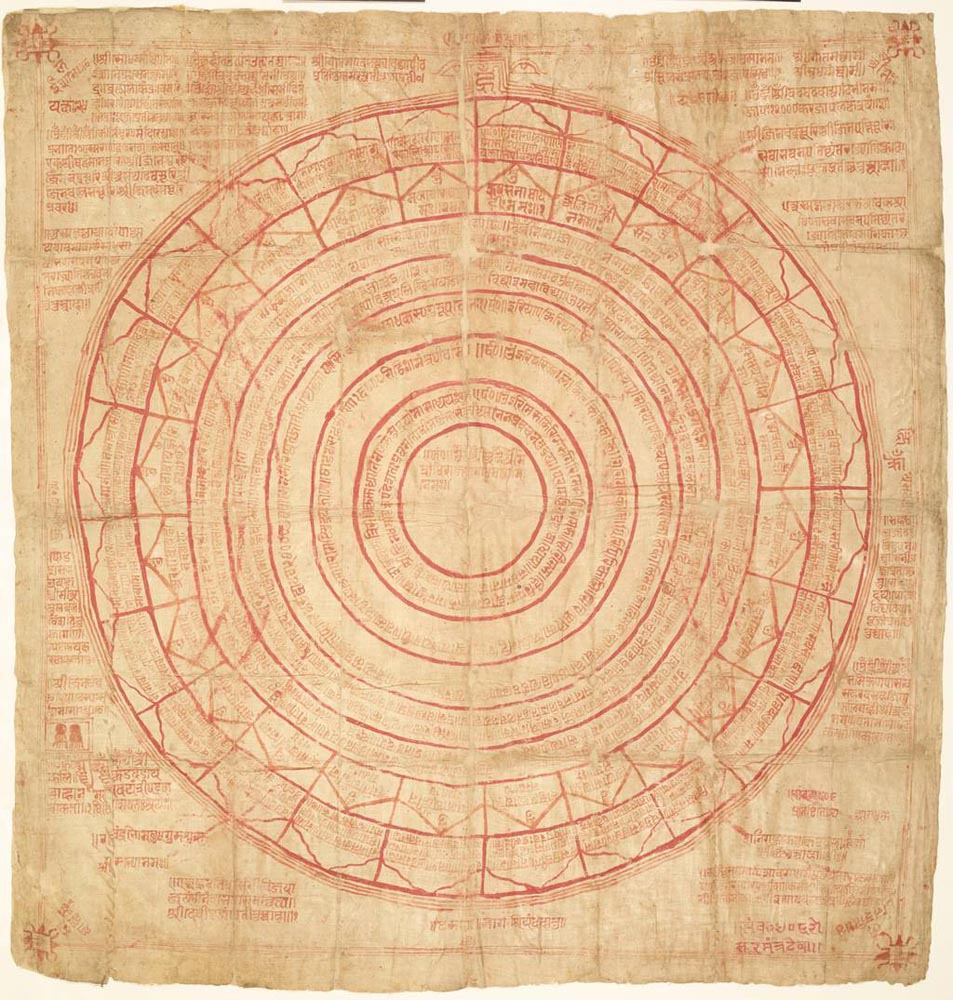
Eight concentric circles contain phrases in small writing. The circles are surrounded by a lot of text, filling up most of the space within the square frame enclosing the circular shape. Above the circle are two eyes looking upwards, separated by a symbol. A pair of footprints can be seen on the left, towards the bottom, in the middle of text. Decorative emblems are at the four corners of the square. All the writing and symbols on the cloth are in red ink.
This is a sūri-mantra-paṭa – a type of yantra or mystical diagram – found among Śvetāmbara monastic orders. The magic and sacred syllable hrīṃ is at the top, in the middle, with an auspicious eye each side. The circles are similar to the depiction of continents and oceans in Jain cosmology while the writing in each one consists of lines of mantras written in Sanskrit or Prakrit.
Mantras
In the circle in the middle is the principal mantra, which is devoted to ‘Gotamasvāmin’, a respectful name for Indrabhūti Gautama, the main disciple of Mahāvīra, the 24th Jina. The second circle from the outside is dedicated to the 24 Jinas, whose names appear in individual boxes. The other circles contain mantras offering homage to:
- the different sorts of knowledge
- the various kinds of monks who have this knowledge
- terms or concepts of Jain belief
- the nine planets, in the lower part of the left side, continuing on the right side
- the four orders of Jain deities – Bhavanapati, Vyantara, Jyotiṣka and Vaimānika
- other groups of beings such as the Jinas’ divine attendants, the yakṣas and yakṣīs
- the vidyā-devīs, who are associated with magical knowledge or powers
- assorted classes of demons, such as preta and piśāca.
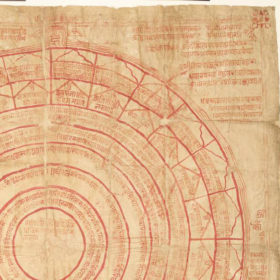
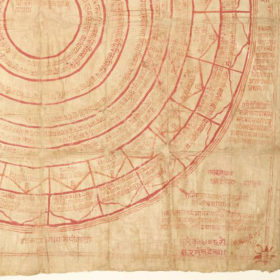
Dispersed around the yantra are a few Sanskrit stanzas, which pay homage to deities, such as the one to Śrīdevī in the bottom-left part. In the middle of the right-hand side is a Prakrit stanza honouring Pārśvanātha or Lord Pārśva, the 23rd Jina.
Kharatara-gaccha sect
One phrase appears in several places on the yantra, referring to asmad-gaccha – ‘our gaccha’. The gaccha or sect is not named but the heads of the Kharatara-gaccha monastic order are listed in the top corners, making it clear that the yantra refers to this sect.
The list begins in the top left with the monk who is said to have founded the sect in the 11th century, Vardhamāna-sūri, who died in 1031 CE, and the monk who consolidated this order, Jineśvara-sūri.
Then come his disciples and successors:
- Jinacandra-sūri
- Abhayadeva-sūri
- Jinavallabha-sūri
- Jinadatta-sūri.
The list continues in the top right of the yantra, with the names of:
- Jinacandra-sūri, called ‘Maṇidhārī’, who was Jinadatta-sūri’s successor
- Jinapati-sūri (1153–1222 CE).
The name Jinacandra-sūri appears also above the footprints – pādukās – on the lower left side of the maṇḍala. The footprints are accompanied by the phrase:
śrīJinacandrasūri-pādebhyaḥ sadā namo ‘stu //
may there always be homage to the feet of Jinacandrasūri
There are several heads of the Kharatara-gaccha with the name Jinacandra-sūri. But it is likely that the footprints and homage refer to the one listed in the top right, who is one of the Dādā-gurus. These are the major teachers of this monastic order, who largely owe their fame to their miraculous powers (see Babb 1996).
Date
In the middle of the right-hand portion is the phrase:
saṃvat 1506 pratiṣṭito ‘ya[m] ārādhaka
it was consecrated in the year 1506 of the Vikrama era. The worshipper is this
Corresponding to 1449 CE, this date makes this sūri-mantra-paṭa one of the oldest surviving examples, if it is authentic.
However, the name of the ārādhaka is missing, who is the person who would have worshipped this yantra. The absence of a name indicates that perhaps this mystical diagram was never used.
Modern label
At the very bottom of the lower-right corner is a label that was not written by the scribe who created the yantra.
It says:
//saṃvat 406 ro Sūramaṃtra ṭebā //1//
commentary on the sūrimantra of saṃvat 406
The word ṭebā is a variant of ṭabo, a Gujarati word that means ‘commentary‘ or ‘word-to-word paraphrase’, while ro is the Rajasthani postposition meaning ‘of’.
The date is strange but is probably meant to be (1)506, repeating the original date in the Vikrama era. It is likely that the label was written in the 19th century, when many Jain mantras and maṇḍalas changed hands, to identify the object.