
Story and images
Tradition holds that Mahāvīra was born in Kuṇḍagrāma and gained liberation on Pāvāpurī.
Mahāvīra’s symbolic colour is yellow and his emblem is a lion.
Like all Jinas, Mahāvīra has a pair of spiritual attendants, often shown in art. His yakṣa is Mātānga while his yakṣī is Siddhāyikā.
Titles
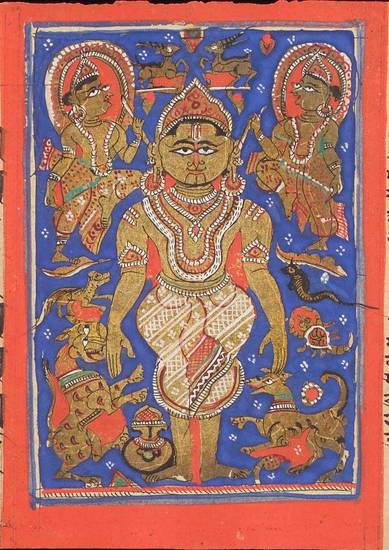
Mahāvīra is tested
Image by Wellcome Trust Library © Wellcome Library, London
‘Mahāvīra’ is a title meaning ‘great hero’ in Sanskrit. Other titles of the 24th Jina are:
- ‘Sanmati’ – ‘of righteous thoughts’ – which is hardly used
- ‘Niggantha’ in Pali or ‘Nirgrantha’ in Sanskrit – ‘without knots’ – which is a title given to ascetics because ‘knots’ mean the household life of desires, duties and worries. This is how he is referred to in Buddhist texts
- the Pali name Nataputta in Buddhist texts, which means ‘son of the Jnatri clan’.
His name at birth was Vardhāmana, which means ‘ever increasing’.
Historical existence
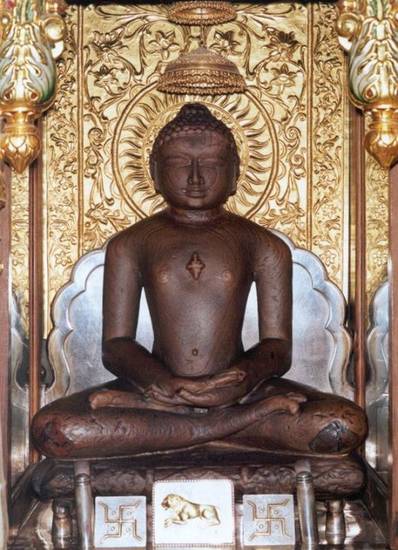
Idol of Mahāvīra
Image by Dayodaya © CC BY-SA 3.0
Mahāvīra’s existence is independently documented in Buddhist texts but the two main Jain sects of Digambaras and Śvetāmbaras have slight differences in their accounts of his life. A near-contemporary of the Buddha, Mahāvīra lived about 563 to 483 BCE, which is around a century later than his earliest traditional dates.
In the early days of Jain studies, Western scholars thought Mahāvīra had founded the Jain religion but it is now widely accepted that he reformed an established religious tradition. He is credited with adding a fifth vow to the four preached by the 23rd Jina, Pārśvanātha or Lord Pārśva.
Transfer of the embryo
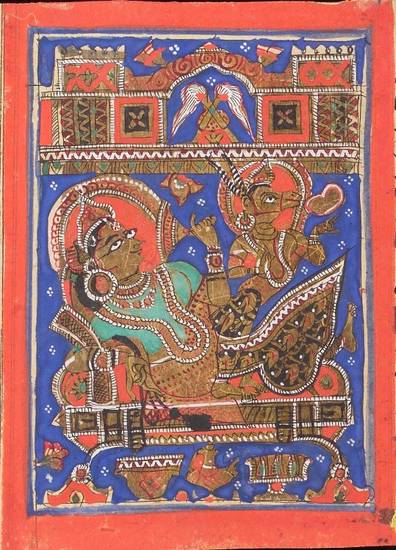
Mahāvīra’s embryo is removed
Image by Wellcome Trust Library © Wellcome Library, London
The life stories of all the Jinas follow prescribed patterns in Jain scriptures, usually with only small variations. However, according to the Śvetāmbara sect, Mahāvīra’s life features a unique episode that takes place before his birth.
Śakra, king of the gods, realises that the embryo of the Jina-to-be has been conceived by a brahmin woman, Devānandā. Since a Jina can only be born of a kṣatriya woman, Śakra sends his general Hariṇaigameṣin to transfer the embryo. Hariṇaigameṣin casts a spell that sends Devānandā and her household into a deep sleep and thus removes the embryo. Hariṇaigameṣin then makes Queen Triśalā and her household fall asleep so he can transfer the embryo Mahāvīra to her womb.
Both women have the auspicious dreams experienced by the mother of a child who grows up to become a Jina.
The queen gives birth safely to the baby in due course.