Category:Fragments of Jain manuscripts (Or. 13950)

Eight Jinas

Description

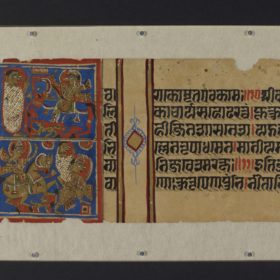
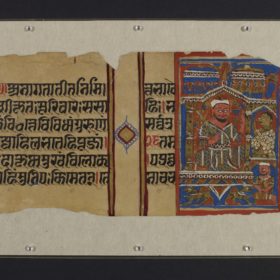
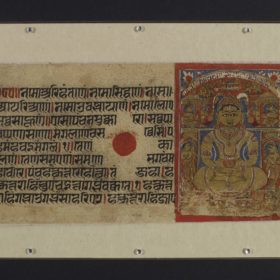
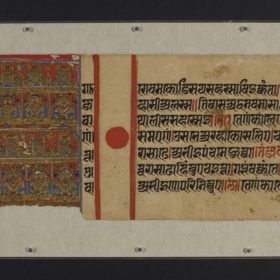
In the upper corner of the left margin there is a damaged caption reading: …timā 6 // 37. This could stand for [Jinapra]timā – ‘Jina images’.

Four identical figures are seated in two rows in temple structures, all in the posture of meditation. They are eight Jinas.

They cannot be identified individually. This kind of depiction is a way of dealing with the 20 intermediate Jinas whose lives are not told at length in the Kalpa-sūtra. The lives of the Jinas from number 21 to 2 are summarised with little difference in the stories. The usual way to show them is to represent them, like here, as identical figures. Here only a selection of eight Jinas is shown. In other manuscripts, all 20 are depicted, either in one picture, or, more often, in two pictures each containing ten figures.

Other visual elements

As with many Kalpa-sūtra manuscripts, there is a clear intention to make the manuscript a valuable and remarkable object in itself. Here this aim is signalled by the:

  • shape and style of the script, which is close to calligraphy
  • use of gold ink in the paintings
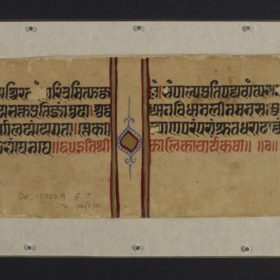
  • division of the page into two equally-sized panels, separated by a 2-centimetre margin containing a red circle.

The red circle in the centre along the central horizontal plane is a symbolic reminder of the way in which palm-leaf manuscripts were bound at one time. Strings through this hole in the palm leaf were used to thread together the loose folios so the reader could turn them over easily. The circle is in the place where the hole would once have been. One circle generally means a recto side, and three circles a verso side.

In the left margin the number ‘6’ is clear and should indicate the number of figures in the painting yet does not match what is actually shown. Such discrepancies are common in Jain manuscripts because the captions are directions for the painter, who in some cases did not follow them.

The number ‘37’ indicates the number of the picture within this manuscript. However, only one page of the original manuscript is available.

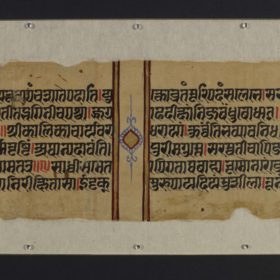
Script

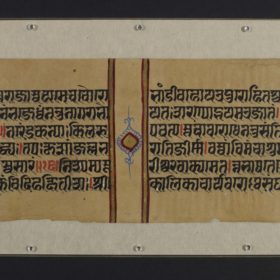
The elaborate script used is the Jaina Devanāgarī script. It is used for writing numerous Indian languages, here for Prakrit. There are a few notable features of this script, which:

  • is an old type in the way the sounds e and o are notated when used with a consonant, known as pṛṣṭhamātrā script
  • uses red ink for certain purposes.

Red is used to highlight stanza breaks and certain symbols and phrases, specifically:

  • the vertical lines within the text marking verse divisions, with single red vertical lines indicating where a verse is divided in two while double red vertical lines are found at the end of the verse
  • for the symbol cha, seen in the middle of line 3 and in the last line, which signals the end of a section or paragraph
  • for the phrase on line 5 taṃ jahā – ‘to wit’ – which introduces a list.

Background

The Kalpa-sūtra is the most frequently illustrated Jain text of the Śvetāmbara sect. It is read and recited by monks in the festival of Paryuṣaṇ, which takes place in August to September each year.

The first part of the Kalpa-sūtra deals with the lives of the Jinas, especially Mahāvīra, Pārśva, Nemi and Ṛṣabha. It features almost identical stories of their births, lives as princes and then their renunciation, enlightenment and emancipation.

The second part – Sthavirāvali – is a praise of the early teachers of Jainism. The third part – Sāmācārī – deals with particular monastic rules to be followed during the rainy season.

Assorted folios

The pages or folios under this shelfmark belong to different manuscripts. The folios show a variety of handwriting, language and artistic style and are on noticeably different paper.

The folios are from four separate manuscripts, as follows:

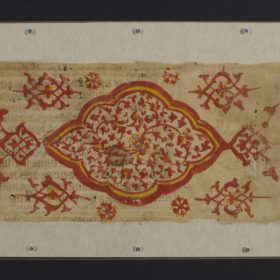
There is also a manuscript holder made for an unknown manuscript.

It is not known what has happened to the rest of each manuscript.

Copies of the Kalpa-sūtra and Kālakācārya-kathā are often made in a single manuscript, which may be why these folios were bundled together. At some point in the past these folios and the manuscript holder were put into a box at the British Library and labelled ‘Frags. of Jain Mss. Skt. / Pkt.’ meaning ‘Fragments of Jain manuscripts in Sanskrit and Prakrit‘. However, it is important to remember that they do not belong together.

Transcription

1. [sā]garovama-koḍi-saya-sahassā viikaṃtā / sesaṃ
2. jahā Sīalassa // te-vāsa addha-nava-māsāhiya
3. bāyālīsa sahasse[h]i //cha//1 teṇaṃ kāleṇaṃ te-
4. ṇaṃ samaeṇaṃ / Usabhe arahā Kosalie / cau U-
5. ttarāsāḍhe / Abhīi paṃcame hutthā // taṃ jahā // 1
6. Uttarāsāḍhāhiṃ cue caittā / gabbhaṃ vakkaṃte / jā-
7. va Abhīiṇā parinivvue // cha// teṇaṃ kāleṇaṃ

Translation

1. [Since the passing away of Arhat Ajita, namely the second Jina, 5,000,000] crores of sāgaropamas have passed / the rest
2. like for Śītala [the tenth Jina]// 3 years, 8 months and a half plus
3. 42 000 [= 42,003 years and 8 and a half months] //cha// 1 In that time
4. in that period, the Arhat Ṛṣabha from Kosala / Four [auspicious events in his life took place under the constellation]
5. Uttarāsāḍha, and the fifth took place in conjunction with Abījit. To wit:
6. He descended [from heaven] on Uttarāsāḍha, after having descended he entered the womb, etc. until
7. he was finally emancipated in Abhījit // cha// At that time.

Comments

The following elements are noteworthy in the text on this page, namely:

  • lines 1 to 3 mark the end of the section dealing with the 20 intermediate Jinas, whose lives are not told in detail in the Kalpa-sūtra
  • line 4 and the following lines begin the section where the life of the first Jina, Ṛṣabhanātha or Lord Ṛṣabha, is told at length.

The list of the 20 intermediate Jinas in the Kalpa-sūtra gives only the intervals of time between the appearance of each Jina. This is done in reverse order, starting with Jina number 21, Naminātha or Lord Nami, and going up to the second Jina, Ajitanātha or Lord Ajita.

Along with Mahāvīra, Pārśvanātha or Lord Pārśva and Neminātha or Lord Nemi, Ṛṣabha is one of the four Jinas whose life is narrated at length in the Kalpa-sūtra.

Related Articles

How to read a Jain manuscript

Śītala

Ananta

Supārśva

Malli

Ajita

Abhinandana

Puṣpadanta or Suvidhi

Emblems of the 24 Jinas

Ara

Śānti

Jina

Dharma

Vimala

What is a Jain manuscript?

Jain Beliefs

Padmaprabha

Nami

Saṃbhava

Kalpa-sūtra

Candraprabha

Munisuvrata

Sumati

Kunthu

Śreyāṃsa

Vāsupūjya

Related Manuscripts

Image of a Jina

Image of a Jina

Image of a Jina

Image of a Jina