Unlike monotheistic traditions, the Jains do not have a unique holy book that characterises their faith. Instead they have a body of holy writings or scriptures. In India, they share this feature with the Buddhists. Hindus are in a similar position, even though they have the Vedas, which can be considered the ultimate source of teaching.

The Jinas, especially the 24th, Mahāvīra, are the ultimate source of teaching for all Jains. All sects agree that this teaching was first transmitted orally. All are also aware that in the course of time this teaching changed, with some parts altered through faulty memorisation or simply lost. They dispute, however, which parts have survived and which have survived in amended form. This is why Śvetāmbaras and Digambaras do not agree about which scriptures are authoritative.

The Śvetāmbaras have a canon of 32 or 45 Āgamas, made up of several types of scripture. Believing that all the original Āgamas have been lost for centuries, the Digambaras have a different canon. They hold that two texts preserve parts of the Pūrvas or original teachings of the Jinas. These and other early texts make up their scriptures.

Both sects agree on only a single scripture. The Tattvārtha-sūtra contains the main doctrines of the Jain faith, though the two main sects have slightly different versions and composition dates.

Knowledge of what is now in written form is essential to being a good Jain. It is included in the second type of knowledge in Jain epistemology – śruta-jñāna – ‘knowledge of what has been heard’. In the often fervent debates about the importance of this knowledge in spiritual development, one powerful view says that scriptural knowledge is not enough by itself.

Although scriptural knowledge is very important, access to holy texts has frequently been restricted. In some sects particular scriptures are still limited to certain groups, such as male mendicants. Lay access to holy writings has usually been under the guidance of mendicants and often has not been direct and unmediated. Printing and editing the scriptures are thus relatively recent activities.

Whether they have access to the textual material through which the Jinas’ teaching came to be handed down or not, all Jains are aware of the existence of their holy writings. These writings are the basis of their ritual and religious life and are venerated in various ways. The most striking examples are individual Śvetāmbara and Digambara festivals in which holy texts form the centrepieces.

Terms and classifications

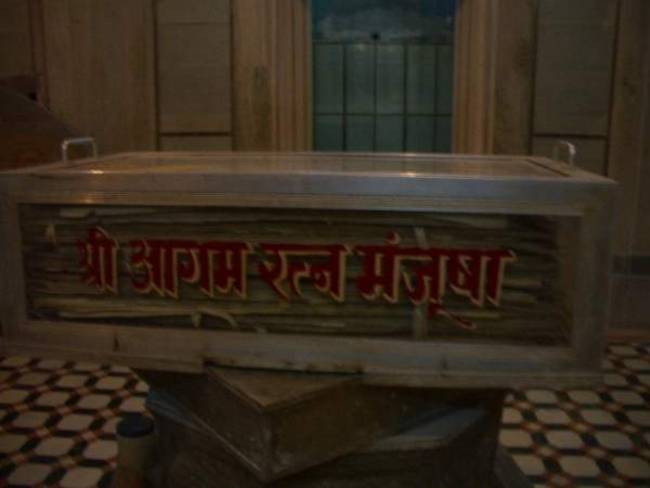
A Jain temple-library holds sacred books, individually wrapped and labelled. The rice on the table in front is an offering left by worshippers. Jains consider their scriptures to be holy objects, with books often the focus of religious rituals. Jain holy texts
Image by Malaiya © CC BY-SA 3.0
The word ‘canon’ for the Jain holy writings is increasingly felt to be inadequate, for it implies an unchanging body of texts sanctioned by a central authority. Jains commonly use the words siddhānta and āgama, which are pan-Indian terms. The former term conveys the idea of validity and authority, and is perhaps more common among Digambaras. The latter term means ‘what has come down to us’ or tradition. Other terms used in Prakrit are ‘open teaching of monks’ – niggantha-pāvayaṇa – or ‘basket of the chief disciples’ – gaṇi-piḍaga. These are both in the singular and refer to the primary sources of the teaching as something global. To a large extent, the concepts of siddhānta and āgama denote fluid groupings that are open to change. For practical purposes, various categories of the scriptures have taken shape over time and have been populated with specific texts. Whereas some categories are fairly fixed, others can be extended or reduced. The number of items in each group may play a role in sectarian identity because some may be rejected as apocryphal. The terms āgama and siddhānta may also be understood as even broader groupings, covering any text with a Jain author that teaches some aspect of the tradition – whether commentary, hymn, story or treatise. These forms are all regarded as media meant to ‘awaken’ the ‘somnolent sūtras’ (Dundas 1996). Therefore classifications of Jain scriptures may use various criteria. Different classifications may thus be compatible. Each of the items in both classes contains a number of texts that may be either fixed or varying, according to the criteria adopted. The Śvetāmbara canon comprises either 32 or 45 texts, depending on the sect.

Chief disciples – the gaṇadharas
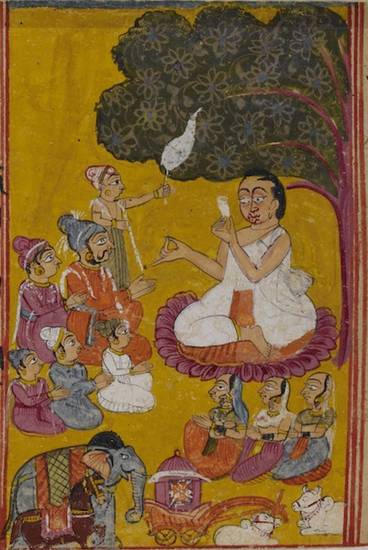
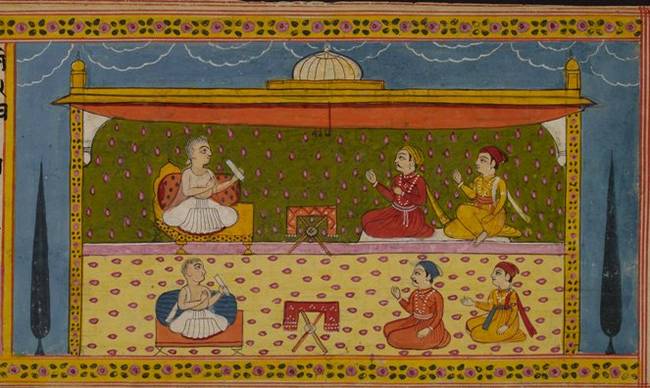
This manuscript painting shows Indrabhūti Gautama preaching. The white-clad monk is fanned by a servant and sits on a lotus, symbols of worldly and spiritual rank. King Śreṇika and his family sit separately from the lords and ladies of the court Indrabhūti Gautama preaches
Image by British Library © CC0 1.0 (Creative Commons Public Domain)
‘A Jina utters the meaning, the chief disciples put together the text skilfully’. This oft-quoted statement from the Āvaśayaka-niryukti, an early Śvetāmbara commentary, describes the process of teaching and the respective roles of the Jina and his chief disciples. The chief disciples – gaṇadharas – are the closest followers of a Jina, who have taken mendicant vows in his presence and form the core of his fourfold community. Mahāvīra, for instance, has 11, who are said to be converted brahmins. They are the only ones who can understand the Jina’s meaning from the various lectures and discussions he leads over time. They shape it so it can be passed on to others, resulting in the 14 Pūrvas and the 12 Aṅgas. The differences in Śvetāmbara and Digambara understanding of the ‘divine sound’ may influence the role of the chief disciples. It could be more important among the Digambaras since the gaṇadharas have to translate into words a sound that does not correspond to any specific language. The chief disciples attain final liberation without further rebirth and cannot continue their activities as monastic leaders or teachers after they have reached omniscience – kevala-jñāna. Thus they must ensure that they transmit the Jina’s teachings while still ordinary monks.

Chain of oral transmission
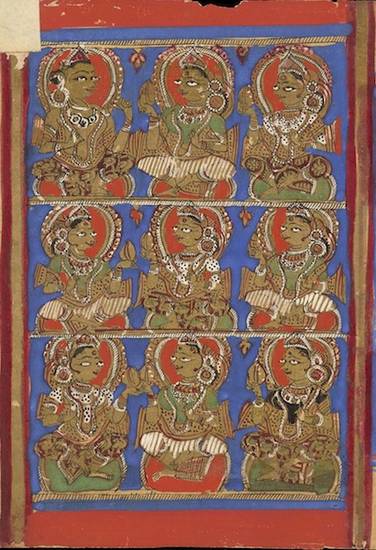
This picture from a manuscript of the Kalpa-sūtra dates from 1512. It depicts the elder Jambū-svāmin and his eight wives Jambū-svāmin and his eight wives
Image by Wellcome Trust Library © Wellcome Library, London
In theory only the Jinas and their chief disciples are involved in passing on teachings orally. Each of the Jinas has direct disciples, but nothing much is known about their exact role in transmission. Precise evidence is available only for the 24th Jina, Mahāvīra. Mahāvīra’s first chief disciple was Indrabhūti Gautama. But he attained omniscience on the day Mahāvīra died, which is commemorated in Dīvālī. Then the leader and preacher was Sudharman, who attained omniscience 12 years after Mahāvīra’s death. He was thus in a position to preach and lead Mahāvīra’s community during this 12-year period. Sudharman taught his disciple, Jambū, as the introduction to many Aṅgas shows. When Sudharman died, at the age of 100, the first generation of Mahāvīra’s disciples was extinct. Jambū was the first ‘elder’ – sthavira. He became the leader of the monastic community and the chief teacher for eight years. When he attained omniscience and final liberation in the 64th year after Mahāvīra’s death, he was the last person to be liberated in this time cycle. Jambū’s successors continued to transmit Mahāvīra’s message by memorising it, with their followers doing the same. The first ‘elders’ who followed Jambū were:
  • Prabhava
  • Śayyambhava, around 429 BCE
  • Yaśobhadra
  • Bhadrabāhu in the 4th century BCE, who was the last to master the 14 Pūrvas
  • Sthūlabhadra.
More elders are traditional, with the full list forming the topic of the second part of the Kalpa-sūtra, the‘Sthavirāvalī’ or ‘String of Elders‘. This list is also found at the opening of another work in the Śvetāmbara canon, the Nandī-sūtra. Legends about the main elders are knitted together in Hemacandra’s Pariśiṣṭa-parvan – Lives of the Elders – written in the 12th century (Fynes 1998).

Crises and losses

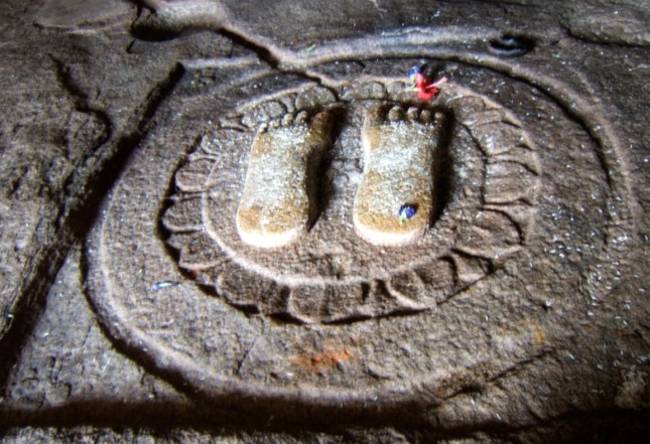
Sacred footprints in Bhadrabāhu’s Cave on Candra-giri at the pilgrimage site of Shravana Belgola, Karnataka. These footprints – caraṇa – are considered to be those of the 3rd-century sage Bhadrabāhu, who fasted to death at Shravana Belgola Bhadrabāhu’s sacred footprints
Image by Ilya Mauter © CC BY-SA 2.5
Legendary accounts show that a major crisis occurred around 300 BCE in the area of eastern India where the Jain community had originated and was strong. A 12-year famine in the Magadha region proved disastrous. The accounts explain why the Digambaras and Śvetāmbaras have such different canons of holy writings. Dating from much later than the events they describe, the traditional stories suppose that the split between the two sects had already taken place. In fact, at the time of the famine, these two groups are emerging as separate factions. According to Digambara sources, Bhadrabāhu led a fraction of the monastic community to the south, to today’s Karnatak, to escape the effects of the long famine. The Emperor Candragupta was also part of the group. Both Bhadrabāhu and Candragupta are thought to have fasted unto death in Shravana Belgola. Some 12 years later Bhadrabāhu’s followers went back to Pāṭaliputra, modern-day Patna and the capital of the ancient kingdom of Magadha. There they discovered that Sthūlabhadra had organised a recitation of the holy writings, which produced an official revised edition or recension. The returned monks disagreed with the recension. The northerners had also given up practising nudity while the community had been split up. The group that refused to accept these two innovations are those who were later called Digambaras.
Śvetāmbara sources say that Bhadrabāhu did not go south but went to Nepal. Organising a recitation of the sacred texts in Pāṭaliputra, Sthūlabhadra asked Bhadrabāhu to recite the Pūrvas, which only he knew.
Both sects agree that Bhadrabāhu was the last person to memorise the whole of the 14 texts. After he died they both hold that only part of the Pūrvas was still known, until, finally, they became extinct. They disagree, however, on when exactly he died. Digambaras believe he died 175 years after the traditional date of Mahāvīra’s death, around 352 BCE. The Śvetāmbara sect holds that he died 162 years after Mahāvīra, which is 348 BCE.

Śvetāmbara canon
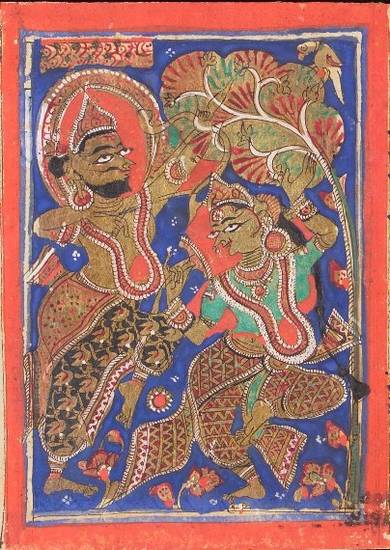
As one of the early 'elders' – sthavira – of the Jain tradition, Sthūlabhadra is an important figure. He organised a recitation of the holy texts around 300 BCE, which was key in the gradual split between the Śvetāmbara and Digambara sects. The elder Sthūlabhadra
Image by Wellcome Trust Library © Wellcome Library, London
This part of the story does not concern the Digambaras. Since they denied the authenticity of the first recitation at Pāṭaliputra, they view later ones in the same light. These councils produced what is known as the Śvetāmbara canon, which dates back to the 5th century. The elders and teachers recognised that natural disasters or other crises threatened the preservation of the tradition. They made successive attempts to collect whatever was available during official recitations – vācanās – or ‘councils’. Sthūlabhadra presided over the first council, which strengthened the growing divisions between the two groups that would later be known as the major Jain  sects. It took place in Pāṭaliputra ‘160 years after Mahāvīra’s death’, which would correspond to 367 BCE. At that time, the Pūrvas and the 12th Aṅga, the Dŗṣṭi-vāda, were already lost. The next recitations took place in the 4th century CE, though it is possible that the texts had begun to be written down earlier. The second recitation was held at Mathurā in modern-day Uttar Pradesh, under the supervision of Skandila-sūri. A concurrent council took place at Valabhī, in Gujarat, led by Nāgārjuna. These two recitations were apparently irreconcilable. Scattered traces of the readings adopted by the ‘Nāgārjunīyas’ are preserved in the surviving Śvetāmbara scriptures but no more than that. The final redaction of the Śvetāmbara canon was achieved during a council at Valabhī in the 5th century. According to tradition, the religious teacher Devarddhigaṇi Kṣamāśramaṇa organised the council ‘980 or 993 years’ after Mahāvīra’s death, which is 453 or 466 CE. All the accounts of the episode are much later but it appears that council attendees agreed to write down everything that remained to avoid more losses than had already occurred.

Digambara canon

What the Digambaras view as authoritative reflections of the early teachings are works that they believe were put into writing in the 2nd century CE. They are the Ṣaṭkhaṇḍāgama and the Kaṣāya-prābhŗta. They are fragments of the Pūrvas, which were all that the oral tradition had saved by that time.

Beyond boundaries – the Tattvārtha-sūtra

Because Digambaras and Śvetāmbara have different canons, it is important to underline the unique place of another Jain holy writing – the Tattvārtha-sūtra. This is the only text accepted as an essential scripture by all Jain sects. There are disagreements about the date it was written and differences in the Digambara and Śvetāmbara versions of the text. However, the Tattvārtha-sūtra sums up key beliefs of Jainism and its authority remains strong. Commentaries reflect these sectarian differences but also emphasise the place of the scripture at the heart of the Jain tradition. This is the reason the Tattvārtha-sūtra was selected to represent Jainism in the Sacred Literature Series, which organises the publication of key texts in different faiths. It was translated into English under the title That Which Is.

Languages

Initially, the language of the Jain scriptures was an issue – it was Prakrit against Sanskrit. But in later phases various languages came to coexist and have been used in different contexts in India, where multi-linguism has always been widespread.

Prakrits

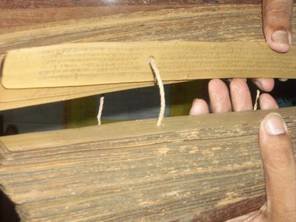
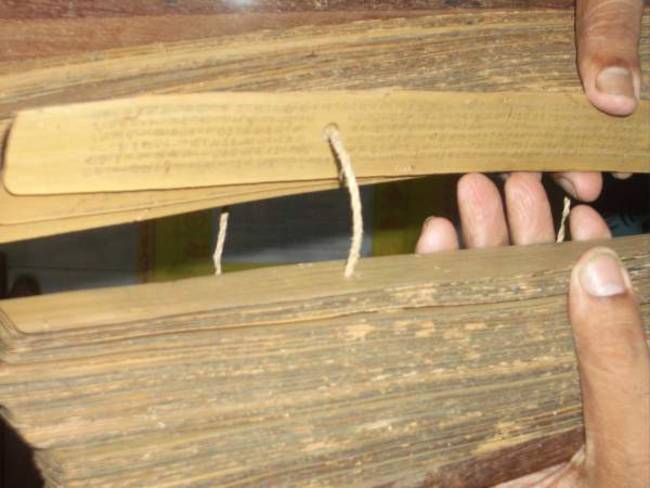
A palm-leaf manuscript from Tamil Nadu. The manuscript is kept together by a string threaded through holes in each long thin folio. When the teachings of the Jinas were first written down, they were etched onto palm leaves, which are very fragile Palm-leaf manuscript
Image by Nalini Balbir © Nalini Balbir
Both the Digambara and the Śvetāmbara Āgamas are written in Prakrit, not Sanskrit. This is considered to have been a deliberate choice. In Mahāvīra’s time Sanskrit was the language of the sacred texts of the brahmins and appears to have been reserved for an ‘elite’. As Mahāvīra’s teaching was ‘open’ to all – an idea that the term pavayaṇa might convey – it was written in the most widely understood language. The Śvetāmbara Āgamas in the strict sense of the term are written in the variety of Prakrit known as Ardhamāgadhī, with a mixture of another form of Prakrit called Jaina Māhārāṣṭrī. The former is associated with the region of eastern India, where Mahāvīra preached, and the latter with western India. Jains migrated west later, and western India is where the final redaction of the scriptures took place, at Valabhī in Gujarat. Somebody who understands one of the two can also understand the other. The differences are grammatical. The degree of blend depends on the texts. Those which are considered ‘early’, such as the Ācārānga-sūtra, are more Ardhamāgadhī. Early commentaries on the Śvetāmbara canon were also written in Jaina Māhārāṣṭrī Prakrit, such as:
  • the verse niryuktis and bhāṣyas, in the first centuries CE
  • the prose cūrṇis in the 6th to 7th centuries CE.
In their first phase the Digambara Āgamas are written in the variety of Prakrit known as Jaina Śaurasenī. Again, this is not altogether a distinct language. The differences from other Prakrits mainly relate to phonetics. Digambaras also used a later form of Prakrit known as Apabhraṃśa, which is the language of some poetical treatises and narratives.

Sanskrit

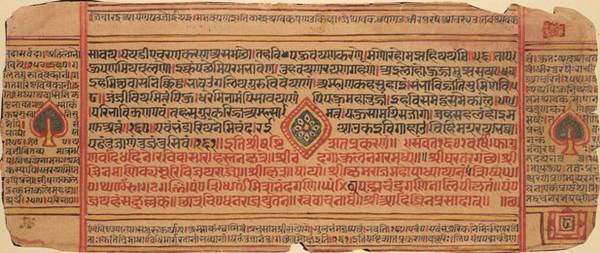
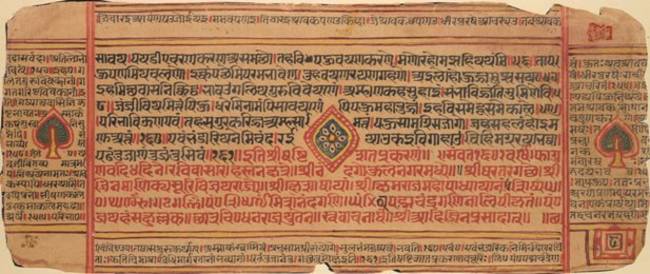
This is a good example of the pañca-pāṭha style of using the manuscript margins for commentary. This manuscript page is from a 16th-century copy of the Ṣaṣṭi-śataka. Pañca-pāṭha style of manuscript commentary
Image by British Library © The British Library Board
In around the 5th century CE Jain writers began to use Sanskrit for certain scriptures. Though these texts were not believed to represent the earliest tradition, they have the status of quasi-canonical works, because Sanskrit was felt to be the language of knowledge and intellectual debate. The best-known example is the Tattvārtha-sūtra. Most commentaries on the scriptures among both Śvetāmbaras and Digambaras were written in Sanskrit. It has remained a trans-regional language of culture.
Jaina Studies: Their Present State and Future Tasks

Ludwig Alsdorf

Autobiographies of Jain Monks and Nuns in the 20th Century: A Preliminary Essay

Nalini Balbir

Les lecteurs jaina śvetāmbara face à leur canon

Nalini Balbir

Is a Manuscript an Object or a Living Being?: Jain Views on the Life and Use of Sacred Texts

Nalini Balbir

On the role and meaning of the Śvetāmbara canon in the history of Jainism

Nalini Balbir

In Search of the Original Ardhamāgadhī

N. M. Kansara

The Intellectual Formation of a Jain Monk: A Śvetāmbara Monastic Curriculum

John E. Cort

Somnolent Sūtras: Scriptural Commentary in Śvetāmbara Jainism

Paul Dundas

The Jains

Paul Dundas

History, Scripture and Controversy in a Medieval Jain Sect

Paul Dundas

Scripture and Community: Collected Essays on the Jains

Kendall W. Folkert

Going by the Book: The Role of Written Texts in Medieval Jain Sectarian Conflicts

Phyllis Granoff

The Lives of the Jain Elders

Hemacandra

The Jaina Path of Purification

Padmanabh S. Jaini

Hemaraja Pande’s Caurāsī Bol

Padmanabh S. Jaini

The Doctrine of the Jainas: Described after the Old Sources

Walther Schubring

The Dating of the Jaina Councils: Do Scholarly Presentations Reflect the Traditional Sources?

Royce Wiles

Historical Dictionary of Jainism

Kristi L. Wiley

Śruta-pañcamī – part 1

Some features of the annual Digambara festival of knowledge – Śruta-pañcamī – are demonstrated in this YouTube video, such as the worship ritual and the procession of holy texts. Temple rites include the ritual anointment of freestanding metal plaques representing holy texts and idols, accompanied by jangling percussion. The main part of the ritual shown in this video centres around the worship of the śruta-skandha-yantra, a plaque made of brass in the form of a tree, which represents the kinds of scriptures Digambaras recognise. Carried in procession, the sacred books are garlanded with flowers and flanked by attendants using fly-whisks, which indicate the princely status of the artefacts, while devotees kneel before a naked monk and touch his feet. The Ṣaṭkhaṇḍāgama, the main authoritative source of Digambara teachings, is the book worshipped here.

This three-part YouTube video records the festival at Mudalur, Tamil Nadu in India, held over 28th and 29th May 2009. This is the first part and you can watch the second part at: http://www.youtube.com/watch?v=M-I9AYjIcAc

http://www.youtube.com/watch?v=5S2bcehoy-U

Śruta-pañcamī – part 2

The procession of holy texts in the annual Digambara festival of knowledge – Śruta-pañcamī – is the main subject of this YouTube video. As the centre of festivities, the sacred books are decorated with flower garlands. They are placed on a model elephant, protected from the sun by a canopy and fanned with fly-whisks, all symbols of royalty. The Jain flag is waved in front. Lay Jains, many dressed in orange – the colour of spirituality in India – take part in the noisy procession. Some carry the metal sculptures of the 12 dreams of a Jina’s birth. A nude monk, holding his peacock-feather broom, and white-clad nuns also participate. The procession ends with a display of holy books, the reflection of which is ritually anointed, and a rite of worship in which the auspicious symbol of the svastika can be clearly seen.

This three-part YouTube video records the festival at Mudalur, Tamil Nadu in India, held over 28th and 29th May 2009. This is the second part and you can watch the last part at: http://www.youtube.com/watch?v=zR21K-vcp5U

http://www.youtube.com/watch?v=M-I9AYjIcAc

Śruta-pañcamī – part 3

This YouTube video follows the end of the first day’s events of the annual Digambara festival of knowledge – Śruta-pañcamī. First, a rite of worship before a brightly coloured rangoli – a design of coloured powder or rice symbolising joy and welcome – is performed. The lay community files past the rangoli and metal sculpture representing knowledge while monks and lay people chant a Sanskrit hymn. This song praises knowledge, omniscience, the scriptures and the goddess Sarasvatī, who embodies knowledge. Behind the rangoli piles of holy books can be seen, which have been carried in procession through the village as guides to knowledge. After the fire ritual, an inititation ceremony – dīkṣā – of a new monk, featuring keśa-loca  – ‘pulling out of the hair’ – takes place before the crowd. Afterwards, they move trays of fire in circles – āratī – offering pūja or worship to the new mendicant. An anointing ceremony – abhiṣeka – of the māna-stambha pillar found in front of Jain temples follows, with a final procession past the symbols of knowledge.

This three-part YouTube video records the festival at Mudalur, Tamil Nadu in India, held over 28th and 29th May 2009. This is the final part and you can watch the first part at: http://www.youtube.com/watch?v=5S2bcehoy-U

http://www.youtube.com/watch?v=zR21K-vcp5U

Nineteenth-century Jains at prayer

Attributed to LaPlante, an engraving entitled ‘Religious Service of the Jains, Bombay’, published in the Illustrated London News in 1875. A monk is shown sitting in the lotus position with a bookstand to his right. The lay Jains sit on the floor to hear his sermon.

From the collection of Professor Frances W. Pritchett of Columbia University in New York.

http://www.columbia.edu/itc/mealac/pritchett/00routesdata/1000_1099/jaintemples/jainlife/iln1875max.jpg

Jain eLibrary

The Jain eLibrary provides PDFs or other files of Jain texts to download for non-commercial purposes. Scriptures, commentaries, dictionaries, articles, magazines and books on all aspects of Jainism are available in many languages, including English and modern Indian languages. Most sects are represented and both ancient and contemporary works are included.

Only registered users who have signed into the site can download material. To register, you must provide a valid email address, a password and some personal details.

You will need to have Adobe Acrobat Reader on your computer to open PDF files.

https://jainelibrary.org

Lalbhai Dalpatbhai Institute of Indology and Museum

Based in Ahmedabad, Gujarat, the Lalbhai Dalpatbhai Institute of Indology is a national centre affiliated to the National Mission for Manuscripts. With a library of manuscripts, it has a specific section for manuscript preservation and cataloguing. In addition to holding seminars for researchers into Śvetāmbara Jainism, the L. D. Institute publishes books and the Sambodhi journal in English, Hindi and Gujarati. The L. D. Museum, on the same site, holds an important collection of Jain artefacts – statues, manuscripts, the N. C. Mehta Collection of paintings and a gallery of monastic equipment that belonged to Muni Puṇyavijaya.

http://www.ldmuseum.co.in/

Mahavir Aradhana Kendra – institute

Based around the pilgrimage site of Mahaviralaya – a temple dedicated to Mahāvīra, the last Jina – Mahavir Aradhana Kendra is a manuscript library and research institute, which publishes academic books, chiefly on Śvetāmbara Jainism. There is also a museum that includes the monastic equipment used by Gacchādhipati Ācārya Śrī Kailāsaāgara-sūrīśvara Mahārāj.

http://kobatirth.org/

Parshvanath Vidyashram Research Institute

The Parshvanath Vidyashram Research Institute focuses on research into Śvetāmbara Jainism. Based in Varanasi, in Uttar Pradesh, it has a manuscript library and publishes books and the Śramaṇ journal in Hindi and English.

https://pv-edu.org/

Bhogilal Leherchand Institute of Indology

The Bhogilal Leherchand Institute of Indology in New Delhi focuses on scholarly research into Śvetāmbara Jainism. With a library of manuscripts for research, it organises academic seminars and publishes scholarly books.

http://blinstitute.org/

Lorem ipsum dolor sit amet, consectetur adipiscing elit. Ut elit tellus, luctus nec ullamcorper mattis, pulvinar dapibus leo.

Contents