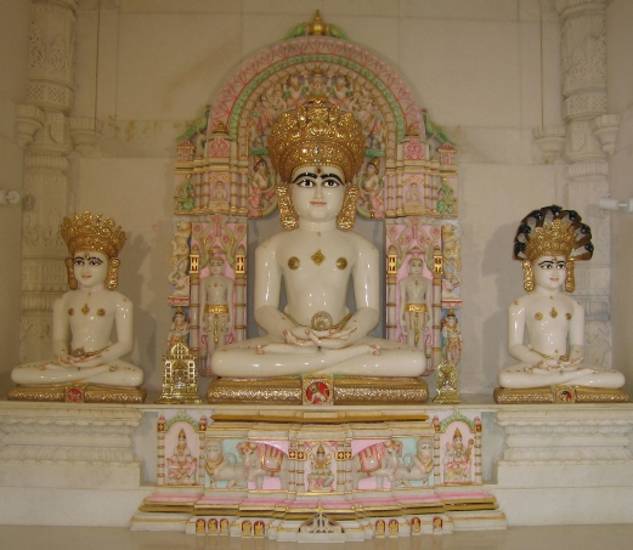
The 24 Jinas
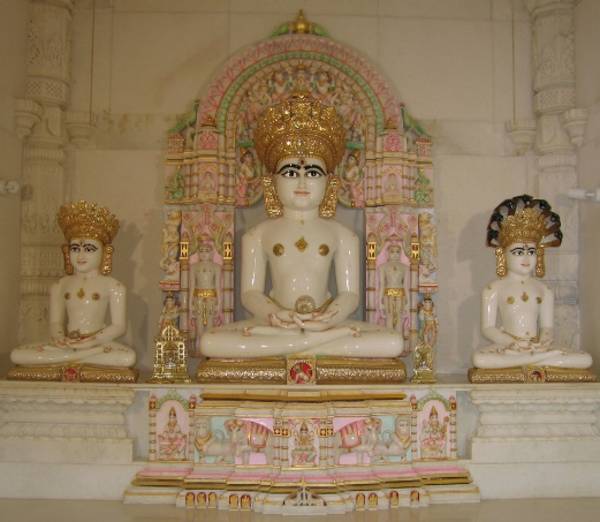
Śvetāmbara figures of Ṛṣabha, Māhavīra and Pārśva
Image by unknown © Oshwal Association of the UK (OAUK)
According to traditional Jain cosmology, time flows in an endless cycle in the Lands of Action, where human beings live. Each cycle of time is made up of 12 periods. In each cycle 24 Jinas are born, during the periods when life is comparatively harsher in terms of knowledge, lifespan, stature, pleasure, morality and spirituality. These conditions make it harder to lead a virtuous life and advance spiritually so the Jinas offer guidance to believers, reminding them of eternal truths. However, Jinas do not appear in the worst times, perhaps partly because these are the lowest points of the time cycle.
In this era the first Jina was Ṛṣabhanātha or Lord Ṛṣabha and the last Mahāvīra. The historical existence of Mahāvīra and his predecessor, the 23rd Jina Pārśvanātha or Lord Pārśva is generally accepted, but there is no historical evidence for the other Jinas.
Life of a Jina
The lives of all the Jinas follow the same pattern, revolving around five key events:
- conception – cyavana
- birth – janma
- initiation into monastic life – dīkṣā
- enlightenment – kevala-jñāna
- final liberation – nirvāṇa or mokṣa.
Jains celebrate these auspicious moments – kalyāṇakas – on special occasions.
The oldest text giving details of some of the Jinas’ lives is the Śvetāmbara Kalpa-sūtra. But in the course of time both Śvetāmbaras and Digambaras have produced a vast body of literature narrating in detail the lives of all Jinas, including their previous births. As the literature grew, so these tales of their lives featured an increasing number of episodes. Standard representatives of this genre are the Śvetāmbara Lives of the 63 Illustrious Great Men – Triṣaṣṭi-śalākā-puruṣa-caritra – and on the Digambara side, the Mahā-purāṇa. They are both in Sanskrit. The former text was written by the 12th-century monk, Hemacandra, while the Digambara ascetics Jinasena and Guṇabhadra composed the latter in the ninth century. As counterparts to the Hindu Purāṇas, such texts act as a storehouse of various legends and define what is known as ‘Universal History‘.
Conception and birth
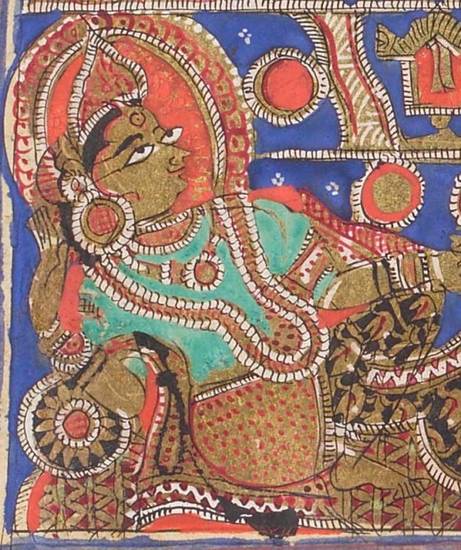
Marudevī has the auspicious dreams
Image by Wellcome Trust Library © Wellcome Library, London
- The mother of a Jina-to-be experiences a sequence of auspicious dreams at conception or during pregnancy.
- The child who will become a Jina is born into the kṣatriya caste.
- They are born with tremendously strong bodies, enabling them to survive the extreme physical and mental austerities needed to get rid of the karma from previous lives.
Renunciation
- The child is a prince, brought up in luxury and enjoying the pleasures of the world.
- The gods remind the young man of his great destiny as a Jina, prompting him to give up the ease of his worldly life and become a monk.
Enlightenment
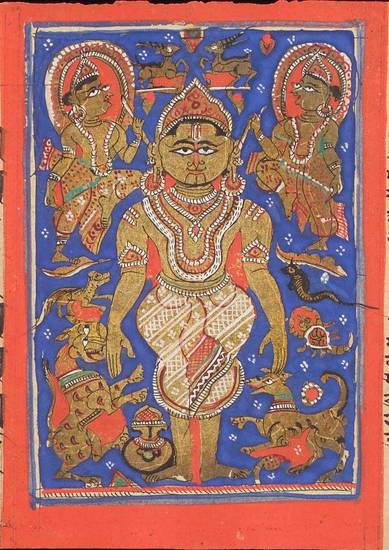
Mahāvīra is tested
Image by Wellcome Trust Library © Wellcome Library, London
- The monk is a ‘perfect ascetic’, exemplary in his behaviour and spirituality.
- He undergoes a series of gruelling physical and mental trials – upasarga – that tests his strength and mental fortitude to the limit before he can purge his soul of karma.
- While meditating under a tree, the ascetic reaches enlightenment, equivalent to absolute knowledge or omniscience.
- The gods build an assembly hall for the new Jina, who preaches his first sermon – samavasaraṇa – to all animals, gods and human beings using the divine sound – divya-dhvani.
- The Jina forms a fourfold community consisting of monks, nuns, lay men and lay women.
- His teachings are collected into Āgamas by his chief disciples – gaṇadharas.
Liberation
- Towards the end of his life, the Jina practises special meditations – dhyāna – that end the activity of his body, speech and soul.
- His soul is emancipated from the cycle of rebirth and instantly rises to the siddha-śilā, where all liberated souls delight in neverending bliss
- Once the Jina’s soul is in the siddha-śilā as a paramātman, it remains separated from the other liberated souls.
Sources
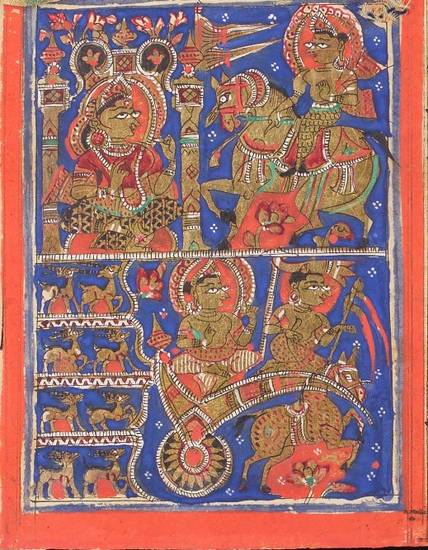
Nemi’s renunciation
Image by Wellcome Trust Library © Wellcome Library, London
The main source of information about the lives of the Jinas is the first part of the Kalpa-sūtra, called the ‘Lives of the Jinas’ – Jina-caritra. This Śvetāmbara text is attributed to Bhadrabāhu although the date of composition is unknown. The ‘Lives of the Jinas’ consists of biographies of four of the 24 Jinas who are important figures of worship. They are, in order:
- Mahāvīra, the 24th Jina
- Pārśvanātha or Lord Pārśva, the 23rd
- Neminātha or Lord Nemi, the 22nd
- Ṛṣabhanātha or Lord Ṛṣabha, the first
The lives of the remaining 20 Jinas are sketched much more briefly and are closer to outlines of key events than to narratives.
Other Śvetāmbara canonical sources for the lives of the Jinas are:
- the Ācārānga-sūtra, the first book of the canon, where the ascetic career of Mahāvīra and the hardships he undergoes are depicted quite realistically
- the 22nd chapter of the Uttarādhyayana-sūtra, in which a famous episode dramatically relates how the 22nd Jina, Nemi, decides to renounce the world just before his wedding ceremony.
Differences between Digambaras and Śvetāmbaras
The two main Jain sects of the Digambaras and the Śvetāmbaras differ in their beliefs about Jinas. These are relatively minor and partly relate to disagreements over whether women can gain liberation and whether monks should be nude.
When the Jinas are represented in Mūrti-pūjaka art, the differences between the sects become visually clear although the figures always adopt one of two meditation poses. There are also small differences in the emblem of each Jina between the two sects.
| Digambara | Śvetāmbara |
|---|---|
| The mother of a Jina-to-be has 16 auspicious dreams. | The mother of a Jina-to-be has 14 auspicious dreams. |
| All the Jinas are conceived and born of kṣatriya women. | The soul of Mahāvīra was conceived in the womb of a brahmin woman, Devānandā, and was then transferred by the gods to a kṣatriya woman, Triśalā, who bore and gave birth to him. This episode of the ’embryo transfer’ is unique to Mahāvīra. |
| Jinas are always male. | The 19th Jina Mallī was female. |
| Mahāvīra turned to ascetic life without having known family life. | Mahāvīra was married and fathered a daughter before turning to ascetic life. |
| All Jinas practise nudity after they become ascetics. | Only Mahāvīra and Ṛṣabha went nude after renunciation. |
Images of the Jinas
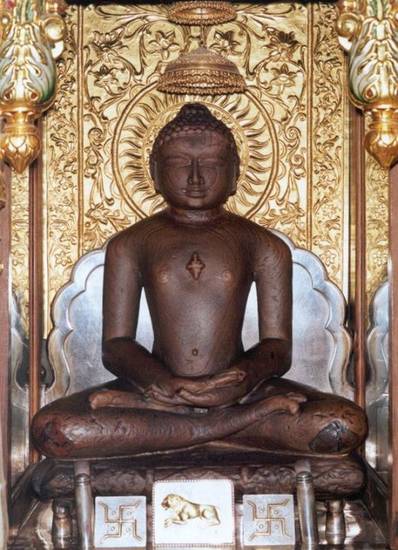
Idol of Mahāvīra
Image by Dayodaya © CC BY-SA 3.0
Images of the Jinas produced among the Digambara Mūrti-pūjaks are always naked, very plainly sculpted and have closed eyes. They do not wear any jewellery, although they may have have a kind of tilaka on the forehead and an endless knot on the chest.
This artistic Mūrti-pūjak tradition contrasts with Śvetāmbara Mūrti-pūjak statues of the Jinas, which have open eyes and loincloths, and are often painted and set in ornately sculpted altars and temples. This is because the Jina is thought of as a spiritual king and is frequently depicted with ornaments and pictured seated on a throne. Otherwise he wears only a loincloth or perhaps the simple white robe of a monk.