
JAINpedia continues to grow, moving towards our goal of being the premier online reference source for the Jain faith.We regularly let you know on this page what’s been added to the website so make sure you check back here to find out what’s new on JAINpedia.
June 2026 Update
Wellcome Collection To Return 2,000 Historic Jain Manuscripts To Institute of Jainology In Landmark Restitution Agreement. The collection of 2,000 manuscripts is the largest outside India, and many are already digitised and available here on Jainpedia. Read more
August 2025 Update
Welcome to JAINpedia v3.0. We hope that you enjoy learning and researching through this new improved version of JAINpedia.
New Features
1. Performance
We have improved the responsiveness of the website. Users should be able to see a noticeable difference in the speed of response when clicking on any item.
2. Design
We have changed the look and feel of the website in line with contemporary websites. We hope you enjoy this modified more modern look!
3. Enhanced glossary entries
We have eradicated some of the issues with glossaries so they provide more consistent and reliable glossary content.
4. New Content
Where possible, we have added new content to continue to enrich the website and will continue to do so as opportunities arise.
5. Social Media
We have updated the social media connections on the website and look forward to communication and comments from our users through this medium.
6. Technology Upgrades
We have upgraded our website technology for better performance and reliability.
August 2021 Update
A very warm welcome to Jainpedia v2.0. We are excited that the new version of this site is ready, and we hope you enjoy using it. Version 1.0 was developed in partnership with the Department of Humanities at King’s College London, and we are delighted to have partnered with Thought Agile to put it on a more sustainable platform and enhance the site. In this blog, I wanted to highlight some of the key upgrades and look forward to hearing your thoughts.
New Features
1. Design
The new Jainpedia is mobile friendly with a responsive design, so as to provide a better and more consistent experience. We have focused on better performance, greater manuscript and picture clarity, and better text readability.
2. New Front Page
The new front page is better organised, with the slideshow giving greater insights to the site, Two articles and manuscripts are highlighted, for example Paryusan & Dasa Laksana-parvan articles and Kalpa Sutra Manuscripts to reflect the forthcoming festival.
The front page has quick links to Jainism FAQs and Highlights of Jainpedia, for new visitors. The Timeline has been updated with 21st Century events and milestones. The About and Resources sections, which have not been changed since the initial launch, are now fully updated. The Support Us page is now linked to PayPal and as a charity, we are extremely grateful for your support in maintaining and growing this site. The Jainpedia Social Media Feeds – Facebook and Twitter Pages are active on the home page, and updated regularly.
There is a What’s New section enabling quick access to what’s new on the website from the front page. There is also a new Subscribe facility for updates on the site.
3.Content
We have made the navigation of the manuscript folios much easier, with increased folio size and better zoom functionality. The print and download facility have been improved to help with study. These have now also been optimised for mobile users. The Glossary Terms have been further extended to help with the readability of the articles and manuscripts. Articles are now presented on a single page, with better navigation to view all Areas; gallery, links, glossary etc.
The Gallery area has a new and enhanced design and layout, with better visual thumbnails and description. The E-Library is now updated and operational, and the collection is better presented with a Featured Publications section showcasing publications from the various categories as well as a section on Recent Additions. We are pleased to inform that the most recent addition is The Catalogue of Jain Manuscripts of British Library (3 Volumes).
The website content can easily be shared via Facebook, Twitter, Linkedin, Pinterest, WhatsApp and Email.
4. Accessibility
The accessibility is greatly improved with a prominently displayed and simple to use accessibility feature enabling increase or decrease in text size, high or negative contrast modes, light background mode, links underline and quick link to sitemap.
Past Updates
Articles
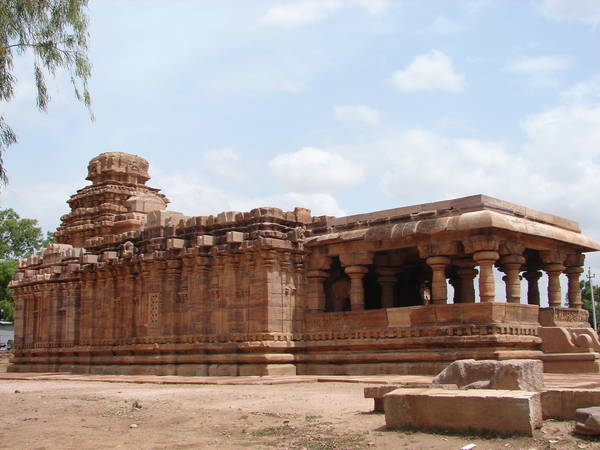
Maṇḍapa-line temple
Image by Dinesh Kannambadi © CC BY-SA 3.0
Our latest JAINpedia article explores the maṇḍapa-line type of temple. Julia A. B. Hegewald looks at the most common architectural style of Jain temple in India, found all over the subcontinent.
Famous examples, such as the Ādinātha Temple at Ranakpur, seem very complex buildings but they share the same design principles as simple temples such as the Odegal Basti at Shravana Belgola. Find out more in the article.
If you’ve missed them, you may like to read other articles on temple architecture by the same scholar. A recent piece discusses sacred pavilions, which are both:
- important elements in Jain temple architecture, often found in larger temples
- structures in their own right, used to shelter holy objects.
e-Library
The fourth issue of Kid Spirit from 2005 is now live for you to enjoy! The pages created especially for children as part of the main Jain Spirit magazine proved so popular that they became a separate short magazine with this issue. Enjoy the comic strip, fun recipe, reader profiles and more that never grow old.
Browse through another addition to the Jain Spirit archive in the e-Library. Covering the spring of 2005, issue 22 is now ready for you to explore its striking pictures and interesting articles about contemporary Jainism. Although it was published nearly ten years ago now, the contents are just as thought-provoking and relevant in 2015.
Have you read Mahāvīra’s Words? The original text by Walther Schubring, a leading scholar of Jainism in the 20th century, was critical in Western academia’s understanding of the early works of the Śvetāmbara canon. This translated, expanded edition puts it into context for contemporary readers.
Speaking of which, have you read the brand-new translation of the Iṣṭopadeśa in the e-Library? The fifth-century Sanskrit text by Ācārya Pujyapada explains the way to the liberation of the soul. This important Digambara work has been translated by Vijay K. Jain, with a foreword by Ācārya Vidyanand Maharaj.
Explore the e-Library
While you’re reading the new additions to the e-Library, why not look at some of the other publications in there?
There are editions of Jain Spirit magazine plus beautiful illustrations of Jain artwork, such as the New Documents of Jaina Painting, to explore.
If you want to know more about the scholarly study of the scriptures or academic research into important Jain topics, try the L. D. series. Key works by eminent scholars in the e-Library include K. K. Dixit’s English translation of Pandit Sukhlalji’s Commentary on Tattvārtha Sūtra of Vācaka Umāsvāti and Colette Caillat’s Atonements in the Ancient Ritual of the Jaina Monks.
More additions to the e-Library are coming soon…
Manuscripts
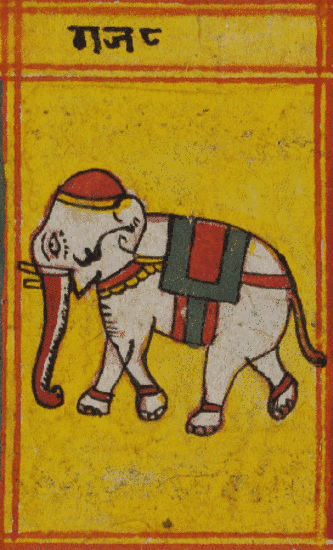
White elephant
Image by Victoria and Albert Museum © V&A Images/Victoria and Albert Museum, London
Why don’t you explore the striking Saṃgrahaṇī-ratna or Trailokyadīpikā? Part of the Jain collections at the Victoria and Albert Museum in London, the 18th-century manuscript is a detailed text on Jain cosmology that has been recently digitised.
Like all Saṃgrahaṇī-ratnas, it describes the complex relationships between the elements of the Jain universe and provides information about the various beings that live in different parts of the world. Looking at the manuscript, you’re struck by the many tables of numbers and colourful illustrations. Almost geometrical in style, the eye-catching illustrations seem as bright as the day they were painted.
Recent artefacts
Have you explored the beautiful illustrated page of a sāmudrika-śāstra? Sāmudrika-śāstras are texts giving details of physical features that indicate character and future events and experiences. Reading the palm of the hand – hasta – is a key area for predictions in Indian culture generally, although Jain mendicants have traditionally been forbidden from trying to divine the future. Dating from the 17th century, the stunning painting in the British Library collections depicts small animals and objects associated with different parts of the hand, which can be used to interpret the future. We have provided original contextual material to help you understand it more deeply.
In 2013 we added three digitised manuscripts or artefacts from the Royal Asiatic Society. These are the first items from the collections of the RAS to appear on JAINpedia, but we hope to add more shortly. Discover the RAS’s most interesting and important Jain artefacts, by examining this:
- rare specimen of a sūri-mantra-paṭa, a specialised mystical diagram used only by certain high-ranking Śvetāmbara monks
- beautiful aḍhāī-dvīpa, a colourful depiction of the Two and A Half parts of the human world
- manuscript of the Kalpa-sūtra, a very popular Śvetāmbara scripture, which is a colourful early example and a feature of the Tod Collection.
All of these items are presented with contextual information to help you get more out of the manuscripts. JAINpedia editor-in-chief Nalini Balbir has created original:
- descriptions
- transcriptions of the original Sanskrit
- translations into English with explanations of key points.
We’ve also added resources, such as glossary terms, web links and reading lists, to help you find out more.
Full launch
The JAINpedia website had its full launch in June 2013. The launch unveiled the new features of the interactive timeline and a browsable image gallery.
All the features planned for the launch phase are now live, supporting high-calibre original content to provide the richest site on the Jain faith available anywhere on the web.
But JAINpedia continues to grow, with the addition of:
- original theme articles on new topics
- new manuscript descriptions to improve your understanding
- more digitised manuscripts coming soon…
Timeline
Check out this interactive feature! The timeline puts significant Jain events into the wider contexts of Indian and world history in a visually attractive way.
Starting in the present day, you scroll to the left to see what has happened in the past and discover how events across India and the world fit together with Jain tradition. Make sure you understand the types of events by looking at the key at the bottom of the page. Click on the events to read more and, for Jain events, you can select links to visit original articles on JAINpedia.
Events will continue to be added from time to time so remember to look out for new events in the timeline.
Gallery
The image gallery appeared on the full launch of the JAINpedia website.
This feature collects together all the images used in each of the articles, which are divided into four themes. You can browse through each of the images in the site-wide gallery or choose a theme gallery to look through. You can click on an image to view it in more detail and read the caption. As a new article is published, so its images will automatically appear in the appropriate theme gallery.
The gallery is available through both the Resources section and the main site menu, accessible at the top of each page of the website.
Recent articles
Since JAINpedia first went live, we’ve been hard at work and have expanded all of the four Themes with lots of original articles.
Discover more about these topics by reading the articles and exploring the links and media.
Let us know what you think by getting in touch.
People theme
In the People theme we have added several full articles.
| the 19th-century British Indologist Henry Thomas Colebrooke and his work on Jain topics | an outline of the distinguished learned society, the Royal Asiatic Society, which has some rare digitised items in the Manuscripts section | |
| the Jain saint Bāhubali | the seventh Jina, Supārśva | the ninth Jina, Candraprabha |
| Śreyāṃsa, the 11th Jina | Vāsupūjya, the 12th Jina | Vimala, the 13th Jina |
| the 14th Jina, Ananta | the 15th Jina, Dharma | the 19th Jina, Malli |
Principles theme
In the Principles theme we have added articles on several topics on the tenets and beliefs of Jainism.
| Devarddhigaṇi, associated with the Śvetāmbara canon | the Śvetāmbara mystical poet, Ānandaghan | a summary of Jain beliefs | an overview of the soul in Jainism | |
| the concept of leśyā | introduction to the key theory of karma | the stages of the ‘scales of perfection’ | an outline of the notion of knowledge | |
| primer on the fundamental concept of liberation | summary of the cycle of rebirth | a description of the core principle of non-violence | a study of the Anuvrat Movement | |
| vows – vratas – relate to self-control and are a key element of religious practice | the central nature and history of sacred writings | the sacred texts of the Śvetāmbara canon | an exploration of the various traditions or sects of the Jain faith | |
| the five ‘fundamental’ vows are part of initiation as a monk or nun while lay people can take ‘lesser’ vows | the Tattvārtha-sūtra, often considered the essence of Jain belief | the core Śvetāmbara scriptures called the Aṅgas | an introduction to the Digambara sect | |
| the soul is born into various types of bodies, depending on its karma | the holy works of the Digambara canon | the long-lost scriptures known as the Pūrvas | an overview of the sect of the Śvetāmbaras | |
| the three gems are a basic framework of Jain doctrine | the Digambara lay thinker Banārasīdās | details of Śvetāmbara scriptures, the Story Aṅgas | a summary of the largest Śvetāmbara group, the Śvetāmbara Mūrti-pūjaka | |
| Jainism in scientific terms | the influential Digambara philosopher Kundakunda | an exploration of Śvetāmbara holy texts, the Reference Aṅgas | the tradition of the Śvetāmbara Sthānaka-vāsin | |
| Jainism in scientific thought | the Digambara thinker Yogīndu | the complementary Śvetāmbara texts called the Upāṅgas | the group known as Śvetāmbara Terāpanthins | |
| other Jain writings, which are not holy texts | the basic Śvetāmbara texts for monastic training, the Mūla-sūtras | a summary of non-sectarian movements in the 20th century | ||
| the Jain epics | the group of Śvetāmbara scriptures known as Cūlika-sūtras | |||
| the Jain Mahābhāratas | the Prakīrṇaka-sūtras, which some Śvetāmbara sects reject | |||
| the Jain Rāmāyaṇas |
In this theme there is a special section called Highlights of JAINpedia, which explores in detail some key manuscripts digitised on the website. Items in the Manuscripts part of the website are chosen because they are good examples of important or popular texts, or because they are rare or unusual in some way. They often contain beautiful illustrations. Some are works of art in their own right, especially objects such as the letter of invitation – vijñapti-patra – or the manuscript covers depicting the auspicious dreams. There are articles planned to accompany each of these digitised items, and some of them are already live, such as the:
- rare and beautiful sūri-mantra-paṭa
- Story of Yaśodhara
- significant Śvetāmbara text of the Kalpa-sūtra
- important Jain hymn of the Bhaktāmara-stotra
- Story of Śālibhadra.
Practices theme
In the Practices theme we have added articles on a range of subjects.
| the songs of devotion that are a key part of worship | the various deities who play important roles in Jain worship and belief | the popular god Nākoḍā Bhairava | the idea of the ‘Perfect Ascetic’ |
| the pairs of yakṣas and yakṣīs who attend the Jinas | the mother-goddess Ambikā or Kuṣmāṇḍinī | Cakreśvarī or Apraticakrā, the powerful yakṣī | the complexities and importance of monastic clothing |
| the well-known goddess Jvālamālinī | the goddess Padmāvatī, who is especially popular in southern India | the god Brahmadeva or Brahmayakṣa | discussion of the various mendicant orders |
Places theme
In the Places theme we have added several interesting articles on the experiences of the Jains in India.
| temple-cities are one of the most distinctive marks of the Jain religion in India, and are sometimes made up of scores or hundreds of individual temples | encounters between Jains and the Islamic powers that ruled India for hundreds of years | Jains and early Muslim rulers, the Delhi Sultanate | |
| the cave temples that are still places of worship for modern Jains | relations between Jains and the Mughals, who ruled India from 1526 | Jains and the issue of Muslim iconoclasm |